Article
Community
Culture
Football
Friendship
4 min read

As the season starts, here's why fans go mad for football

The game is part of life, but not all of life

Henry Corbett, a vicar in Liverpool and chaplain to Everton Football Club.  


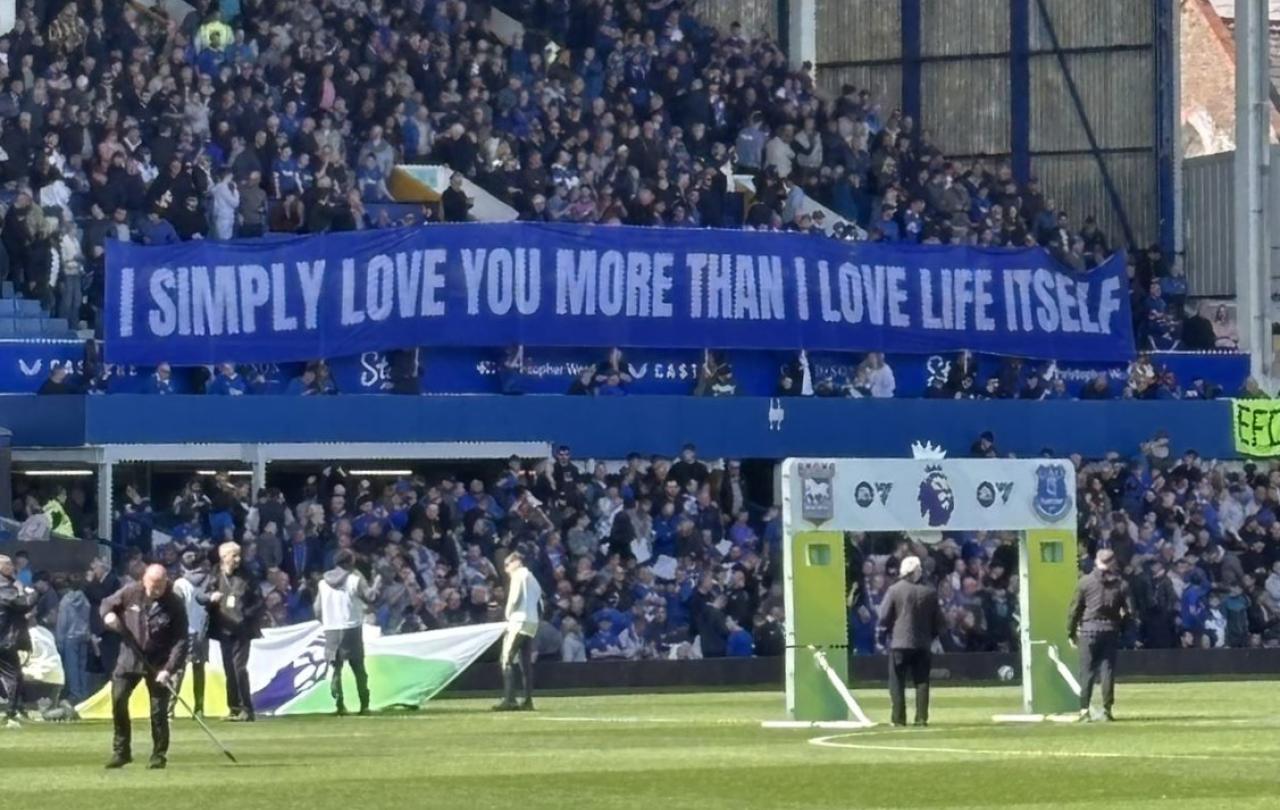
A football stand displays a long banner with text on it.
Everton F.C.

“I hate football,” said the mother of two mad keen footballing children. The clue to the hatred is maybe in the ‘mad keen’. Why do children and adults care so much about football? 

“That Champions League music is so pompous…!” 

“It’s only a football match! They make it too important. If their team loses then they are miserable for the whole weekend.” 

“We can’t plan holidays until the fixtures come out.” 

The money spent, the jobs refused, lost or short-changed, all because of football. A giant banner at a recent Everton home game read “I simply love you more than I love life itself”. 

And there is football manager Bill Shankly wisdom: “Football is not a matter of life and death. It’s more important than that.” At least that was a typical Shankly quip, hyperbole for effect.  

Why do some of us love football so much? 

It often goes back to childhood. Playing with mates, scoring a goal, saving a goal, enjoying the togetherness, the shared aim, the friendships formed. Then there’s that first experience of going to a match. Up the stairs and there before you is a great huge rectangular expanse of green grass. Back in the day, it was maybe not so green, but still way more impressive than your back garden or the local park. Then comes the drama, unscripted, of the game. The sways of emotion, the joy, the frustration, and all experienced as part of a bigger community. When you kick a ball with your mates aged 50, or go to a game aged 80, you are doing something that connects you with your childhood enthusiasm, joy and wonder. 

Then there are the family connections. You may have gone to that first match with your Mum, Dad, Grandad, older brother or sister. When Everton supporters were asked about their feelings at the last Premier League game at Goodison Park, again and again they referenced family members who they had gone to the match with. Some passed away, some no longer able to go, even some whose ashes were buried behind the goal. 

There are the great memories of games seen or even played in. That win from 2-0 down, that last minute goal, the euphoria of a Cup win against the odds. And the memories are shared ones, with family, with friends. Football can write some miserable scripts, 0-0, 0-1, 0-6, but it can also write some wonderful memorable dramas.  

Love for family, for friends, for a team, for players is a deep emotion and when that love is linked to victory or defeat the stakes are raised. 

There is another reason which can touch us all, football-lovers or football-haters. Deep down we all want to be winners in life, not losers. The feeling of victory, not defeat, is such a treasured one. And the win, or loss, is a shared one: we are part of a group together, an identity together. Love for family, for friends, for a team, for players is a deep emotion and when that love is linked to victory or defeat the stakes are raised. In life we want goodness to win over evil, kindness to win over cruelty. The reason every Church shows the symbol of the Cross is because there was the ultimate demonstration of purposeful love, the sacrifice for the sins of the world, down the ages, across the world. When the apostle Paul writes to beleaguered, persecuted Christians facing death at the hands of Emperor Nero, he tells them “We are more than conquerors,” more than winners.  

Football, playing or watching, taps into that deep feeling of victory. “We’re on the march with (manager’s name here!) army…. And we’ll really shake them up when we win the FA Cup…” When my team faced the prospect of relegation I wondered why I was feeling butterflies, and more than butterflies, in my stomach. Why did I care so much about this game of football, and the result at the weekend? Yes, because it affected people’s lives, because it would mean loss of income and job losses at the club if relegation happened. But also, because the feeling of defeat, of failure, would hang over us, and that feeling goes deep, to the pit of the stomach.  

So why do some of us care so much? Because football taps into deep feelings; of family and friendship, joy and elation, togetherness and identity, and that wonderful feeling of victory… or the sorrow of defeat. Those feelings go deep. The problem is that football, unlike the Cross, sometime delivers, but definitely doesn’t always. That’s a reason why the mum of those those two mad-keen football-loving children should try and make sure that her two sons have other interests besides football, another faith beside faith in their team. Football is part of life, but not all of life. I also hope she stops hating what can be a beautiful, enchanting, community-fostering game, with many a helpful story to tell. 

Support Seen & Unseen

Since Spring 2023, our readers have enjoyed over 1,500 articles. All for free. 
This is made possible through the generosity of our amazing community of supporters.

If you enjoy Seen & Unseen, would you consider making a gift towards our work?
 
Do so by joining Behind The Seen. Alongside other benefits, you’ll receive an extra fortnightly email from me sharing my reading and reflections on the ideas that are shaping our times.

Graham Tomlin
Editor-in-Chief

Article
Comment
Film & TV
Politics
Purpose
4 min read

BBC scandals turn the spotlight on its lost mission

When it's good it's great but when it's bad it’s Babylonian

George is a visiting fellow at the London School of Economics and an Anglican priest.

Tim Davie in a blue suite smiles
Tim Davie, BBC boss.

I’m a great fan of the BBC. Generally speaking, I like and admire its journalists and its output and, occasionally, I take its and the licence-payer’s shilling. 

I may be increasingly unusual in choosing to be woken by Radio 4’s Today, but love it because of, rather than despite of, its presenters’ impertinent and interruptive style with politicians. Its radio drama is seductive. I admit to having assiduously followed The Archers, until (literally) I lost the plot at Covid. Short radio drama series can be compulsive listening, such as Al Smith’s first-class Life Lines, featuring Sarah Ridgeway as an ambulance call handler. 

As for TV, I’m showing my age – The Repair Shop, Antiques Roadshow and Professor Alice Roberts’ archaeology in Digging for Britain. Ancient Top of the Pops repeats accompany Friday evening drinks. 

But back to the journalism. Say what you like, the BBC’s news output is the world’s benchmark. It has consistently hired best-of-breed reporters, particularly on the foreign stage. Whatever politicians of both the left or right claim, depending on their circumstance, it is even-handed in its analysis.  

Newsnight under Victoria Derbyshire is immeasurably improved by its slick, half-hour, after-dinner sofa format. It disassembles the pompous and hypocritical, from Trump apparatchiks to Jeremy Clarkson at a farmers’ demo, his stammering and panicky “classic BBC” attempted dismissal now cheekily deployed in its own advertising. 

But – and you’ll know the “but” was coming – there’s the dark side. There has recently been a litany of managerial let-downs, any of which could have put a more commercial enterprise out of business. Conservative governments have customarily been most prone to traducing the BBC, possibly because they think it should know its place, which is not so much below the salt as serving at their table. 

So it’s quite the new thing for a Labour culture secretary, Lisa Nandy, further to undermine the credibility of its Director-General, Tim Davie, by listing its “catastrophic” failures on his watch. The BBC has just had to apologise (an occurrence now as regular as Gary Lineker’s controversial tweets) for failing to discover, let alone disclose, that the 13-year-old narrator of documentary Gaza: How to survive a Warzone was the son of a Hamas high-up. 

A separate external review has also found that BBC bosses failed adequately to protect staff on MasterChef from presenter Gregg Wallace’s invasive behaviours. And the corporation has had to apologise this month for broadcasting antisemitic chants by the vile act Bob Vylan at Glastonbury. 

It’s not all about Davie’s alleged shortcomings. As the BBC itself might put it, other director-generals are available. George Entwhistle resigned over a Newsnight crackpot report on a child-abuse scandal; Greg Dyke over Lord Hutton’s report into how the BBC reported the David Kelly suicide affair under the Blair government. Then there was the Jonathan Ross and Russell Brand “prank”. Let’s not, please, lift the coffin lid on Jimmy Savile again. And so, one is forced to say, it goes on. 

Is the BBC uniquely wicked and/or mismanaged? No. But it’s huge and visible. I have a theory that it’s a British institution which, like others, is a victim of its imperial past. It was nurtured in a post-Reith period, when being of the BBC was like carrying a British passport (“His/Her Britannic Majesty requests and requires…”). It not only believes in, it was a child of, its own propaganda. The derring-do of its great foreign correspondents was founded on the unquestioned might of empire. 

That leads, inevitably in a post-imperial age, to hubris. It’s like Babylon, the metaphor rather than the great Mesopotamian city. Once indestructible under emperors such as Nebuchadnezzar, sacker of Jerusalem, it was destroyed by its own vulnerabilities. The scriptural allegory from Genesis is that Babylon raised the great tower of Babel to reach the sky and oversee a world that spoke its one, true language. In his wrath at their pride, God scattered its people, now unable to understand each other, for they’d come to form their own languages. 

See how that works? The BBC has come to believe in itself, rather than its mission. And consequently, it has lost the ability to communicate, both internally and externally.  

It’s not alone. The Church of England has the same post-imperial problem. So does any elected government after about a decade. It’s the jobs of Archbishop of Canterbury and Prime Minister, as well as Director-General of the BBC, that can only end in tears. 

They should get together, these people. Work out accountable corporate structures that can work in the 21st century. Create top leadership jobs that are possible to do, rather than appoint emperors who turn out to have no wardrobes. 

The point surely is not that they are humiliated, but that they have to be humbled. They need to demolish their towers, stop babbling at each other and learn to speak a common language again.  

Support Seen & Unseen

Since Spring 2023, our readers have enjoyed over 1,500 articles. All for free. 
This is made possible through the generosity of our amazing community of supporters.

If you enjoy Seen & Unseen, would you consider making a gift towards our work?
 
Do so by joining Behind The Seen. Alongside other benefits, you’ll receive an extra fortnightly email from me sharing my reading and reflections on the ideas that are shaping our times.

Graham Tomlin
Editor-in-Chief