Article
Character
Creed
Leading
Politics
5 min read

World leaders can learn a lot from Pope Leo

Graham Tomlin was at the Pope's inauguration in Rome. This is what he noticed.

Graham is the Director of the Centre for Cultural Witness and a former Bishop of Kensington.

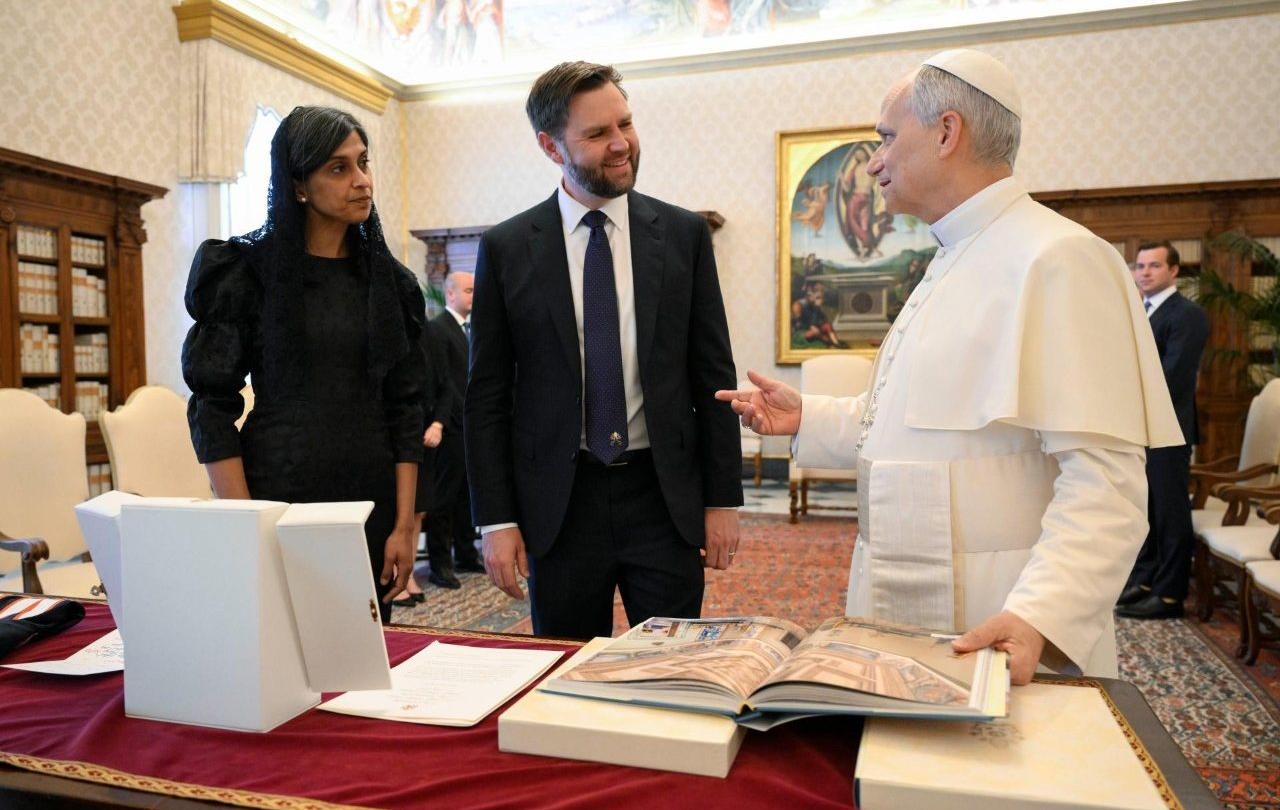
A VIP couple stand and talk with the Pope.
Usha and J.D. Vance meet the Pope after his inauguration.
Vatican Media.

On Sunday morning, along with a host of bishops, patriarchs, priests and assorted others, I was led around the back of Peter's Basilica in Rome, into the cavernous spaces of that extraordinary building.

As we walked through the echoing church with the sunlight slanting through the windows like shafts of light from an angelic realm, our small group of Anglicans waited for our turn to walk out into the blinding sunshine. The names of the churches were ticked off like a game of ecclesiastical bingo: “Coptic Orthodox Church of Alexandria? OK.” Syriac Orthodox Church of Antioch? – This way please. “Armenian Apostolic Church – just wait a minute…” 

As we moved through the front doors of the Church, the first thing we saw was a crowd of 200,000 people stretching as far as the eye can see. Behind us was the imposing face of St Peter’s, that great monument to Catholic supremacy and authority. The world’s media looked down from the balconies above us. Opposite our seats were the rich red velvet chairs ready for President Zelensky, J.D. Vance, and the heads of state of numerous countries across Europe and beyond.  

As we walked out, I turned to a friend in our group, and instinctively said to him, “you'd need to be someone of remarkable humility not to let all this go to your head.” 

I couldn't help thinking of Robert Prevost, who was about to walk through these doors, a man who was made a bishop in 2015 - only became a cardinal two years ago, and was now to find himself the focus of rapt attention by this vast crowd and millions of others on TV, as the spiritual leader of 1.4 billion Catholics, catapulted from relative obscurity to being the most famous man in the world within a couple of weeks. 

St Peter’s is designed to impress. The piazza in front of the church is surrounded by imposing statues of apostles, saints, martyrs, and fathers of the church, all looking down on proceedings below. It was this church that inadvertently triggered the Reformation, as a fund-raising scheme for its construction involved selling some indulgences in Germany that raised Martin Luther’s fury. The frontage, with its soaring pillars, grand windows, sumptuous balconies and rich tapestries, is meant to overawe you. Inside, the space is huge, with vast windows letting in the light, stunning works of art everywhere. This was a display of the Renaissance papacy, leading into the Counter-Reformation, the confident Baroque spirit that announced the triumph of the Church over all its enemies. 

A Pope with a streak of vanity would be a dangerous thing. Everything points to the power of this position – the successor of Peter, the one on whom the rock of the Church was to be built; the leader of the largest body of Christians in the world; someone instantly recognisable across the globe, to whom world leaders have to come, cap in hand. No wonder some popes in the past have become political manipulators, vying with emperors and kings over who has more power.  

Yet these days, the Catholic Church sounds a humbler note. Pope Francis started the church down a line of ‘synodality’, inviting other voices into the church’s deliberations rather than just male priests. Pope Leo seems to want to continue down that line. 

Referring to his election he said: 

 “I was chosen, without any merit of my own, and now, with fear and trembling, I come to you as a brother, who desires to be the servant of your faith and your joy, walking with you on the path of God’s love.” 

The tone was not of self-aggrandisement, asserting the power of the position. There was no strategy to dynamically change the church and the world. No grand design to use the levers of power to shape society according to his vision. Instead, this was about unleashing a more elusive and uncontrolled force: the power of self-denying compassion.  

As Pope Leo put it: 

“The ministry of Peter is distinguished precisely by self-sacrificing love, because the Church of Rome presides in charity and its true authority is the charity of Christ. It is never a question of capturing others by force, by religious propaganda, or by means of power. Instead, it is always and only a question of loving as Jesus did.” 

Now that’s different from the way popes have sometimes spoken in the past. The Church has no power other than the power of love – the kind of self-sacrifice seen in the life of Christ. If the pope ‘presides’, as Presidents do, he ‘presides in charity’. A little different from some other Presidents I can think of.  

Admittedly we don’t know much about him yet, But Bob Prevost strikes you as a humble man. Someone who can turn down a place at Harvard Law School to go instead to serve the poorest communities in Peru for 20 years, sleeping on the floor of huts, travelling by donkey to remote villages, unnoticed and obscure, suggests a distinct lack of self-importance. You don’t canvas to become pope, announcing your candidacy, working your way up the ranks, arguing your merits to the electorate. Instead, you get on with what you do, and if the call comes, you follow it.  

As Pope Leo, he will need that humility as he takes on this role for the rest of his life. He will need it to resist the subtle lure of the deference others offer him, the adulation he will receive wherever he goes, the buildings he lives in, the magnificence of the popes who went before him, the way people will hang on his very word. The temptation to think that Bob Prevost is, after all, a mighty big fish, someone whose talents have got him to this point will be strong.  

But if he gives in to that temptation, he will slip back into the run of the mill way of the world, lording it over those he oversees. He seems aware of the slippery nature of such a position. Whoever was called to be the successor of St Peter, he said, needed to exercise oversight “without ever yielding to the temptation to be an autocrat, lording it over those entrusted to him. On the contrary, he is called to serve the faith of his brothers and sisters, and to walk alongside them." 

It was Jesus who said:

“Among the nations, their rulers lord it over them. But it is not so among you. Whoever wants to be great among you must be your servant.” 

Other Presidents, prime ministers and patriarchs could take a leaf out of that book.  

Celebrate our 2nd birthday!

Since Spring 2023, our readers have enjoyed over 1,000 articles. All for free. 
This is made possible through the generosity of our amazing community of supporters.

If you enjoy Seen & Unseen, would you consider making a gift towards our work?

Do so by joining Behind The Seen. Alongside other benefits, you’ll receive an extra fortnightly email from me sharing my reading and reflections on the ideas that are shaping our times.

Graham Tomlin
Editor-in-Chief
Article
Creed
Easter
5 min read

The compassion of Easter's tears

There’s complexity and beauty behind crying.
A stone statue's face depicts a falling tear.
Ohlsdorf Cemetery, Hamburg.
Marek Studzinski on Unsplash.

The great English metaphysical playboy poet, John Donne, became Dean of St. Paul’s Cathedral in 1621. During Lent a year later he preached a majestic sermon entitled ‘To speake of Tears’. I first read it 30 years ago and it has prodded and challenged me ever since. This hyper-bright poet and reformed Lothario brought to the pulpit all his astonishing rhetorical skill, and a deep learning, combined with an overriding sense of God’s mercy and the wonder of new beginnings. His sermons were as thick as treacle and as rich as chocolate mousse, but built on a profound religious sympathy and a pastor’s ear for the yearnings of his listeners. 

In his 1622 sermon, Donne highlights the different kinds of tears shed by Jesus in the last weeks of his life.  

He speaks of Jesus’ ‘humane tears’ - tears he shed alongside Mary and Martha at the grave of his dear friend Lazarus - so surprising, Donne suggests, that the scholars charged with the chapter and verse divisions of the New Testament stopped in wonder at the two words ‘Jesus wept’ and made it a complete (and the shortest) verse in the Bible. 

He speaks of Jesus’ ‘prophetic tears’ on Palm Sunday, as Jesus looks down over the city of Jerusalem, foreseeing the people’s rejection of God and the judgement that would come upon this city he loved. These tears are again surprising - Jesus had been borne into the city on the excited adulation of the crowds - so why does he weep? 

Donne speaks of Jesus’ ‘pontifical’ or ‘sacrificial tears’ on the Cross - forsaken, despairing tears, encapsulated in Jesus’ agonisingly seizing a line of dereliction from the Psalms and hurling it at the dark sky - ‘My God, my God, why have you forsaken me?’  

Donne was hardly the first theologian to wonder at these tears. But he is compelling in separating them out, wondering how different they are, and plotting the complexity of Jesus becoming a Man of Sorrows, for people who know so much sorrow. And he has the pastor’s touch as well as the preacher’s flourish to help us understand that we see ourselves most clearly through the tears of Jesus, or as C.S. Lewis would put it in the Problem of Pain, ‘the tears of God are the meaning of history.’ 

Tears, like snowflakes, are unique. Donne started to tease them apart 400 years ago, and we can see this even more clearly today, though it is always a challenge to do so because of the emotional intensity and maelstrom they spring from. 

We now know there are physically three kinds of tears; basal tears, which lubricate the eye, irritant tears, which flush out bugs or specks of dirt and emotional tears, agreed by most to be unique to humans (though newborn babies don’t normally cry tears for the first month or more). Rose-Lynn Fisher poignantly deepened this understanding of different kinds of tears in her ground-breaking work on The Topography of Tears. As an artist, she captured some of her own tears and placed them on a microscope slide. She then took close-up pictures of the tears with a digital microscopy camera mounted on a 1960’s Zeiss standard light microscope; 

‘The microscope provided the means to examine my tears and visually evoke the unseen realm of my emotions.’ 

She discovered that no two tears look the same, much as another hero of mine, Snowflake Bentley, had discovered, using a similar method in a frostier setting, the same is true for snowflakes. Tears of grief, even if shed at the same time, are all uniquely different; each one subtly changed by air temperature, and the proteins, minerals, hormones, antibodies and enzymes in an individual tear. 

This knowledge brings a new weight to Jesus’ searching question to Mary on Easter morning - ‘Woman, why are you crying?’ These tears that I’m shedding, today, what kind of tears are these? Angry, grieving, frustrated, fearful? Fisher gives astonishing names to her close-ups of tears - ‘Compassion’, ‘Tears of Change’, ‘Overwhelm’, ‘Redemption.’ And it opens up the question of what tears am I not shedding? If there are so many different kinds of tears, are there some I am avoiding, or closing my heart to? 

Richard Rohr has just published a long-awaited book on the Minor Prophets called The Tears of Things. I cannot possibly summarise it here, but Rohr includes an argument for the necessity of tears to soften our anger and outrage, the defining emotions of our age. He charts the prophet’s journey from outrage at the lawlessness of the world, through tears for the greed and cruelty of the world, to a settled but fiercer love and mercy. The prophetic tears of Jesus - tears of love, not for ourselves, but an expression of compassion for others - are the ultimate expression of this. This is a compelling vision - I would prefer the people who mould our world to be less shouty and angry, and more tearful and compassionate, people who live near enough to the pain of others to have cried with them and for them before making a plan. 

The Psalms offer us a second discipline for our tears. As well as knowing them, that is understanding them, naming them, placing them, we can sow them: 

‘Those who sow in tears 

Will reap with songs of joy.’ 

This is an ancient invitation to give weight to our tears. To take them to God, to share them with others, and not just to see them as a way to get things of our chest.  

Our human tears can deepen our sense of frailty and dependence on others and God. 

Our prophetic tears can invigorate our fight for justice and peace, without destroying our spirit or making us worse than the people we criticise. 

Our forsaken tears, the ones shed quietly, without hope, without even the hope that God sees them, can prepare the way for God’s new beginnings. 

Celebrate our 2nd birthday!

Since Spring 2023, our readers have enjoyed over 1,000 articles. All for free. 
This is made possible through the generosity of our amazing community of supporters.


If you enjoy Seen & Unseen, would you consider making a gift towards our work?


Do so by joining Behind The Seen. Alongside other benefits, you’ll receive an extra fortnightly email from me sharing my reading and reflections on the ideas that are shaping our times.


Graham Tomlin
Editor-in-Chief