Article
America
Conspiracy theory
Culture
Politics
6 min read

When America presses in on you

A returning American feels the heat generated by contesting ‘realities'.

Jared holds a Theological Ethics PhD from the University of Aberdeen. His research focuses conspiracy theory, politics, and evangelicalism.

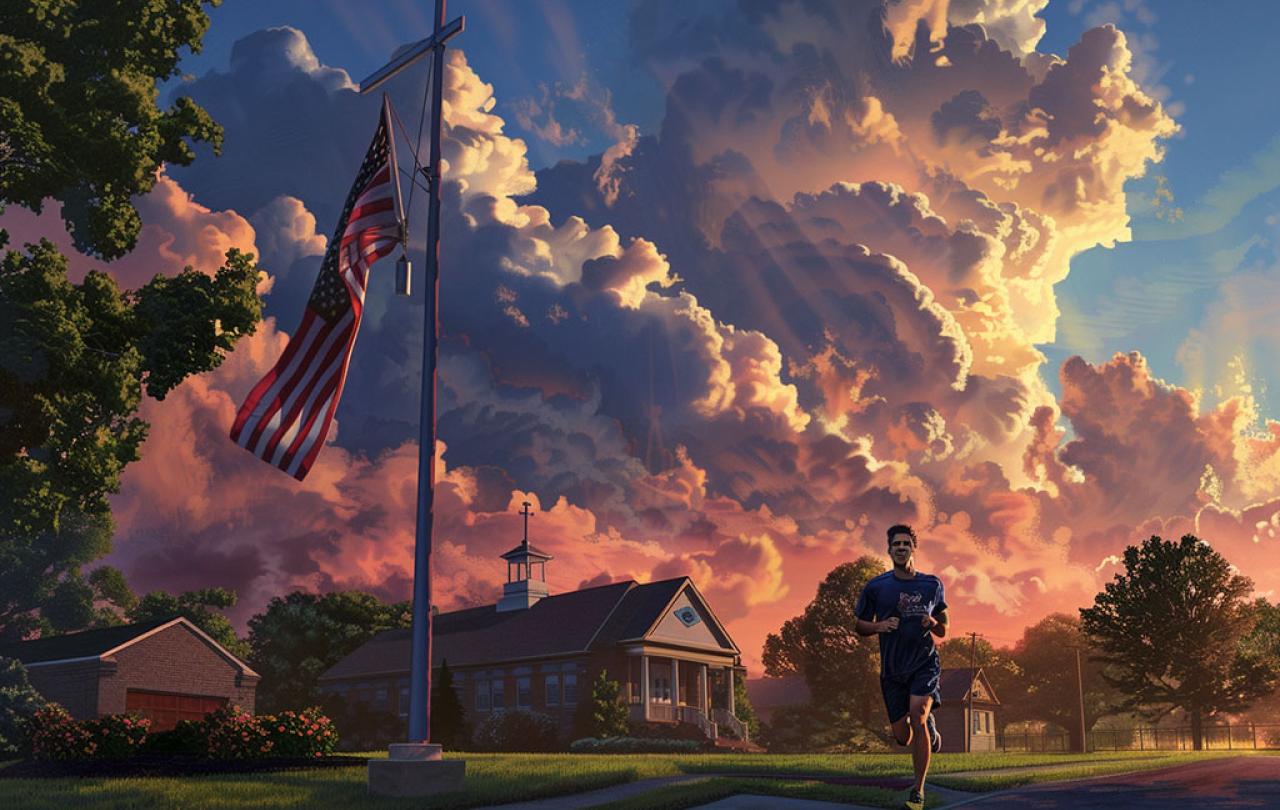
A runner passes a church and a flag in an America suburb, under billowing clouds.
Nick Jones/Midjourney.ai.

There’s a man. Running. My eyes snap into focus. Time slows - I catch his pace. Then, my eyes start widening. An odd feeling. Being forced into it. Seconds stretched out into minutes. Taking in more, looking for more, looking down that sidewalk, on a street corner in New Jersey. 

Before? I was sitting there. In the backseat of my Uber. Winding our way through New Jersey. And I’m sitting there, tired, mindlessly scrolling my phone until that moment. He’s there running.  

And I see him. T-shirt. Running shorts. And I’m sitting. And—a nervous flash—he’s running. Why?  

And my eyes adjust, widening, scanning, checking detail, and I’m almost seized. My mind shaking itself, coming online, no more automation. My consciousness catches up: “you’re in America,” I tell myself. 

Right. I’m not in Scotland. And that man is running. Here in New Jersey. In America. And I’m talking back to myself in this silent car. I’m watching him run. I’m asking why am I slowing this down? And—it flashes—“running from what?” 

And I catch up to myself. To what I was trying to say, that people in America run from shooters, too. A wave crashing, sitting in the back of the Uber, and look. Now I’m really looking. Not forced. But naming. There’s other pedestrians passing him, walking. Slowing. On the other side of the street— no fast movement. No screaming. No pops. 

I start breathing. I didn’t know I stopped. He’s out jogging. The automated safety check ends. The tranquility of tyranny resumes. I’m sitting in the back of an Uber. I make a note. Be more alert at the train station.  

— 

People ask me how the relocation back to America has been. And I don’t know what to tell them. There’s a wide gap between the visceral sense of it all pressing in on you, and more common—but also abstract—analysis.  

The experience of coming back has been oddly particular. I lived in Scotland for three years, and most of it was spent studying America. From that distance, the broad strokes of American life, the larger trajectories and dangers of our shared political decisions and religious extremism, well, they’re a bit clearer. 

But coming back, America presses in on you. And the only way of talking about that, maybe, is specificity. Kerouac was always good at articulating this. His America wasn’t the rise of the military industrial complex in the 50s. It was the road, the gas station on the way from Denver, it was jazz, the dim doorways of San Francisco bars. I’m thinking of Kerouac, but also Langston Hughes. Poets and artists who in their own time, held a mirror up to America, helped us move from the “I” to the “we” as Steinbeck said. 

We’re all asking a version of “what’s wrong in America?” (And, do keep asking.) But to ask that question often assumes the broadest strokes, the ones that are most clear from a distance. Which means they are, in one at the same time, the most abstract.  

These realities are everywhere, and no where. They are the air we breathe. They appear to the privileged as “logical” and to the powerless as “inevitable.” 

Asking after democracy, after the election, and the increasingly nebulous “the church” — I’m convinced that answering “what’s wrong in America?” in the biggest of terms is leading me to (wrongly) believe that responsibility lies among the gargantuan free-floating concepts which we use to narrate our world. As if solving the “crisis of democracy” is a conceptual problem. When in reality, it is concrete, and involves more than coalition building or political activism.  

Why more? Because the choices Americans have made over the last 10 years originate from imaginations which limits the scope and scale of what is possible. This is what I mean by “America presses in on you.” 

Coming back to America has made this clear. I’m more aware than ever that we can produce good answers and generate compelling analysis about America without ever asking in what way these answers or analysis are sharp enough, concrete enough to puncture the bubbles of social reality in which people choose to live and in some cases are forced to live. 

These realities are everywhere, and no where. They are the air we breathe. They appear to the privileged as “logical” and to the powerless as “inevitable.” They press in on us all in their own way. 

In some cases, they dull our senses. We say, “as long as our Amazon deliveries continue, as long as the streaming services work.” In some cases, they don’t just press in on us, but press down and perpetuate injustice. As Dietrich Bonhoeffer asked, “where are the responsible ones?” 

The visceral shock of return is ongoing. And it hits me in strange ways, on Uber rides and in worship. American life is everywhere and I’m seeing it with different eyes.

Do I care about democratic machinery? Yes. Am I concerned about whether or not the church is, in fact, the church, and not a gear in a partisan machine? Yes. But I’m increasingly convinced that responsible living in the American situation becomes most clear, most evident as we consider the large in terms of the small. 

Responsibility emerges with attention paid to the concrete and intimate. January 6 is the subject of my dissertation. But before that, in the months leading up to January 6, I was a pastor just 40 miles from DC. For me, January 6 was a local event. That particularity, that specificity, is a window into a concrete responsibility.  

And now, back in this same community, I found myself distracted in a church this weekend. The man in front of me raised his hands in worship, revealing a revolver hanging on his belt. What America is this? But also, what Christianity is this? 

The visceral shock of return is ongoing. And it hits me in strange ways, on Uber rides and in worship. American life is everywhere and I’m seeing it with different eyes. And I wonder what it will take to break the spell of our most cherished illusions, of a certain type of freedom — one that tells us it is Christian to raise our hand in surrender to a god who we say is loving enough to save the world, but seemingly not strong enough to deliver us from our evil. 

In the end, perhaps it’s best to say that it’s been proof of a good ruining. After all, we’ve experienced nothing short of a conversion, a move closer towards peace, towards hope, that unsettles all our strategies of security and comfort underwritten by violence and oppression. This is the kingdom of Heaven. Something Jesus announced that continues to unsettle and disrupt the likes of T.S. Eliot who put it well in Journey of the Magi

We returned to our places, these 

Kingdoms, 

But no longer at ease here, in the old 

        dispensation, 

With an alien people clutching their gods 

I should be glad of another death. 
Article
Culture
Film & TV
Politics
6 min read

Fear of the news means it needs to change

Here's how to rethink reporting.

Steve is news director of Article 18, a human rights organisation documenting Christian persecution in Iran.

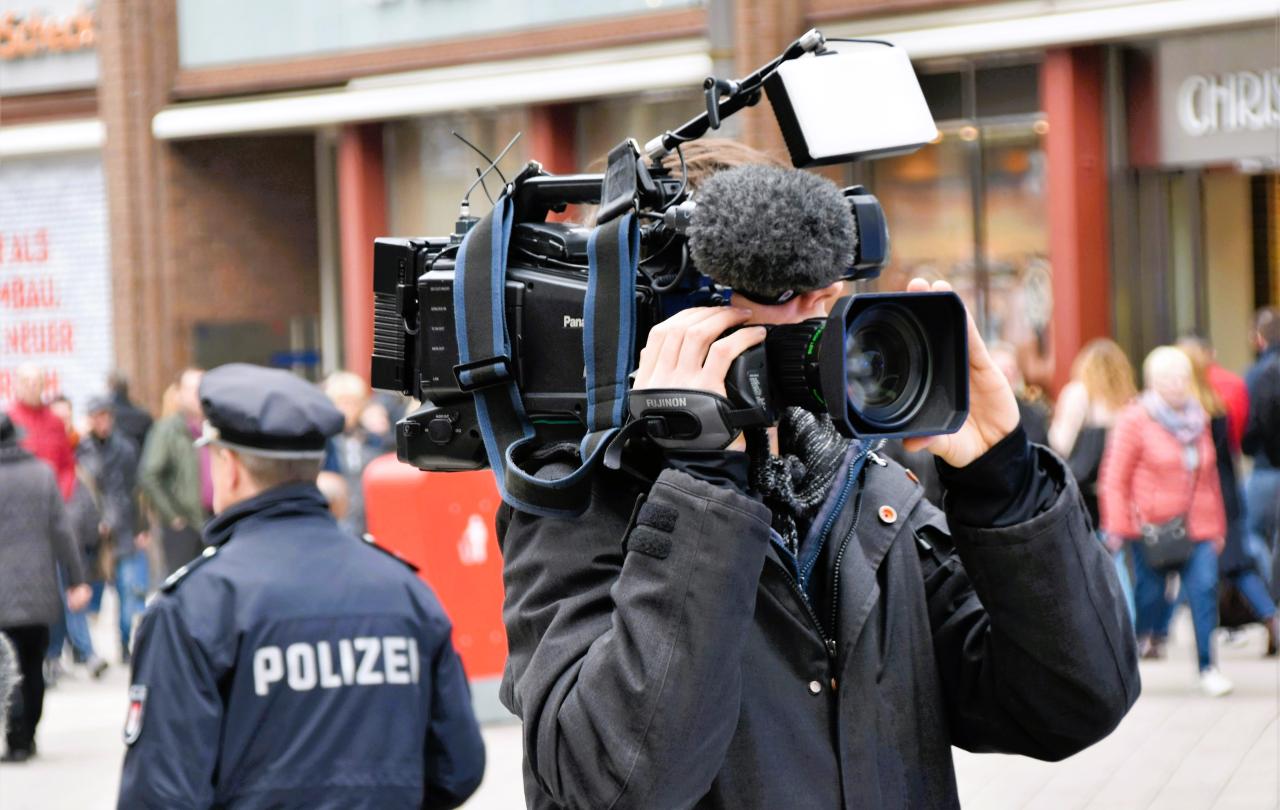
A news cameraman holding a camera, stands back to back to a police officer.
Waldemar on Unsplash.

Several non-journalist friends have told me over the past few years that they have started to disconnect themselves from the news - in some cases entirely - so wearied have they become by the incessant gloom of our reporting.  

Meanwhile, new research from the Reuters Institute has found that people have been “turning away from the news” consistently across 17 countries tracked over the past decade - from the US to the UK, Japan to Brazil. 

And one of the primary reasons, the researchers discovered, is the “fatigue and overload” of negative news. 

Another factor was the declining trust in the media, which has again been something I have heard consistently from friends in recent years, with many telling me they are constantly reassessing who they turn to for news. 

Perhaps that is only healthy, but both trends suggest to me that there may be a problem with the way news currently is, and the effect it is having on us. 

One of the most regular examples of the “bad news” we journalists tell is the reporting of terror attacks, but whenever I hear news of an attack - whether here or elsewhere - I think not only of the immediate victims and their loved ones, but also those who may soon become victims by association. 

Perhaps the most obvious recent example here in the UK was the case of the Southport stabbings, a shocking incident that led to understandable - albeit misguided - outrage. 

As soon as it emerged that a “foreigner” - or at least someone who sounded like they might be a foreigner - was responsible, many jumped to the conclusion not only that he was an Islamist but also probably an asylum-seeker, and an illegal one at that. 

It later transpired, of course, that the 17-year-old who carried out the terrible attack had been born and raised in Wales - to “Christian” parents, no less. So not an asylum-seeker, after all, nor even a foreigner; and even though it later became clear that he had downloaded disturbing content including from Al-Qaeda, his inspiration seemed to come from a wide range of sources. 

Here was another example, our prime minister told us, that showed “terrorism had changed” and was no longer the work only of Islamists or the far-right but of “loners” and “misfits” of all backgrounds, common only in their sadism and “desperat[ion] for notoriety”. 

And yet, in the Southport case and no doubt many others, by the time the killer’s background and likely motive finally became clear, the horse had already bolted.  

In that particular case, the reaction was especially extreme, with mosques and refugee hotels attacked as part of widespread rioting. But even when there are no riots after such an attack, there can surely be little doubt that the minds of the wider British public will have been impacted in some way by the news. 

For some, perhaps the primary response will be increased fear - in general but also perhaps especially of those different from themselves. For others, on top of fear, might they also feel increased hatred, or at least mistrust? 

And such feelings will surely only increase with every new reported attack, especially when the perpetrator appears to be someone new to these shores, and even more so, it would seem, if it is an asylum-seeker. 

To ignore the reality that many attacks have been carried out by asylum-seekers in recent years is to ignore reality. But for those of us desperate not only to prevent the further polarisation of our society but also to protect the many legitimate refugees who wouldn’t dream of committing such attacks, what can be done? 

Perhaps it’s only because I’m a journalist, but in my opinion one major thing I think could help arrest the current trend would be for us to rethink the way in which we do news in general.  

Not in order to mislead the public or pull the wool over their eyes - if bad things keep happening, they must be reported, as must the identities of the perpetrators, as well as any trends in this regard - but by way of providing the necessary balance and context.  

For example, by looking into what percentage of attacks - here or elsewhere - have been committed by Islamists, foreigners, or asylum-seekers; or considering what percentage of the total population of such groups the attackers represent, and how this compares to statistics regarding other groups. 

The question we journalists - and those who read our words - need most to ask is whether we are doing a good job of informing the public about the world they live in. 

Might it also be helpful to undertake a general reconsideration of what constitutes news? Does, for example, bad news always have to reign supreme in the minds of those who curate our news cycle?  

A decade ago, I had it in mind to create a new app or perhaps even news service dedicated to rebalancing the news, such that bad news stories wouldn’t outnumber the good. Many others have had similar ideas in recent years, and several platforms have been launched, dedicated to the promotion of “good news” stories. And yet one could argue that such platforms risk being as unrepresentative of reality as those that tell only bad-news tales. Can’t a compromise be found? 

One of the first things you learn as a journalist, other than that sex sells, is that greater numbers of deaths, and especially those of children, always constitutes headline material. And one needs only to flick through today’s major news outlets to see that this practice remains almost universally upheld. But does it have to be so?  

And why is it that some conflicts and injustices will make our headlines, while others won’t?  

Take, for example, the Sudanese civil war or the recent beheading of 70 Christians in the Democratic Republic of the Congo. Why is it that these horrors don’t make our headlines, while tragedies in Ukraine or Gaza do? Who makes the call, and for what reasons?  

Another long-established principle in journalism is to consider first and foremost who your audience is. So, for example, when writing for a British audience, to consider what might be of most interest to Brits. Are Ukraine and Gaza, for example, simply more relevant to British interests - in both senses of the word - than what is happening in the Global South? And even were that to be true, just because such principles of journalism are long-established, must they remain unchallenged? 

At its core, journalism is about informing, so in my opinion the question we journalists - and those who read our words - need most to ask is whether we are doing a good job of informing the public about the world they live in.  

And in my view, while a lot of good journalism is of course being done, the question of whether the public are receiving a representative picture of their environment is less clear.  

Whether or not the best approach to redress the balance is to dedicate whole news services to telling good-news stories, there’s surely little doubt that such stories are chronically underreported.  

And if our duty is not only to inform but also, by virtue of that, not to mislead, mightn’t it be argued that in failing to sufficiently well inform society about the real state of our world, we are in fact misleading them? 

No-one wants to end up in a Soviet-style “paradise” in which murders are simply denied in order to maintain the status quo, but nor, surely, do we want to live in a world in which people become unnecessarily fearful and hateful towards others, in part because of the news we feed them. 

Join with us - Behind the Seen

Seen & Unseen is free for everyone and is made possible through the generosity of our amazing community of supporters.

If you’re enjoying Seen & Unseen, would you consider making a gift towards our work?

Alongside other benefits (book discounts etc.), you’ll receive an extra fortnightly email from me sharing what I’m reading and my reflections on the ideas that are shaping our times.

Graham Tomlin

Editor-in-Chief