Review
Attention
Culture
Music
5 min read

James MacMillan’s music of tranquility and discord

The composer’s music contends both the secular and sacred.

Jonathan is Team Rector for Wickford and Runwell. He is co-author of The Secret Chord, and writes on the arts.

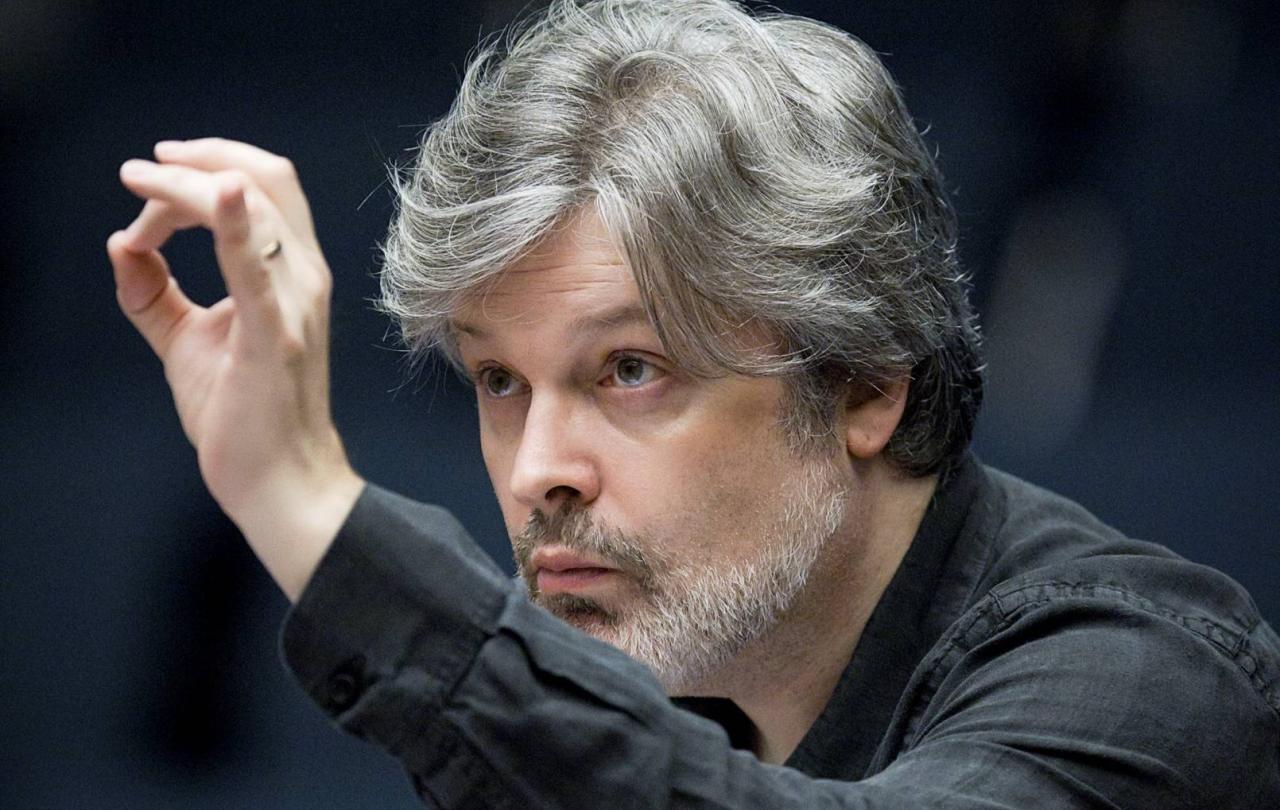
A conductor leans in toward an unseen orchestra with a raised hand.
MacMillan conducting.
Hans van der Woerd, Intermusica.

Sir James MacMillan is one of today’s most successful composers, as is evidenced by his achievements in 2024. This year alone has seen the premiere of a new work for choir ‘Ordo Virtutum’ (January), the UK premiere of his cantata ‘Fiat Lux’ (March), the premiere of his new version of Robert Burns’ song ‘Composed in August’ (March), the premiere of his ‘Concerto for Orchestra’ (September), and the premiere of his ‘Duet for Horn and Piano’ (November).  

Back in March he also became the 26th Fellow of The Ivors Academy, joining a rollcall of extraordinary composers and songwriters, including John Rutter, John Adams, Sir Elton John, Sir Paul McCartney, Dame Judith Weir and Sting. While, in September, he accepted the Sky Arts Classical Music Award 2024 on behalf of The Cumnock Tryst, the annual music festival he founded in his hometown, which brings together many local community groups on stage alongside some of the world’s most acclaimed musicians. 

His music, which is notable for its energy and emotion, is imbued with influences from his Scottish heritage, Catholic faith, social conscience and close connection with Celtic folk music, blended with influences from Far Eastern, Scandinavian and Eastern European music. Accordingly, Tom Gray, Chair of The Ivors Academy, describes MacMillan as “a titan of music, generous in his creativity and craft” and “a foremost proponent of the power of music to communicate and forge bonds”.  

He first became internationally recognised after the extraordinary success of ‘The Confession of Isobel Gowdie’ at the BBC Proms in 1990. Since then, his prolific output has been performed and broadcast around the world with his major works including his most performed work the percussion concerto ‘Veni, Veni, Emmanuel’ (1992), a cello concerto for Mstislav Rostropovich (1996), an opera ‘The Sacrifice’ (2007), the ‘St John Passion’ (2008), and five symphonies. For his services to music, he was awarded a CBE in 2004 and a knighthood in 2015. 

“In this age of unbelief, the search for the sacred in art and music hasn’t gone away”. 


James MacMillan 

As will be clear from the titles of works cited thus far, many of his works, such as ‘Ordo Virtutum’, a setting of a sacred music drama by Hildegard of Bingen concerned with the struggle for the human soul in a battle between good and evil, and ‘Fiat Lux’, a celebration of the divine gift of light, directly express his Catholic faith. David Clayton writes that, “Aside from being one of the greatest living composers and conductors of classical music, Sir James is a Catholic whose faith informs all his work”. Clayton also describes him as “a deep thinker who communicates clearly the nature of the creative process when one seeks to create beauty to bring Glory to God”.  

MacMillan believes that “Far from being a "spent force", religion has proved to be a vibrant, animating principle in modern music and continues to promise much for the future.” When he speaks about music and the idea of the sacred, as he did most recently at The Sheldonian Theatre in Oxford in October, he emphasises that music seems to be “the most spiritual of the arts, and composers have always seemed to be on a search for the sacred in their work”. He notes that “In this age of unbelief, the search for the sacred in art and music hasn’t gone away”. 

In brief, he sees himself as standing in a modernist tradition that includes: Stravinsky, who “was as conservative in his religion as he was revolutionary in his musical imagination”; Schoenberg, “a mystic who reconverted to practising Judaism after the Holocaust”; John Cage, who explored “the spiritual connections between music and silence”; Olivier Messiaen, who “was famously Catholic” with “every note of his unique contribution to music” being “shaped by a deep religious conviction”; Jonathan Harvey, “who has allowed eastern mysticism and his own Anglicanism to adorn his searchingly original scores”; John Tavener, whose conversion to Orthodoxy “had a dramatic impact on his style and aesthetic”; and the “intriguing and disturbing religious shadings of musical modernity” to be found in the post-Shostakovich generation from eastern Europe - Henryk Górecki (Poland), Arvo Pärt (Estonia) Giya Kancheli (Georgia), Galina Ustvolskaya, Alfred Schnittke and Sofia Gubaidulina (Russia). 

In this 'obedience' of listening and following, we are stretched and deepened, physically challenged as performers, imaginatively as listeners. 

He argues that while, for a time, a post-War reaction led many modernist composers to opt for a primarily abstract style and eschew the stirring up of emotions through music, in more recent years, composers have increasingly re-embraced emotion and, thereby, also spirituality. He also notes significant connections between the music of antiquity and that the modern world. The influence of plainsong and Gregorian chant on modern music, for example, demonstrates a continuing relationship between faith and the arts.  

He has suggested that God's power “is presence as absence; absence as presence” and that this is also “precisely what music is”. So, “The umbilical cord between silence and music is the umbilical cord between heaven and earth”. As a result, “the war against silence is a war against ourselves and against our interior life”. He is in agreement with the Scottish Jesuit John McDade, who wrote that "Music may be the closest human analogue to the mystery of the direct and effective communication of grace". MacMillan suggests, therefore, “that music is a phenomenon connected to the work of God in the way it touches something deep in our souls and releases a divine force”. 

In similar vein, he also quotes Rowan Williams who, in a sermon some years ago for the Three Choirs Festival, said: "To listen seriously to music and to perform it are among our most potent ways of learning what it is to live with and before God, learning a service that is a perfect freedom... In this 'obedience' of listening and following, we are stretched and deepened, physically challenged as performers, imaginatively as listeners. The time we have renounced, given up, is given back to us as a time in which we have become more human, more real, even when we can't say what we have learned, only that we have changed." 

Being stretched and deepened in this way is certainly our experience as listeners of MacMillan’s works. Michael Capps suggests that MacMillan knows that “music dealing openly and honestly with the Christian tradition will not always be pleasing, safe, or tame”. His music “contends” in that it “produces arguments and embodies alternatives, not only to its many secular substitutes, but also to allegedly Christian options that lack the tang and piquancy of Christian particularity.” As a result, “MacMillan’s music also reveals: it shows us a world of both tranquility and discord that we readily recognize, and allows us to better appreciate that world’s fleeting harmonies”. 
Watch now

Article
Culture
Fashion
6 min read

London Fashion Week: unstitching the tension between designers and religion

Why couture turns churches into runways.
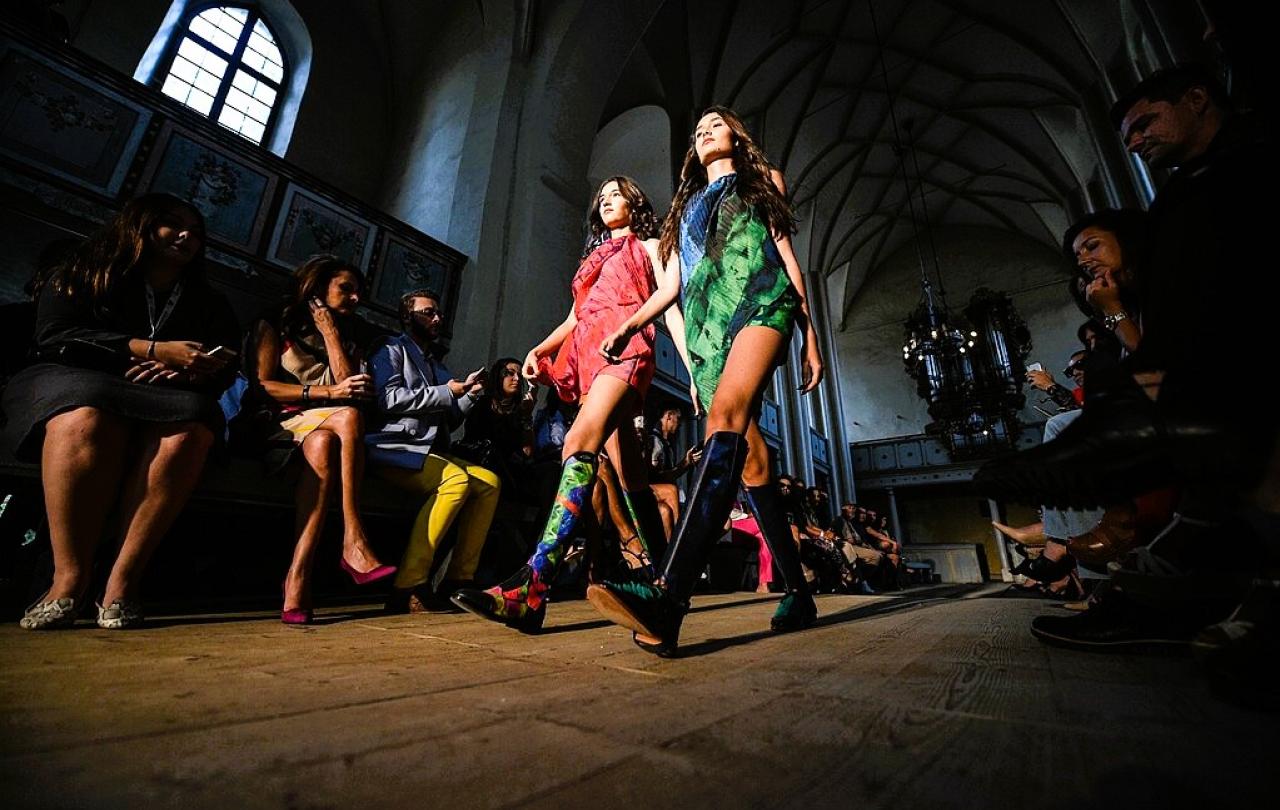
Two models stride along a catwalk of a fashion show held in a church
Orgamea, CC BY-SA 4.0, via Wikimedia Commons.

During London Fashion Week, galleries, warehouses, halls and factories transform into runways to showcase designers’ newest collections. But sometimes they choose a venue that would otherwise be unexpected for an industry-insider event- one of London’s many churches.

In some ways, the Christian chapel is a natural runway – a crowd cut in two with all eyes on a procession down the central aisle. A church wedding might be the most literal analogy- with the bridesmaids and wedding party as the models on a runway showcasing their fine gowns. But the reasons why a designer might choose a Christian venue go beyond a convenient space. 

A venue of smells, bells, fabrics and painting

The Christian Church has a rich history of materiality that other Western institutions would struggle to compete with. During the Middle Ages and the Renaissance, the Church was the main proprietor of all artistic practice. Churches commissioned painters to beautify their walls and to illustrate biblical stories in the form of triptychs and altars. Textile workers embroidered intricate patterns onto clerical vestments, and metal workers and glass makers collaborated to craft stained glass windows. The Church and art were inseparable and for many, attending church was the only way you would see these human-crafted artistic wonders. 

Church history and art history are so intertwined that even in the present day, it’s hard to be in the creative industries without some awareness of it. 

That sense of materiality is a strong reference point for many who grew up attending more traditional Catholic, Anglican or Orthodox churches, but even for those whose experience with church might involve only the occasional tour of a beautiful church in Italy or Spain. Jean Paul Gaultier, a French haute couture designer, used Catholic iconography in his 2007 show at Paris Fashion week. Each model donned a halo crafted from materials ranging from the roses, metal, feathers, jewells, pearls, gold and yes- even stained glass. Some models carried what looked like hymnals, and a few were even wearing the image of Virgin Mary or Jesus printed onto a veil or fitted dress. 

Andrew Bolton, curator of the 2017 exhibit Heavenly Bodies at the Metropolitan Museum of Art, said “what we call the Catholic imagination” has “engaged artists and designers and shaped their approach to creativity.” Regardless of personal belief, Bolton believes “Beauty has often been a bridge between believers and unbelievers.” 

Beyond materiality, the history of Christianity has given us much of the language and concepts by which we think through some of life’s biggest questions. Even if you have never thought of yourself as religious, you will have come into contact with ideas of creation, sin, and redemption that come from the Christian Faith. 

At a fashion show, the designer is Creator and his models walk across the runway to showcase his creations. The crowd may be just as religiously devoted to him as church goers are to their god. A church is the natural venue for a designer who thinks himself worthy of that kind of attention. 

A church-made-runway is a symbol of designer as god- god of their own creations, their brand, and perhaps the future of fashion itself. By taking on religious iconography, designers become the centre of glory- at least for the 45 minute runtime of the show. 

Sometimes, like Gaultier, they feel inspired by the church’s rich iconography. At other times, like McQueen- they are upset at a world created by people who take advantage of power and use religion against others.

Subverting religious ideas 

But using the language of Christianity is often about more than co-opting it for a designer’s own glory. It’s often also about subverting the symbolism of religion - to make statements about the hypocrisy or limitations of religion on individuals. 

One of the most famous shows at London Fashion Week was the 1996 Alexander McQueen Dante at Christ Church in Spitalfields, East London. Based on the Christian-inspired Dante’s Divine Comedy, the collection featured a combination of photographs taken during the Vietnam war, bold takes on men’s tailoring, and black crucifiction-adorned eye masks borrowed from the work of photographer Joel-Peter Witkin. According to McQueen, “religion has caused every war in the world, which is why I showed it in a church.” Other more recent shows at churches include Dilara Findikoglu's show in 2018 at St. Andrew’s Holborn which dressed models in devil-inspired costumes and Julien McDonald’s show at Southwark Cathedral in 2019 which was heavily criticised for bringing revealing clothes into a sacred space. 

McQueen and other designers use their shows in churches to question its integrity. Many who have experienced hurt in the church or from Christians in their personal lives resonate with these fashion statements. 

Fashion’s subversion of religious ideas cuts to a core tension many of us experience. I have always felt drawn to Christian ideas. I love the idea that God created humans in his image to “do his handiwork.” Such creativity has fueled human endeavours as famous as Michel Angelo’s Sistine Chapel and as ordinary as my personal wardrobe. And that a loving heavenly Father sacrificed himself to redeem the world and restore creation-it is an extraordinary thought. 

At the same time, the history of the world, of Christians and of the church feels weighty. Christians have used religion to justify colonialism, racism, slavery, and a host of other atrocious acts of taking advantage over vulnerable people. In our personal lives, Christians we know may have acted in bad faith- as greedy, selfish and unkind in their dealings with others.   

And so, Fashion often encapsulates this duality of having both awe and anger at the church.

But we also know that Fashion isn’t an answer to these problems either. Powerful people in the fashion industry deal with the same temptations of greed and power that others do. The industry is fraught with its own problems of hypocrisy, of doing harm to the women they praise, to the earth whose materials they use, and the vulnerable whose labour they exploit. 

I work at an arts and fashion university, where I often see students creatively wrestle with ideas of life, death, faith and hope. Sometimes, like Gaultier, they feel inspired by the church’s rich iconography. At other times, like McQueen- they are upset at a world created by people who take advantage of power and use religion against others. It can be easy for those who come from faiths that are questioned in art to be outraged at this subversion- like many were with McQueen’s original show. 

In the novel I am Asher Lev by Jewish rabbi Chaim Potok, a young Hasidic boy in 1950s Brooklyn grapples with the limitations of his religious community as he realises his passion for art. A key moment comes when he realises that there is a difference between the “good” and the “beautiful.” His mentor Jacob tells him, 

“I do not sculpt and paint to make the world sacred. I sculpt and paint to give permanence to my feelings about how terrible the world truly is.”

An anthropologist by trade, I look at the work of Fashion designers who use and subvert Christian ideas as a culture grappling with faith in a post-religion world. Humans are unique in their ability to change culture through the things they make and the concepts that come out of them. As a Christian, that creativity, and that freedom to wrestle with life’s toughest questions, are both gifts from God. 

Faced with fashions that challenge the status quo or make people uncomfortable, I ask this- What questions is this designer asking? Do I have similar questions? And importantly- where can I start to find some answers?

Join with us - Behind the Seen

Seen & Unseen is free for everyone and is made possible through the generosity of our amazing community of supporters.

If you’re enjoying Seen & Unseen, would you consider making a gift towards our work?

Alongside other benefits (book discounts etc.), you’ll receive an extra fortnightly email from me sharing what I’m reading and my reflections on the ideas that are shaping our times.

Graham Tomlin

Editor-in-Chief