Podcast
Comedy
Culture
Poetry
S&U interviews
4 min read

My conversation with... Frank Skinner

Re-Enchanting... Comedy. Frank Skinner is only interested in the weird. In the un-graspable. In the outrageous. Belle Tindall gets a lesson in "super poetry" from Frank.

Belle is the staff writer at Seen & Unseen and co-host of its Re-enchanting podcast.

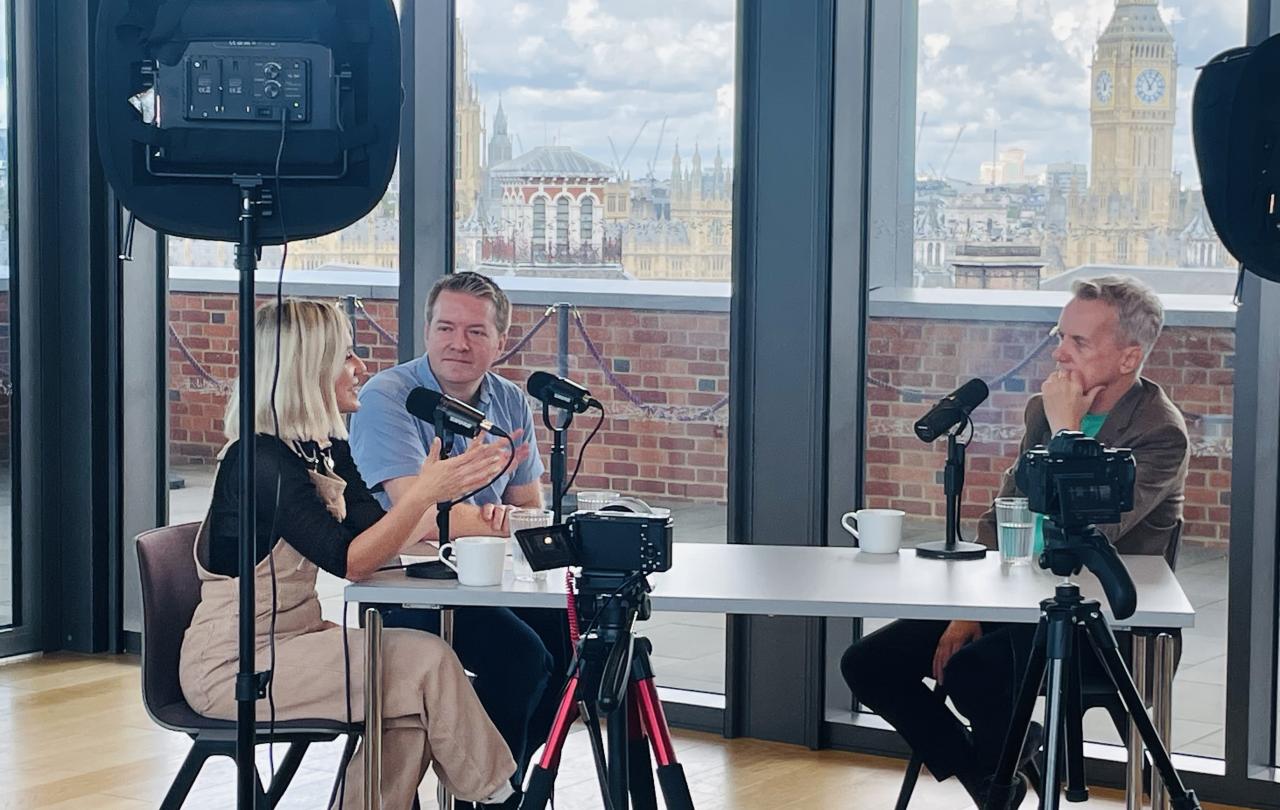
Around a table with microphones, three people record a podcast, one leans in talking and gesturing with a hand while the others listen.
Recording Re-Enchanting... Comedy.

In David Baddiel’s (admittedly excellent) book The God Desire, he has a section on his long-time friend Frank Skinner entitled ‘In a Car with Frank Skinner and his Sins’ (not that Frank would know; he’s refused to read it). After my conversation with Frank Skinner for the Re-Enchanting Podcast, I’d like to similarly entitle this piece ‘On A Rooftop with Frank Skinner and his Doubts’.  

Frank Skinner; a comedian, broadcaster and author who has entertained millions through TV shows such as Fantasy Football League, The Frank Skinner Show, Baddiel and Skinner Unplanned and Room 101, as well as many sell-out stand-up comedy tours. His penmanship is also a force to be reckoned with, having crafted the undeniably iconic Three Lions football anthem (which he penned with the afore mentioned Baddiel) as well as my favourite piece of his work, A Comedian’s Prayer Book. He’s always been open about his Catholic faith, determined to ‘keep his hand up’ as a (very often the) Christian in any given room. Frank’s faith has been, and still is, shot through everything he does – even his ‘sinning’.  

This conversation was always going to be interesting.  

And as such, there are many things one could take away from this conversation with Frank. Perhaps the value he places on doubt as a tool of refinement and source of growth, or his comparing of Richard Dawkins and Christopher Hitchens to bullies at a Christian disco, or even his efforts in ‘responsible sinning’. It’s a fascinating conversation from beginning to end, as I rather embarrassingly told him to his face, I enjoyed "every moment of it."  

However, there was one salient question that was left lingering in my mind days after our conversation ended – are we (by ‘we’, I mean Christians) interesting?  

There’s been a theme that’s run through Re-Enchanting thus far, prevalent in our conversations with Jennifer Wiseman, Paul Kingsnorth, Francis Spufford, and now Frank Skinner. And that theme is this: in the context of our 21st Century cultural moment, Christianity is profoundly weird, and that weirdness is the very basis of its power. It cannot, and should not, be blended into the so-called secular moment we find ourselves in. This is confronting for me, someone who has admittedly spent her life watering down the ‘oddest’ parts of Christianity (only in public, I should state) in an attempt to make it more palatable to my secular peers. As a result, I’ve ashamedly become the type of Christian that Tom Holland would tell to ‘grow up’. Well, if one finds themselves somewhat disillusioned with such a boring ‘no-man’s-land’ of compromised belief, this episode is certainly the perfect antidote. In fact, this entire series is.  

Frank is only interested in the weird. In the un-graspable. In the outrageous. The way he speaks of interactions with his (beloved) atheist friends made it seem as though atheism is one of the most obvious things one could claim to be, meaning that there’s nothing particularly interesting about it:  

“There’s something I find a bit confusing about people in the 21st century saying “this is how daring I am – I’m going to come out as an atheist”… atheism given over as if it’s a brave stance. I’ll show them a brave stance, and it’s not atheism.” 

Speaking , in comparison, of sitting in Mass in his local church, looking on as his priest holds up a piece of wafer declaring that it is the Saviour of the world, Franks says,  

“in the 21st Century, the idea that there’s a God, that he’s got a lamb, a representative that came to earth, that he takes away the sins, and that here he is in this bit of wafer… it’s outrageous. I don’t like the idea that we have to go to them (atheists). It’s made it (Christianity) a dull half-way house." 

Hence this lingering question: are Christians actually the more interesting ones? My conversation with Frank made me think that we may just be.  

Even though, as I have mentioned, the entire conversation was one to remember, it was the final five minutes that that truly ticked the ‘re-enchanting’ box for me. Justin and I, along with our guests, have often discussed Christianity as ‘the greatest story every told’, but Frank introduces us to Christianity as a  

“living poem, super poetry, poetry that’s physical, poetry made flesh, poetry that actually exists.” 

And not only that, but 

“we are a part of that poem, we just need to step into it. There is a blank line waiting for us…” 

How beautiful. It’s clear that, to Frank Skinner, Christianity is not only very interesting, it’s profoundly enchanting. Listen to the first episode of Re-Enchanting Season 2 enjoy Frank’s disconcerting ability to make you simultaneously laugh lightly and ponder deeply. 
Review
Culture
Football
Sport
5 min read

Shootout: what penalties say about life

Football is a global language and the shootout is the end to Shakespearian tragedy.

Simon is Bishop of Tonbridge in the Diocese of Rochester. He writes regularly round social, cultural and political issues.

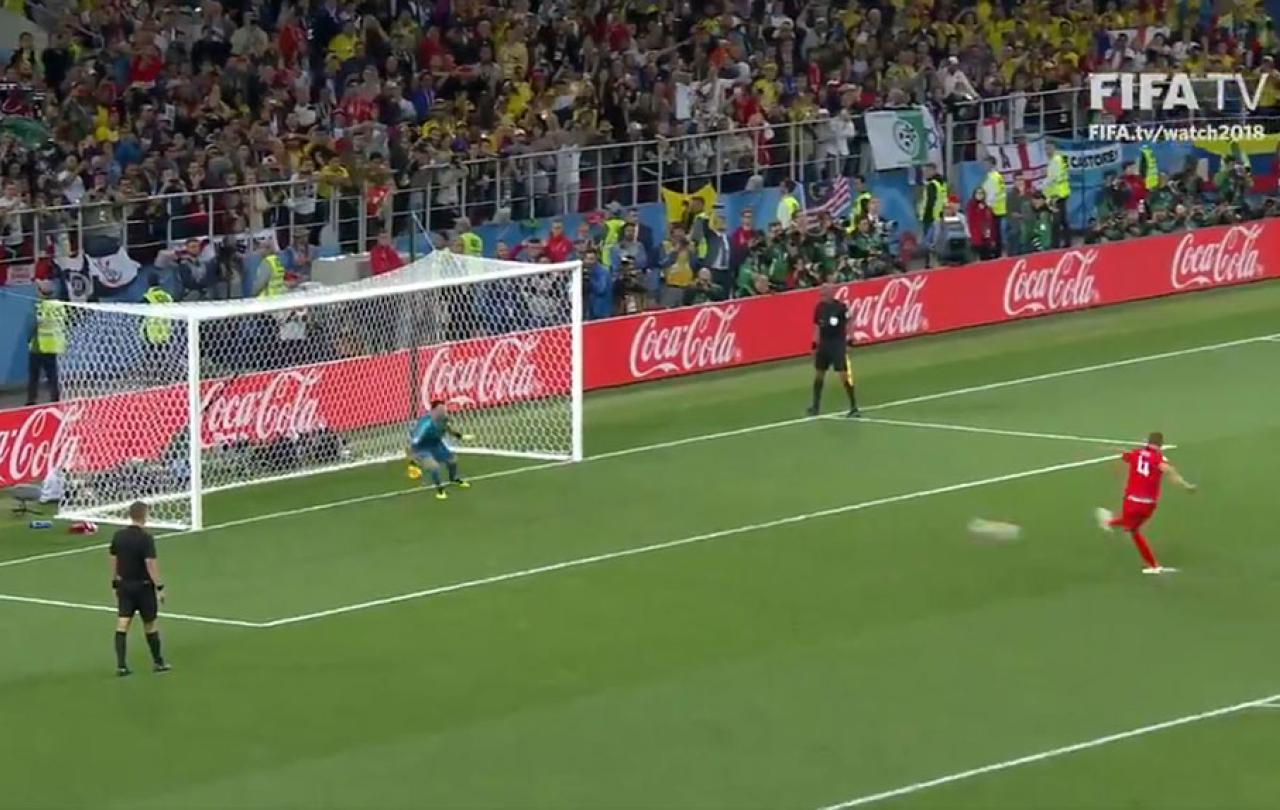
A footballer takes a penalty kick.
England v Columbia: 2018 World Cup shootout.

It is hard to pity entitled, overpaid footballers.  Until, that is, it comes down to penalties after extra time.  Even when you do not care who wins, the drama of the penalty shootout is so intense and all-consuming that every heart rate quickens. 

Is there a more exquisite form of sporting torture? 

Sport is laden with cliché, and the refrain, ‘it’s come down to the lottery of penalties’ is an established part of the lexicon.  But is it just the spin of the roulette?  That you can’t prepare effectively for the cauldron of the stadium?  

Not according to Geir Jordet, it isn’t.  The Norwegian Professor of Psychology and Football is on a mission to convince the world there is lots you can do to get ready and those that don’t are more likely to fail. 

There is skill involved in taking a penalty, an ability that can be honed with practice.  Individual players can be trained to take their time (but not too long), to establish a routine that helps them take control of the situation, to take careful breaths, and to focus.  They can be helped with blocking out the trash talk of opponents, especially goalkeepers, who subtly try to get under their skin in the seconds leading up to a penalty.  Extensive research can be carried out by data-rich backroom staff to help with preparation.  And behind all this is the recognition that taking a penalty is a team effort, not an individual one.   

This latter observation feels especially counter intuitive.  There is nothing more lonely than the appearance of one man or woman taking the long walk from the centre circle to the penalty spot.  But teams can support one another with words of encouragement and touch.  Not just in the grasping of each other’s shoulders in the centre circle, but in reaching out to those who both score and miss.  One reason Geir Jordet advises that the manager should choose penalty takers rather than look for volunteers is that they then can take full responsibility for the outcome.  It is hard to believe there are still times when a manager looks around at players after extra time, hoping to see in the eyes who is up to the task.  These duties should be sorted out in advance, with back-up plans for when players are injured or substituted.

Deciding war between opposing tribes based on an individual contest was quite common in the ancient world – effectively moving to the penalty shootout before the game, to save the effort.

Jordet, in his stimulating book Pressure: Lessons From The Psychology Of The Penalty Shoot Out says that anxiety is normal and should be embraced.  Greater openness round mental wellbeing is allowing the modern professional to admit this.  Erling Haarland, one of the world’s most accomplished goal scorers, has shared the fear he regularly feels round taking a penalty; it is hard to imagine a player from the 1970s saying the same. 

Missing a penalty in the shootout is inevitable; the only way it can conclude.  And statistics show that the world’s greatest players, like Lionel Messi, are not notably better at converting penalties than others.  On average, the best players have around an eighty percent success rate (which, significantly, is one missed penalty out of five in a shootout).  As in other professions, the best results are achieved by creating systems and cultures that can adapt quickly and honestly to errors and learn from them without humiliating those who fail. 

Reading the book cast my mind back to the archetypal shootout between David and Goliath.  Deciding war between opposing tribes based on an individual contest was quite common in the ancient world – effectively moving to the penalty shootout before the game, to save the effort.  Perhaps David should have lost it, and not just because of his size.  Beforehand, he had a serious bust up with his side and those who did not see him as a team player.  Then Goliath trash talked him like Emi Martinez is famed for with Aston Villa and Argentina.  And finally, he ran up to take his shot very quickly, without much reflection.  But then again, Geir Jordet would be the first to point out that preparing badly for a contest does not mean you can’t win it – just that you are less likely to. 

Football is a global language and the penalty shootout is like the cataclysmic end to a Shakespearian tragedy.  English fans are long suffering audiences of this trauma – from Italia 90 to Wembley 2021, via the 1996 Euros when football was coming home until a last minute wrong turning.  But many other nations have under-achieved at penalties, like Holland and Spain and, more recently, France.  Roberto Baggio of Italy missed the decisive penalty in the first World Cup Final to go to penalties in 1994.  He says of it:  

‘I failed that time.  Period.  And it affected me for years.  It was the worst moment of my career.  I still dream about it.’.   

The personal stakes are as high, if not higher, than the nation’s.   

We are left with the feeling that hugely divergent outcomes can emerge from the smallest and most random of causes.  The human tendency is then to rationalise the outcome in ways that make it seem inevitable.  Geir Jordet is aware of this in football, but in other walks of life, we continue to build up wobbly cases on shallow evidence as a way of warding off anxiety or the fear that others will think we are clueless if we admit to the existence of chance.  Most people are right less than eighty percent of the time; something we might hold in mind when the next England players make that solitary walk to the penalty spot.