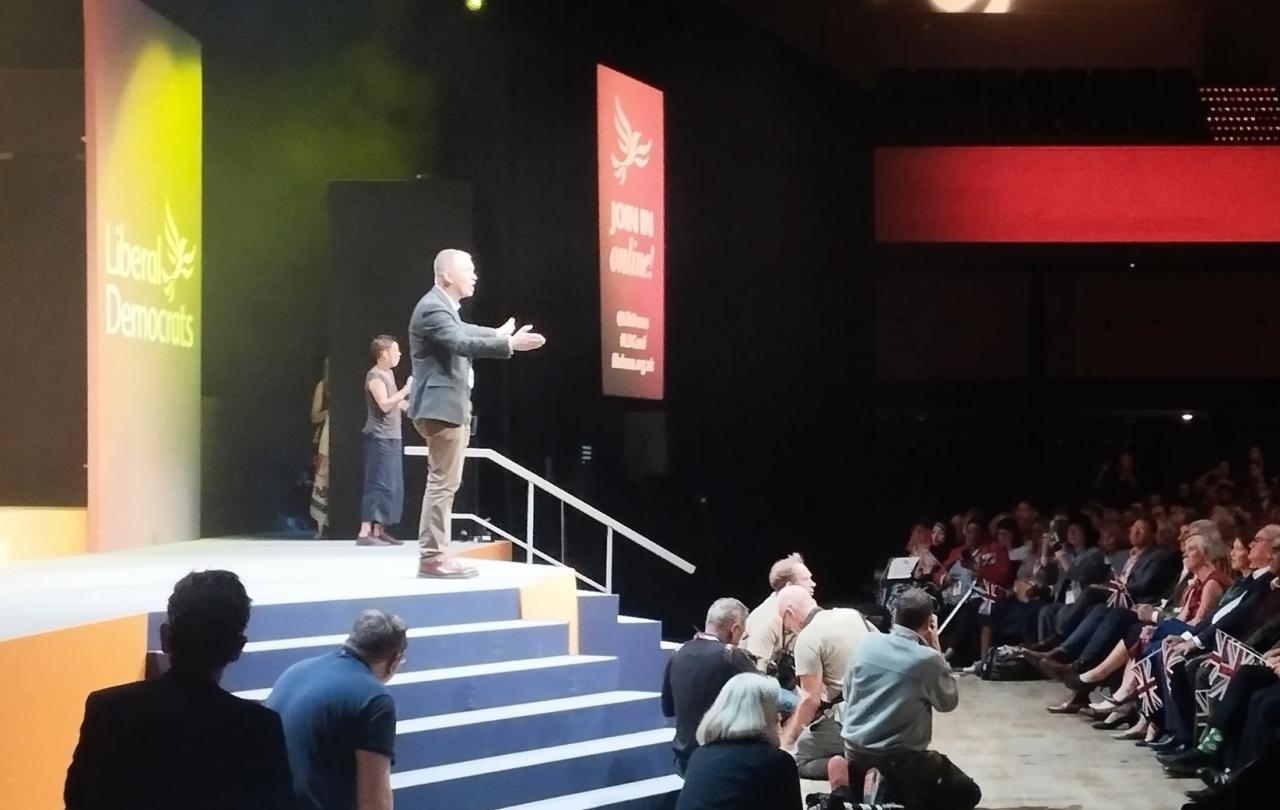
Graham Tomlin: I read a book recently by Bijan Omrani called God is an Englishman. It makes the case for Christian faith as having hugely shaped English life - our legal system, our literature, our poetry, music, language, landscape and everything. The point he makes is that the probably the biggest social change in the last 50-60 years is the decline of Christianity as a publicly recognised set of assumptions. Do you think that's true? And does it matter?
Tim Farron: I think there's certainly some truth in it. I do subscribe to the Tom Holland thesis, which is that Western liberal democracy owes its existence, and therefore the West in terms of values, to the gospel. What do I mean by that? I mean a sense that all human beings are awesomely made in the image of God, and therefore are of enormous value - every single one of them. that justice matters, that no one should be above the law. Likewise, a kind of more negative view of humanity, which is we're all sinners, and therefore we shouldn't be concentrating the power in the hands of too few of us. And so, I think Western liberal democracy definitely owes itself to Christianity. I'm speaking to you from the Houses of Parliament where there are chapels everywhere, and there are relics, shall we say, of the Christian faith all around. Indeed, the day in Parliament, including this day, begin with prayer. And good prayers for that matter. So, I I certainly do take his point.
Is it significant that over the last 50-60 years that has been a declining influence in our politics? Yes, of course it's significant. I think again to quote other people, Oz Guinness's line that we live in a ‘cut-flower society’ is one I really think is true. The reality is that so many of the values that we hold to in Western societies, in the UK in particular, are grounded in faith in Christ, in what the gospel teaches us. And if we've now two or three generations into Christianity formerly being the established religion, but in reality not, then after a while, you lose. Cut flowers look nice and pretty for a while, but eventually they die because they're not attached to the roots.
The image I've heard recently that is that that of a dying tree. A cut flower doesn't take long to die off. But a dying tree, where the roots have shrivelled up takes quite a long time. It can still look like a very flourishing tree, but over decades, it begins to wither above the surface as well as below.
Bede, in the eighth century, was probably the first to really identify the English nation as a as a united entity linked into kingship and Christianity. We had the Coronation recently, which was a deeply Christian event. We have bishops, the succession of the monarchy is Protestant. The King is the Supreme Governor of the of the Church of England. But does all that make Britain a Christian nation? Would you call it a Christian nation?
TF: I'm always quite wary about referring to anything as a Christian nation. Nations aren't saved. Individuals are. I don't think we are ever encouraged in the Bible to think that people or nations are saved by conquest. I'm not just talking about invasions and crusades. I'm talking about elections. We know that all human beings are sinners, that politics is not ultimate. I think there's plenty of guidance for us in the Bible to tell us that politics matters, that we're meant to seek the welfare of the city in which we've been placed, that we're meant to care for those around us, to love our neighbour in practical ways, not only in spiritual ways, but in physical ways as well. I think we're to engage in politics. But politics is not ultimate, and we should be careful about seeing the advance of the Kingdom as something you do either with the rifle or the ballot box.
We’ve just had the Unite the Kingdom march through London with Tommy Robinson and friends. At that event, there were people holding crosses, hymns were sung, there was a chant of “Christ is king”. What do you make of all that does it? Does it worry you?
Yes, it does worry me if I'm honest with you. I can see some silver linings, but the appropriation of Christianity by one political movement troubles me. Well, let's put boldly - it is heretical. Christ should shape our politics. Our politics should not be shaping our faith.
I think there are two forms of Christian nationalism. I'll pick one of them – it is the idea that we should be a kind of clerical state. All the laws should be Christian, and we should act like a Christian nation, almost like a Christian version of some of some Islamic countries.
On the other hand, you've got the marches run by Tommy Robinson - a kind of Christian nationalism where Christianity is seen as a symbol of Englishness and of Britishness, to be appropriated to wear as a badge. It's Land of Hope and Glory, ‘green and pleasant land’, St George, myths of our past flags and all the rest of it. And it's all kind of like a pot-pourri, a minestrone of things that make us British. I don't want to poo-poo that, but that's not Christianity and so my worry is that whenever a political party seeks to appropriate Christianity, then by definition, the other half of the culture war will have their fingers in their ears when it comes to the gospel, and that's a really bad thing. And also, the way in which it is spoken of, it's not spoken of lovingly, gently. It's not spoken of in a way of where we're seeking to bring people into relationship with Christ, but as a kind of a as a badge or as an emblem.
Jesus will not endorse your politics. If you have grabbed hold of the cross and Christianity as motifs of your patriotism, your nationalism, it's not Christianity. Jesus will not endorse you. He won’t endorse people on the other end of the spectrum either. He will disturb you. He will contradict you. And if you want to come into a living relationship with Jesus Christ, be prepared to put all of that in the bin because he will ask you to.
Theologians and sociologists often use a distinction between thick and thin religion. Thin religion is an identity marker which can be used as a bit of a stick to beat people with, but thick religion is where you really take seriously the teachings of the faith. You go deeply into it, develop a life of prayer, attending church, really taking this seriously.
There were genuine Christians on the Tommy Robinson march and I'd love to speak to some and understand where they were coming from on all of this. On my podcast through the whole party conference season, I'll be interviewing Reform people, Lib Dems, Conservatives, Labour - and so I don't condemn anybody for their political views. I do think there’s something about the whole kind of Tommy Robinson cabal, which is just especially ungodly, but that doesn't mean that he's not tapping into concerns that are legit.
What’s the silver lining?
In Christian nationalism, you've got a bunch of people who think they like Christianity. They may never have heard it properly, but they think they like it. And so, there's a good chance they might come into the door, and if they come into the door and the right person is behind pulpit, they might hear the gospel as well.
I'm doing various talks at the Lib Dem conference. Two of them are specifically Christian and in the first instance I'll have to do battle with “isn't Christianity bad? Isn't it all made-up and not true anyway?” And those are two hurdles before I can then even begin with the gospel. When somebody thinks Christianity is part of being English and we should reclaim it, then at least I'm over those first two hurdles! And I can then get into the gospel, which will be equally shocking to them. Equally shocking. It is a very big hurdle. Jesus Christ is the cornerstone that you will trip over because he will tell you that you've got to love your enemy. He will tell you to love the unborn, and he'll also tell you to love the refugee. He will tell you to abide by, traditional sexual ethics, and he will also tell you that racism is an outrageous sin. He will tell you that the package of beliefs that you signed up to - tear them up.
I always like to remind myself of something David Steel said a few weeks after I joined the Liberals when I was 16 at the first conference of my membership. He said any liberal that doesn't disagree with at least ten per cent of Liberal policies isn't really a liberal. And I like that. But I think that with Christians, it should be even more so. You know, you're joining a band of sinners. You know that because you're one of them. And so you're going to join imperfect group of people who are seeking.
Political parties being that is something we maybe accept, but the culture war seems to flush us into trenches which are far more neatly cut, where there is so much more hostility. And I would argue that Christians need to stay out of the court. You can join a party. Don't get in a culture war trench.
What about the rise of Reform? It does seem to tap into a kind of deep unease that is around middle Britain. You will hear people in that movement talking about the increasing prominence of Islam or ‘woke’ ideology. And they see that as a sort of threat to the Christian character of the nation. Are they right to feel threatened by that?
One thing we should say first and foremost: Christ is on the throne. The battle is won. Don't panic. With regard to Middle England or Middle Britain, I want to be really respectful about Muslims and accept their rights to think different things. And I think Islam is just another world view. That's not Christianity, so is atheism, so is agnosticism, so is nominal Christianity. And so, I don't feel especially threatened. I mean, as a Christian I don't feel threatened at all because the victory is Christ’s. It's won and God does not need our help.
Do I think Islam is true? Carefully, I would respectfully think it isn't. I think atheism is untrue. I think agnosticism is untrue. I think modified versions of Christianity where we've added or taken stuff away from it is untrue. Yet I will die in a trench to defend people's rights, to think all of those things.
And I think Christianity is true and Jesus is who he says he is. And so what I do think is that we should have the right to respectfully disagree. And that's the thing that I've think we may have lost in the last 20 or so years, and some people will put that down to woke ideology. But nobody who is ‘woke’ ever uses the phrase ‘woke’! If you use the word ‘woke’, you've turned lots of people off. If you think you're anti-woke entirely, then you're anti-Christian. If you're entirely woke, then you probably are as well. As I said earlier on, if you are following Christ, you should be concerned for the rights and the life of the unborn child, and should be equally concerned for the right to the refugee. And so what are you, woke or not woke? You are above all that. That's what you are. If you're complaining about wokery, you've got a problem. If you're massively woke, you've got a problem, in a very gentle and gracious way. You should be above all.
It seems to me that both kind of conservative and progressive elements or instincts have their roots in Christianity because, you know, the progressive element knows very deeply that the world is fallen. It's broken, it needs justice. Things need changing. We can't just assume everything is fine. But the conservative approach gets that not everything is up for grabs, that there are some things that is given to us. We just simply have to accept the nature of reality that God has given to us. And so, you've got to be a little bit of both if you're if you're being authentic to Jesus?
I think that's right. And I think that's one of the reasons why it's completely legitimate for Christians to belong to different political parties.
I want to ask you about the Conservative MP Danny Kruger joining Reform.
Some would say that our politics is getting more polarised and there's not much space left in the middle.
It is polarised. I think there's an awful lot of anger. You hear some of the language of the Tommy Robinson characters and some others talking about civil war as if they want it, a language you just wouldn't have heard, at least not from the right. You might have heard it from the revolutionary Communists and the Socialist Workers back in the day when I was a student. But then again, let's be careful not to have rose-tinted spectacles about on about the past. The political and ideological difference between Margaret Thatcher and Michael Foot was colossal including, of course, that Margaret Thatcher thought it was stupid to not be in the European Union and Michael Foot wanted to leave! So too over nuclear defence, who we're allied to, who should own the means of production - massive, difficult decisions and divisions between the two parties back then. Today no-one's really arguing about who controls the means of production, or what level of taxation there should be or any of that stuff. These days it’s all about identity. Somebody once said that the lower the stakes, the more ferociously over which they are fought. And it seems now that we're arguing about stuff that - oh, forgive me - doesn't matter.
As for Danny Kruger, he's intellectually credible. That's something Reform haven't got a lot of. And now they have with Danny. And the Labour Party just feels hated. And so, the parties that are not Labour and the Tories are doing well. Reform appear not to be held back by the need to present ideas that are based on evidence, and therefore they can say anything, and therefore they're on 30 per cent of the poll and we're on a mere 17 per cent and the Greens are on nine or 10 per cent.
But I think where we're at is that there's a real detachment of people from the parties they've always supported. And that's been going on for some time. You could say it sort of started the 60s and the 70s, but it's absolutely got turbocharged since Brexit. That certainly seems to be where we are on the timeline and so people who had always voted Labour are now not doing so, those who always voted Tory, not doing, it's incredibly fluid.
I guess what you're pointing to is not so much the polarisation of political discourse, but the fragmentation of it. After all. 400 years ago we were on the brink of a civil war. That's polarisation! If we're living in a very fragmented world, what is the role of the church in such times? And – can we call Britain a Christian nation in any sense?
I think the role of the church is to model Christ. We should love Jesus internally and we should be pointing to him and making him known externally. And that's our job really. I'm not convinced we do that enough.
I think we should be modelling Christ in his servant-heartedness in loving our communities in a practical way. And that means doing things like supporting refugees, supporting people in living in poverty, making sure that we make best use of whatever property the church might have to meet social need, but always, always put in the gospel at the centre of it.
The story of the account of Jonah really resonates with me because of how he is towards Nineveh. Jonah ends up in the belly of the fish because he's legged it, he's gone literally in the opposite direction to where God was wanting to send him. He was going to go to Nineveh, to speak to these terrible people that he really did not like at all. Jonah was meant to tell them that they need to repent and believe. And Jonah knew God is a good and almighty powerful God, and unless he preached the word of God, they never would repent. He hated Nineveh. So he legs it to Spain and ends up in the belly of a fish. But the point is this. We've all got a Nineveh.
Who is it for you? Is it Tommy Robinson? Is it Jeremy Corbyn? Who's your Nineveh? And whoever they are, you pray for them and reach out to them and love them. You do not need to agree with them. You should not agree with them. This models the utterly radical nature of the gospel and holding out the possibility of salvation, a relationship with the living God to absolutely everybody, including the people you do not like. To love your enemy. It's the most radical thing that you can do, it's the heart of what he did because he did that all the way through to the cross.
Tim, thank you so much. It's always good to talk with you. It's always very illuminating, inspiring, encouraging.