Review
Art
Culture
5 min read

Matthew Krishanu: painting childhood

Portraying family, memories and counterpoints.

Jonathan is Team Rector for Wickford and Runwell. He is co-author of The Secret Chord, and writes on the arts.

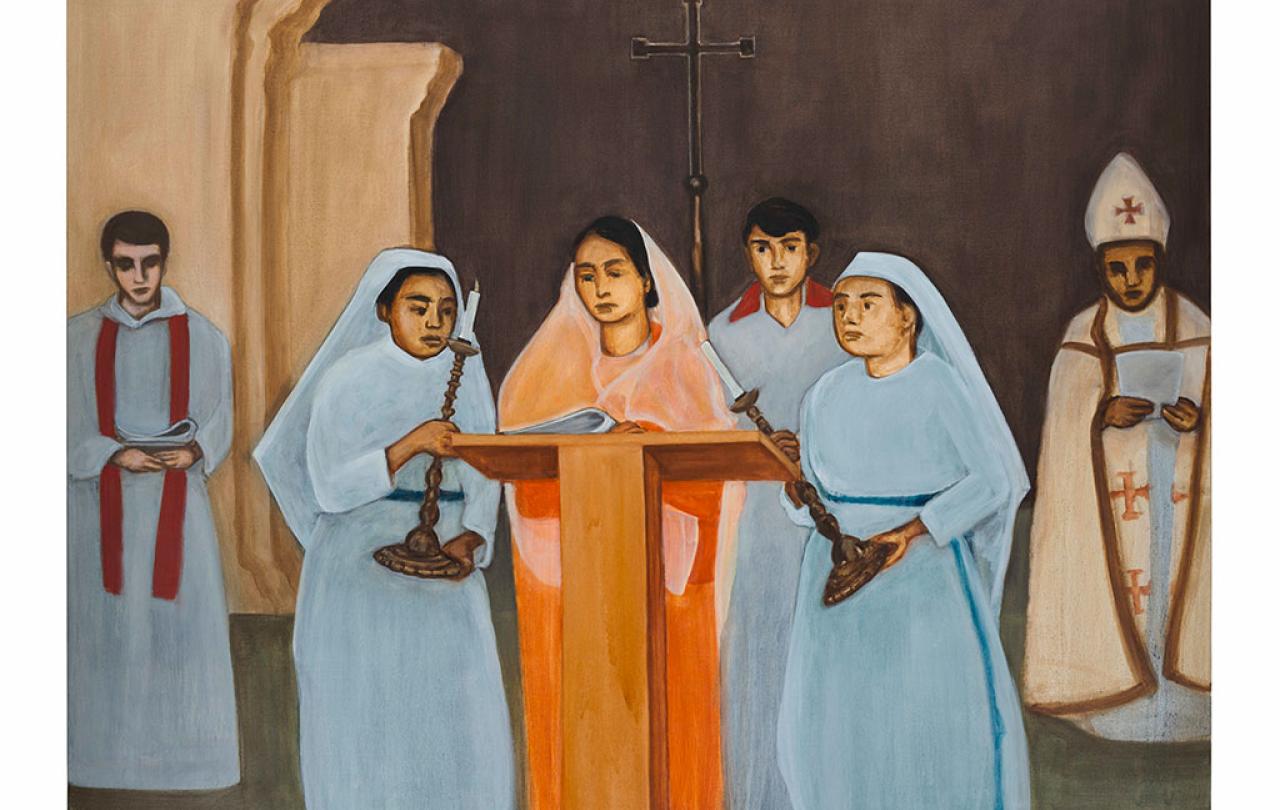
a painting shows Bengali celebrants of a Eucharist.
Preaching, Matthew Krishnau, 2018.
Peter Mallet.

The Bough Breaks by Matthew Krishanu at Camden Art Centre has been described as the most significant exhibition of his work to date because, by showing the drawings and works on paper that he calls the generative heartbeat of his work as well as the works for which he is best known, the exhibition is the fullest expression to date of the expansive world of his artistic practice. 

His images are primarily personal stories told through layers of memory, imagination, and conversations with the history of painting, in atmospheric, pared-back compositions which focus particularly on his childhood years in Bangladesh growing up with his brother, and their parents who were a British Christian priest and a Bengali theologian.  

He speaks of his images in terms of an ‘I-you-them‘ axis. The work he considers his first painting, from 2005, entitled ‘Boy on a Bed’ was originally a scene of an empty room. He recalls that “late in the night before I was going to be exhibiting it, I sketched in this boy with black hair, brown skin, and a little toy car behind him”. He continues, “I knew that was me, and I knew that there was something I wanted to communicate about the inner world of that child”. In 2012, there came another “fundamental shift” in that “I wanted to paint myself and my brother”. With the first ‘Two Boys’ painting, “I remember it felt like worlds had opened up”. He explains that “when you have a single child, you can project ideas of melancholy or loneliness” but “when you have two, they outnumber the single viewer” and “I think the fact that they are clearly brothers and both have brown skin and often a very direct gaze at the viewer, holds a certain power”. 

He recalls being in a show called Painting Childhood: From Holbein to Freud where the very last room was of the ‘Two Boys’: “Having gone through room after room of European children, white children, then coming into a room where these two boys weren't othered in any way, but were taking centre stage in the narrative, was hugely important.” 

Adults are excised from the ‘Two Boys’ series “because I want the boys to be out on a limb or up on a hill, without parental supervision”. However, within the ‘Mission’ series - paintings of church life in Bangladesh - adults are seen from the perspective of children. As a result, they are in the ‘them’ part of the axis: “I see the adults in the third person. I'm constructing them as in some way other to the child's eye. This brings in the strangeness of performance and ritual, the stiffness of it too, particularly when you're used to being barefoot on the ground in Bangladesh and, suddenly, are meant to sit still and quiet. For me, it was compounded by the fact that I was brown skinned, as was my brother and mother, and my father was white skinned, and he was a priest, and he was a man, and all the power that comes with being a white man in Bangladesh; just the way he is perceived by his congregation, and even strangers on the street.”  

He recalls that: At the time I knew that wasn't right and I didn't like the depictions of God as this white man flying around the sky. As a child, you have quite a raw and immediate relationship to life and nature and spirituality and, for me, it was the religious art that was the fundamental barrier to entering the world of the church. Also, the gendering of ‘Our Father’ or Jesus, the ‘only son’. That's why, as a young teen, I decided I didn't want to be confirmed, because I didn't believe in that construction.” 

‘For me, that is where my faith is, in love, in the love of family, in all that a baby calls upon us to give it.’ 

Matthew Krishnau

In a painting like ‘Preaching’, he is exploring what it is to centre, in a congregation of brown adults and children, “the four nuns and my mother preaching with the two female candle holders and have the men on the sides”. So, “It's all about constructing a world which is both a counterpoint to the world of the two boys and nature, but also a counterpoint to the religious hierarchy we see in the church now”. The ‘Holy Family’ series, “which is of Bengali nuns, priests, and bishops” “is a deliberate response to the white depictions of Christ, baby Jesus, and Madonna”. 

He notes that: “It's part of my painting mission to offer a counterpoint on the widest possible framing of an ‘I-to-you’ axis of a brown child, which isn't seen through the lens of National Geographic or Comic Relief ‘white saviours’, but is taken and centred as the heart of a human story. And if there's any spiritual message, then it's about that; of love, of the divinity of children and babies, and the divinity of our beautiful world, the ecological world of trees, water, glorious sunsets and sunrises, and all that comes with the human form.” 

He thinks that this show has “set up a kind of a world philosophy” for him: “The core, the heart of the show, for me, is family, particularly of my late wife and my daughter. In and amongst the drawings, there are some pictures of our baby, and my late wife holding our baby or, indeed, holding the tree that my daughter is climbing. For me, that is where my faith is, in love, in the love of family, in all that a baby calls upon us to give it. That is the closest thing to divinity. I won't even use the word God because it's too masculine in our language. The closest thing to the divine, I sincerely believe, is in the eyes of children, is in the eyes of babies, particularly.” 

He concludes by saying he would love to expand his practice further in the future, noting “a figure that has really resonated in a way I haven't felt before is the Palestinian priest Revd Munther Isaac and his ‘Christ in the rubble’ sermon”. However, his art always “needs to come from a personal connection to something I've conceptually explored; it needs to have that heart first of immediate one-to-one human connection”. 


Matthew Krishanu: The Bough Breaks, 26 April - 23 June 2024, Camden Art Centre, London.
Article
Character
Culture
Idolatry
Psychology
6 min read

We need a sense of shame - but need mercy even more

Shame may be necessary, but only if it can be defeated

Belle is the staff writer at Seen & Unseen and co-host of its Re-enchanting podcast.

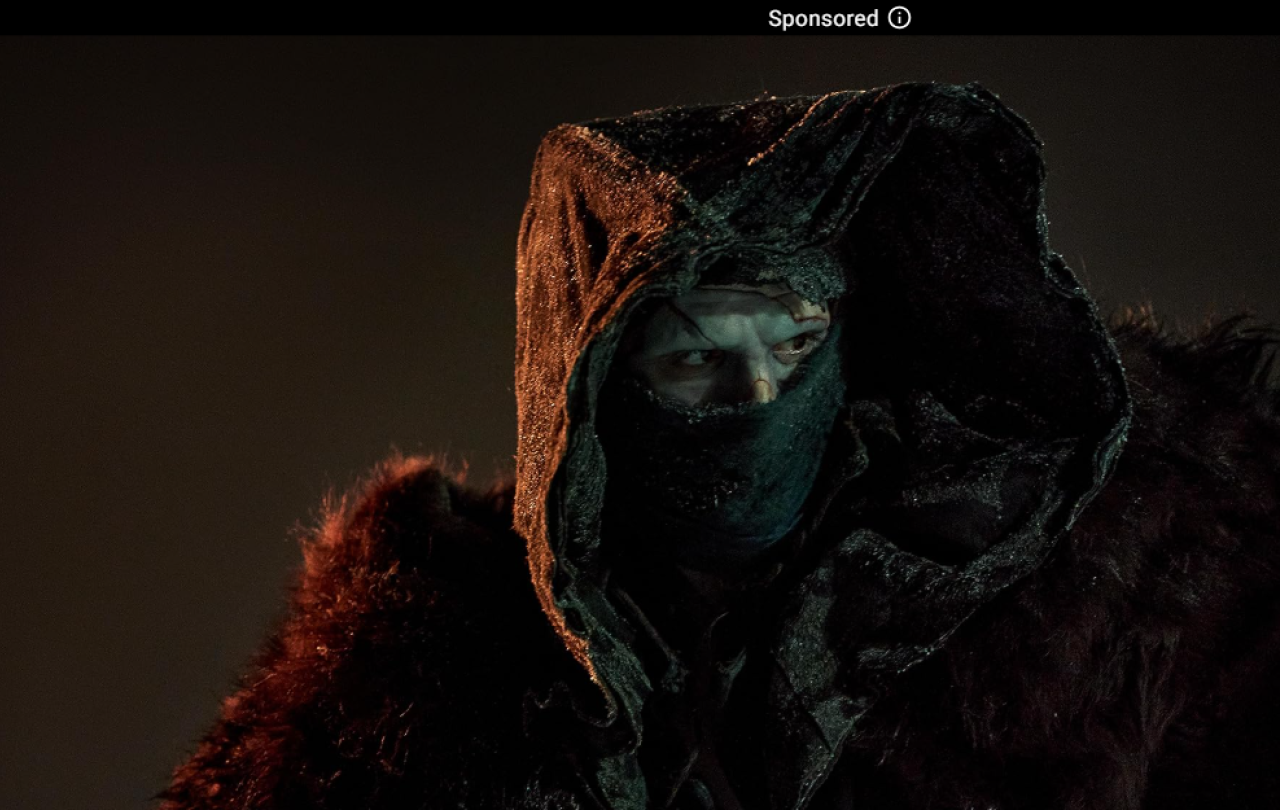
Frankstein stares our from his covered face.
Jacob Elordi plays Frankenstein's monster
Netflix.

I’ve been thinking about the nature of shame a lot recently. Both professionally and personally, it’s a topic that is demanding my attention. It’s following me around, insisting that I look it in the eye, shoving and nudging me – taunting and tempting me to finally snap and wrestle it to the ground. I guess that is the very nature of shame, isn’t it? It’s always so stubbornly there.  

I’ve also noticed that it seems to have elbowed its way into cultural conversations; it’s been putting a real PR shift in, seeking rehabilitation in public discourse.  

The actor, Jacob Elordi, was recently interviewed by the Wall Street Journal. Kind of interesting, kind of not. The sliver of it that really caught my attention was when the interviewer asked Jacob,  

‘What’s one lost art that you wish would come back in style?’  

To which Elordi replied,  

‘The art of shame. I wish people could experience shame a little heavier’.  

Gosh.  

It makes sense that this was Jacob’s answer; the interview was conducted to promote Frankenstein, Guillermo Del Toro’s new movie in which Jacob Elordi plays Frankenstein’s monster. So, I get it. He’s been consumed with what components make up a monster, endeavouring to literally turn himself into one. He’s been ruminating on the recipe of evil, and perhaps he’s found one key ingredient – shamelessness. Maybe Jacob, having dwelt on such, has subsequently looked out at the not-so-fictional ‘monsters’ wreaking havoc and has diagnosed the same thing, a distinct lack of shame.  

It's a solid thesis.  

It reminded me of another recent interview, this one with the acclaimed author, Zadie Smith. She said,  

‘Shame gets a bad rap these days. I think it’s quite a useful emotion, corrective on certain kinds of behaviour… I assume people – including myself – are just deeply, deeply flawed. And so, shame is usually quite appropriate on a day-to-day level… shame is a kind of productive thing to create change. I guess I do believe that. I know it’s definitely a Christian emotion, that’s why it’s so out of fashion. But I always thought it quite productive in the gospels, that idea that you assume that you are entirely in sin. I always assume that.’  

I half agree with both Jacob and Zadie. In a way, I’d be a fool not to. Not to mention, proof of their thesis. 

I cannot deny that I am, as Zadie points out, deeply, deeply flawed. There is a crack in everything I do, a fracture in all my best intentions. And yours, too, I’m afraid (but I have a feeling you know that). There is a brokenness to us, a breaking-things-ness. To each and every one of us, ‘hurt’ is both an adjective and a verb – something we feel and something we do. The things I want to do, I never manage. The things I don’t want to do, I seem to manage every day. I am falling short, missing the mark – I am so fallibly human.  

To acknowledge such is not only obvious, nor is it simply ‘useful’, as Zadie suggests. It’s inherently spiritual, it’s paradigmatic. 

Last summer, I hosted an event at which Francis Spufford, one of my most cherished wordsmiths, playfully quipped, ‘I’ve heard original sin (the notion that we are, as Zadie notes ‘entirely in sin’) described as one of the few theological propositions which you can actually confirm with the naked eye’. ‘Sin’, Tyler Staton similarly writes, ‘is simultaneously the most controversial idea in Christianity and the one most universally agreed upon’.  

There’s something deeply wrong with the world. We all know that.  

Which, presumably, is what Jacob Elordi is getting at – he’s observing bad people not feeling bad enough about the bad that they do, or worse still, the bad that they are. A healthy dose of shame is the medicine that this world needs, he suggests. 

Oh Jacob, I sympathise with that. The thing is, I have a hunch that the presence of shame makes as many monsters as the absence of it.  

And Zadie, I wonder if shame births as much destruction as it does ‘correction’.  

While I agree with you both that, in a world as broken as ours, shame needs to exist in some form or another, it also needs an antidote. It’s a dangerous substance; toxic and destructive. Don’t let it fool you, don’t be over-generous to it – shame may (in its most moderate and appropriate forms) be an acknowledgment of the disease, but it is not the medicine. It could only ever be ‘useful’ if it is, ultimately, defeatable.  

At least, that’s my – admittedly very Christian – conviction. That’s my take. I can’t pretend that it’s not as theological as it is sociological in its underpinnings. 

I’m relatively new to the liturgical aspects of my own faith tradition (that is, the formalised scripts, actions and rituals that have long fuelled religious experience) , so I have the pleasure of not being numb to them. When I read the ancient words of ancient prayers, they shoot right through me, particularly these ones:  

‘Almighty God, our heavenly Father, we have sinned against you and against our neighbour in thought and word and deed, through negligence, through weakness, through our own deliberate fault...’ 

Ouch.  

As I read those words, week in and week out, my brain creates a helpful montage for me – whirring through the countless ways in which I have failed – in what I think, what I say, what I do. I’m confronted with the ways that my breaking-things-ness has leaked out of me through my negligence, it’s spilled out of my weakness, the force of it directed at others through my own deliberate fault.  

Oh yes, I’m well acquainted with the emotion of shame.  

But the only thing productive/appropriate/corrective about falling on my face in shame, is that there is a mercy that can scoop me up. It’s not hopeless, you see? There’s a mend-ability. There’s an antidote to shame; there’s a balm for its burn. There’s a bewildering love that banishes shame from within me – there’s a rescue route from its toxic spiral.  

The moment that shame is acknowledged, its presence verbalised, its power felt – is the very moment it needs to be neutralised. It cannot fester, it cannot be afforded the loudest, nor the last, say.  

And so, to Jacob Elordi’s interesting wish – that ‘people could experience shame a little heavier’, and to Zadie Smith’s fascinating thesis that ‘shame is a kind of productive thing to create change’- I hear you. I see what you’re getting at. But I can only ever wish people to experience the heaviness of shame if it means that they are more sensitive to the feeling of it being undeservedly lifted off them. That’s where change happens. That’s the medicine.  

So, Jacob and Zadie, let’s agree to half-agree on this one, shall we?  

Support Seen & Unseen

Since Spring 2023, our readers have enjoyed over 1,500 articles. All for free. 
This is made possible through the generosity of our amazing community of supporters.

If you enjoy Seen & Unseen, would you consider making a gift towards our work?

Do so by joining Behind The Seen. Alongside other benefits, you’ll receive an extra fortnightly email from me sharing my reading and reflections on the ideas that are shaping our times.

Graham Tomlin
Editor-in-Chief