Article
Character
Creed
Romance
6 min read

‘Marriage is martyrdom', seriously?

Arguing relationship requires sacrifice ignites a sleepy tutorial.
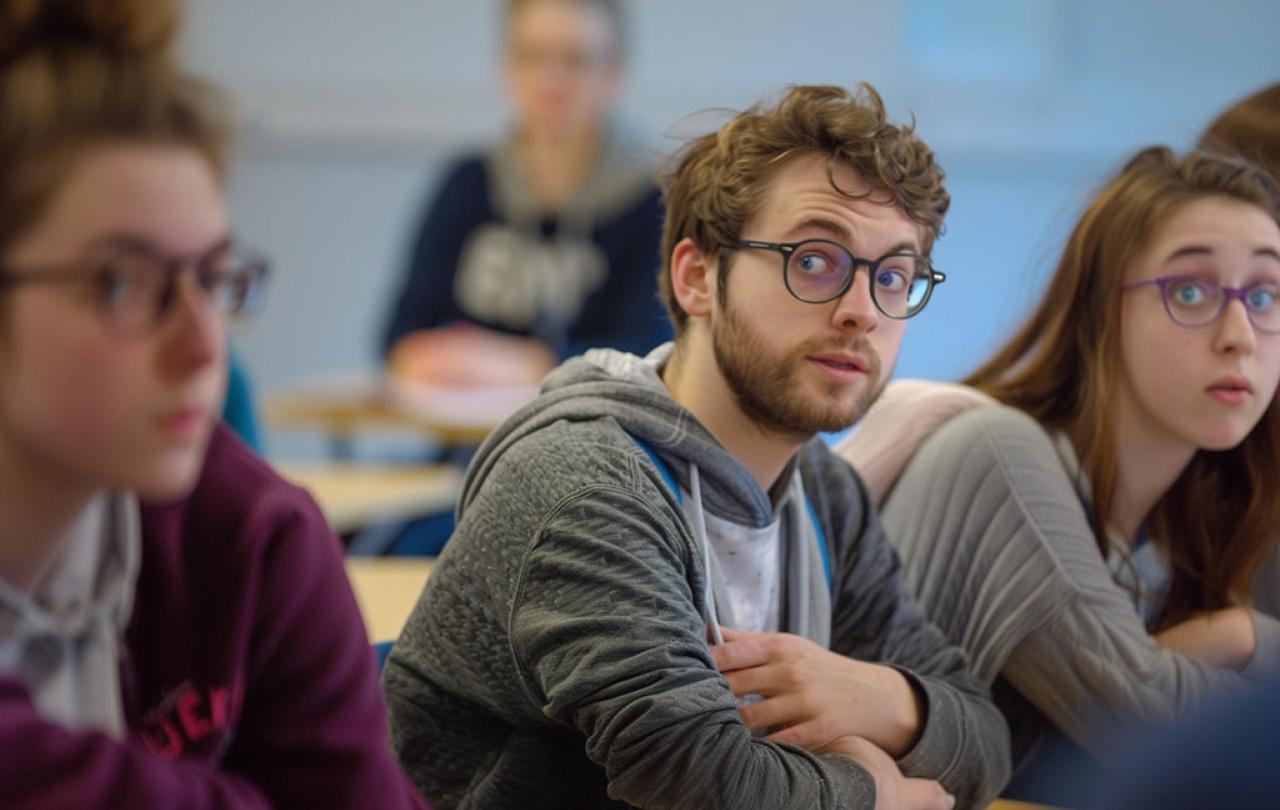
Quizzical-looking students look across a tutorial to others.
Nick Jones/Midjourney.ai.

It is late afternoon on a rainy Monday. My students mooch through the door, filling up the seats in our overheated, clinically modern tutorial room. They are a particularly young class this term – nearly all teenagers still. The setting feels entirely the wrong for poring over texts that are thousands of years old, texts written by some of the earliest Christians, now displayed on flashy laptops and smartphones.  

The first excerpt is short – part of a hand scribbled note by Ignatius of Antioch. He wrote it even as he was marched to his execution at the hands of the Romans.  

Suffer me, my brethren; hinder me not from living, do not wish me to die… Suffer me to receive the pure light; when I ­ shall have arrived ­ there, I ­ shall be a ­ human being.  

Ignatius shows no fear despite facing his impending martyrdom, I explain, because he goes to his death as one who was utterly convinced by the hope of resurrection. To him, death was life, and life was death.  

From the mixture of expressions on the faces around the room, I can easily tell which members of the class have attended Professor Behr’s lectures on this week’s material, and which members of the class have attended only to their mattresses and duvets. (‘Twas ever thus with undergraduates.) “Let’s look at Professor Behr’s own chapter on the subject,” I suggest, adding with a certain emphasis, “It was your required reading for this tutorial.”  

Reading Ignatius, along with some other texts from this period, Behr summarises the argument as follows: earthly life is a transitory thing, and driven by the fear of death, it becomes all too easy to focus on and hang on to this fleeting life. However, the Christian hope is that the self-sacrificing death of Christ, who gave up his life in the service of others, has transformed the reality of death. Death is no longer just the end of this life but the beginning of another one – a better, eternal life. And this, for each Christian, becomes the impetus to pursue one’s own journey towards self-sacrifice, towards laying down one’s earthly life for another, following in the example of Christ, just as Ignatius wished to do. Behr writes: 

“Through Christ’s having ‘changed the use of death’ we are able to change the ground of our existence from necessity and mortality to freedom and self-sacrificial love…”

I glance around the room. A few students seem mildly interested, some others are gazing at their screens, scrolling. Perhaps their curiosity has been piqued by the chapter that they are meant to have already read? More likely they have zoned out and are flicking through TikTok. One guy at the back stares glumly out of the window, mouth half open, the one next to him is dismantling a ballpoint pen.  

“Any thoughts?” I ask the room. Every pair of eyes is on me, and I know that there are thoughts – the silence is thick with them. 

A few moments later, however, and all their eyes are on me. Why? Because in the second part of his chapter, Behr takes this argument of self-sacrifice, of death to life, and uses it as a lens through which to examine the specific human phenomenon of marriage. I read out a few well-chosen excerpts – juicy ones that include the words “eros”, “sexuality” and even “ecstasy” – and it is no surprise that a room full of drowsy teenagers becomes somewhat more alert.  

It is through the natural human desire to be united with another person, argues Behr, that we are truly drawn out of ourselves, and by doing so we learn to give out of our own lives for the sake of the life of another. To commit one’s life and one’s body to another in marriage is the epitome of dying to self, even a kind of martyrdom. And, if marriage leads to parenthood, then the opportunity to live a life of self-sacrifice only increases. However hard it might be, those who are married, parenting, or both are driven by love to place the lives of their spouses and children before their own.  

  “Any thoughts?” I ask the room. Every pair of eyes is on me, and I know that there are thoughts – the silence is thick with them. But who will be brave? Patiently I stare them down. Eventually someone cracks, and a hand creeps up into the air.  

“Yes, go ahead…” I encourage.  

“Well… I think you should never be in a relationship where you have to do that!”  

“OK.” We’re off. “Never have to do what, exactly?”  

“Like, be expected to give up your life for someone else. Like, it’s your life. No one else has a right to ask for you to sacrifice yourself.” 

The conversation went on from there, the class getting more and more animated, a polemic against the idea that marriage, or just long-term relationships in general, should involve the sacrifice of one’s ‘self’. A spouse, they insisted, should be someone who affirms and celebrates everything that you are, and who supports you in whatever dreams or ambitions that you want chase. And children? Well, they should only be brought into the equation to fulfil your dreams, not to limit them. Marriage is many things, but it should not be a sacrifice, less still a martyrdom. 

Well, let us not be too hard on the optimism of youth. The optimism that imagines marriage and family life will be something that gives, and gives, and will never take anything away. How can they know – those who have never been awake at 3am with a projectile-vomiting toddler, and those who have never had to calmly negotiate over where all the money goes? It is the optimism of those who have never had to pass up on a job or an opportunity because it doesn’t fit in with the spouses’ promotion or the kids’ schooling. These, and a thousand other moments of self-sacrifice: the gritty realities of a daily choice to stick in a marriage (or any kind of long term relationship) and make it work.  

This is a much slower kind of martyrdom, a decision made not once but daily, in a society where such decisions are frequently undone. 

But is this gritty reality a giving up of life, or an embracing of it? Perhaps, like Ignatius, in this kind of death to self we actually find life. In a committed union, we carefully place our lives in the service of another, not because they expect us to, but because out of love we choose to. This is done, of course, in trust that the other person will do the same in return. There is no suggestion, either here or in Behr’s chapter, that someone should stay in a union where that placing of oneself is being merely used and abused. But where two people find a true mutuality in that laying down of self, well, love has funny way of making limits feel like a kind of freedom after all.   

“Hinder me not from living…” writes Ignatius, as he is marched to his certain death. His eyes were filled with the image of new self, a better self, that would come to him all at once and suddenly through the laying down of his life for what he believed in.  With a faith so strong, this may have been an easy kind of martyrdom – a decision made once, which could not, by him, be undone. But let us also hinder not those who choose to unite their lives to another. This is a much slower kind of martyrdom, a decision made not once but daily, in a society where such decisions are frequently undone. One day some of these young people will feel the call to this kind of death, and that in this death there is life. Hinder them not to die.  

Explainer
Belief
Books
Creed
Poetry
6 min read

Why a book? The words that change the world and me

Living by a literature that’s imbibed in countless cultures.

Belle is the staff writer at Seen & Unseen and co-host of its Re-enchanting podcast.

A man sits on a pier intently reading a book on his lap.
Ben White on Unsplash.

I have a belief system, a story that I live by, a lens through which I perceive the world. That doesn’t make me unusual or in any way different to you – we all have those, whether we’re aware of them or not. What may make me different to you is that mine are primarily explained to me through a book – or, more accurately, a library of sixty-six books – which we call the Bible. 

The story that I live by, that I breathe in and out, is bound. It sits within a cover, it moves through pages, it unfolds according to a contents page – it has genre, it has authors, it has punctuation.  

And I’ve never really found this odd. 

I think it’s because I’m what Charles Taylor would call a ‘storied creature’, my default is to make sense of the world on a largely imaginative level. I’m also quite romantic; poetically inclined, one could say. It sometimes feels as though words flow through my veins – if you were to cut me open, I may just bleed a puddle of my favourite Jane Austen monologues straight onto the floor. And so, my personality happens to lend itself spectacularly well to living my life according to a spiritual, sixty-six book wide, library. I’ve never really had to wrestle with the strangeness of such a thing, I’ve never sat down and stared the oddness of it in the eye, I’ve never even really asked myself (or God): why a book?  

I feel I should pause here, and offer a quick Rory Stewart-esque explainer, just so that we’re all on the same page.  

What I, and Christians through time and place, call the Bible is an anthology of sixty-six books, written by around forty authors, in three languages, over the span of 1,400-ish years. Within it, one can find poetry, narrative, apocalyptic literature, erotic literature, lists and figures, instructions and explanations. It is – year in and year out – the bestselling book in the world, with over 100 million copies sold or gifted each year. The New York Times Bestseller List actually omits it from its rundown, because otherwise it would always be so boringly there – sitting comfortably right at the top. No other book ever comes close. Words from this anthology of literature are graven into the floors and walls of the Houses of Parliament, they’re woven into almost every work of Shakespeare, they’re spray-painted clumsily onto billboards in the city I call home.  

And so, I guess, in one way, the answer to my question – why a book? – is all of that. The peculiar far-reaching resonance of the methodology speaks for itself. I think of Robin Williams’ impassioned monologue in Dead Poets Society… 

‘No matter what anybody tells you, words and ideas can change the world. We don't read and write poetry because it's cute. We read and write poetry because we are members of the human race. And the human race is filled with passion.’  

… And I get it. I understand why it was literature that was compiled, why language and words were the tool of choice. For better and for worse, biblical words and ideas have changed the world – they have been ‘the making of the western mind’, just ask Tom Holland. And so, pragmatically, one could argue that the Bible being a book (or a book of books) means that it has successfully imbedded itself in countless cultures, while also transcending them. It’s gone further, lasted longer, sunk deeper than any other form of communication could. Such is the power of words. 

But to stop my pondering there feels like I’d be stopping short. I’m not sure that a distant, pragmatic, academic answer is one that I feel satisfied with.  

So, this morning, I sat down with a cup of tea, a pen, my notebook, and a newfound curiosity - and I asked myself, and God, why a book?  

Why poetry?  

Why story?  

Why wordplay?  

Why have I – an educated, arguably disenchanted, most definitely left-brained, twenty-first century adult - been so willing to let these things mould my interior life? Why am I so moved by them? Moved to action, moved to tears, moved to rage. How can I read something that was written a millennia ago, in a part of the world I have never trod on, and somehow feel as if it is a love letter written exclusively to my own soul?  

I think that those are the real questions - the questions to which I have both a thousand and zero answers.  

And, like any work of literature, it does not give its meaning up easily – it requires me to sit with it, to excavate it, to gnaw on it like a dog with a bone. 

Zero answers, because I fundamentally think that it’s a spiritual thing, a God-designed thing, a thing that sits beyond any explanation I could piece together. The God that I believe exists wants me to know about him, wants me to learn and study, wants me to get glimpses of how thinks, how he works, he feels about me – and you. That’s a wild and wonderous thing. That reality leads me be stunned not only at the methodology, but the desire behind it, as St. Augustine wrote,  

‘the whole Bible does nothing but tell of God’s love’.  

And so, this literature, to me, is a source of truth, leaning into Iain McGilchrist’s inkling that,  

‘the fact that religions and mystical and spiritual traditions have always had to use language in a poetic way doesn’t mean that what they’re talking about is not real, it means it is ultimately real.’ 

The biblical literature uses words to take us to the edge of them.  

And, like any work of literature, it does not give its meaning up easily – it requires me to sit with it, to excavate it, to gnaw on it like a dog with a bone.  

Sometimes reading it feels like a balm on my heart, other times it feels like a wrestle in the dirt. But I guess that’s the beauty of it being a book, right? My worldview sits within a piece of literature that is adorned with my scribbles, tear stains, tea spills. A book that meets me every single day, ready to read me as I read it, giving my as many questions as it does answers. 

So, why a book? Because now that I think about it, it is odd. The powerful resonance of words for all cultures at all times, perhaps? Or the way that poetry was designed to make a bee line for the deepest parts of us? Or the fact that it is only through language that we can talk about the things that go beyond it?  

There are a thousand human-sized answers, if you really need them. I happen to enjoy the mystically-charged zero answers, myself.  

Celebrate our 2nd birthday!

Since Spring 2023, our readers have enjoyed over 1,000 articles. All for free. 
This is made possible through the generosity of our amazing community of supporters.

If you enjoy Seen & Unseen, would you consider making a gift towards our work?

Do so by joining Behind The Seen. Alongside other benefits, you’ll receive an extra fortnightly email from me sharing my reading and reflections on the ideas that are shaping our times.

Graham Tomlin
Editor-in-Chief