
Article
Character
Creed
Romance
6 min read

‘Marriage is martyrdom', seriously?

Arguing relationship requires sacrifice ignites a sleepy tutorial.
Quizzical-looking students look across a tutorial to others.
Nick Jones/Midjourney.ai.

It is late afternoon on a rainy Monday. My students mooch through the door, filling up the seats in our overheated, clinically modern tutorial room. They are a particularly young class this term – nearly all teenagers still. The setting feels entirely the wrong for poring over texts that are thousands of years old, texts written by some of the earliest Christians, now displayed on flashy laptops and smartphones.  

The first excerpt is short – part of a hand scribbled note by Ignatius of Antioch. He wrote it even as he was marched to his execution at the hands of the Romans.  

Suffer me, my brethren; hinder me not from living, do not wish me to die… Suffer me to receive the pure light; when I ­ shall have arrived ­ there, I ­ shall be a ­ human being.  

Ignatius shows no fear despite facing his impending martyrdom, I explain, because he goes to his death as one who was utterly convinced by the hope of resurrection. To him, death was life, and life was death.  

From the mixture of expressions on the faces around the room, I can easily tell which members of the class have attended Professor Behr’s lectures on this week’s material, and which members of the class have attended only to their mattresses and duvets. (‘Twas ever thus with undergraduates.) “Let’s look at Professor Behr’s own chapter on the subject,” I suggest, adding with a certain emphasis, “It was your required reading for this tutorial.”  

Reading Ignatius, along with some other texts from this period, Behr summarises the argument as follows: earthly life is a transitory thing, and driven by the fear of death, it becomes all too easy to focus on and hang on to this fleeting life. However, the Christian hope is that the self-sacrificing death of Christ, who gave up his life in the service of others, has transformed the reality of death. Death is no longer just the end of this life but the beginning of another one – a better, eternal life. And this, for each Christian, becomes the impetus to pursue one’s own journey towards self-sacrifice, towards laying down one’s earthly life for another, following in the example of Christ, just as Ignatius wished to do. Behr writes: 

“Through Christ’s having ‘changed the use of death’ we are able to change the ground of our existence from necessity and mortality to freedom and self-sacrificial love…”

I glance around the room. A few students seem mildly interested, some others are gazing at their screens, scrolling. Perhaps their curiosity has been piqued by the chapter that they are meant to have already read? More likely they have zoned out and are flicking through TikTok. One guy at the back stares glumly out of the window, mouth half open, the one next to him is dismantling a ballpoint pen.  

“Any thoughts?” I ask the room. Every pair of eyes is on me, and I know that there are thoughts – the silence is thick with them. 

A few moments later, however, and all their eyes are on me. Why? Because in the second part of his chapter, Behr takes this argument of self-sacrifice, of death to life, and uses it as a lens through which to examine the specific human phenomenon of marriage. I read out a few well-chosen excerpts – juicy ones that include the words “eros”, “sexuality” and even “ecstasy” – and it is no surprise that a room full of drowsy teenagers becomes somewhat more alert.  

It is through the natural human desire to be united with another person, argues Behr, that we are truly drawn out of ourselves, and by doing so we learn to give out of our own lives for the sake of the life of another. To commit one’s life and one’s body to another in marriage is the epitome of dying to self, even a kind of martyrdom. And, if marriage leads to parenthood, then the opportunity to live a life of self-sacrifice only increases. However hard it might be, those who are married, parenting, or both are driven by love to place the lives of their spouses and children before their own.  

  “Any thoughts?” I ask the room. Every pair of eyes is on me, and I know that there are thoughts – the silence is thick with them. But who will be brave? Patiently I stare them down. Eventually someone cracks, and a hand creeps up into the air.  

“Yes, go ahead…” I encourage.  

“Well… I think you should never be in a relationship where you have to do that!”  

“OK.” We’re off. “Never have to do what, exactly?”  

“Like, be expected to give up your life for someone else. Like, it’s your life. No one else has a right to ask for you to sacrifice yourself.” 

The conversation went on from there, the class getting more and more animated, a polemic against the idea that marriage, or just long-term relationships in general, should involve the sacrifice of one’s ‘self’. A spouse, they insisted, should be someone who affirms and celebrates everything that you are, and who supports you in whatever dreams or ambitions that you want chase. And children? Well, they should only be brought into the equation to fulfil your dreams, not to limit them. Marriage is many things, but it should not be a sacrifice, less still a martyrdom. 

Well, let us not be too hard on the optimism of youth. The optimism that imagines marriage and family life will be something that gives, and gives, and will never take anything away. How can they know – those who have never been awake at 3am with a projectile-vomiting toddler, and those who have never had to calmly negotiate over where all the money goes? It is the optimism of those who have never had to pass up on a job or an opportunity because it doesn’t fit in with the spouses’ promotion or the kids’ schooling. These, and a thousand other moments of self-sacrifice: the gritty realities of a daily choice to stick in a marriage (or any kind of long term relationship) and make it work.  

This is a much slower kind of martyrdom, a decision made not once but daily, in a society where such decisions are frequently undone. 

But is this gritty reality a giving up of life, or an embracing of it? Perhaps, like Ignatius, in this kind of death to self we actually find life. In a committed union, we carefully place our lives in the service of another, not because they expect us to, but because out of love we choose to. This is done, of course, in trust that the other person will do the same in return. There is no suggestion, either here or in Behr’s chapter, that someone should stay in a union where that placing of oneself is being merely used and abused. But where two people find a true mutuality in that laying down of self, well, love has funny way of making limits feel like a kind of freedom after all.   

“Hinder me not from living…” writes Ignatius, as he is marched to his certain death. His eyes were filled with the image of new self, a better self, that would come to him all at once and suddenly through the laying down of his life for what he believed in.  With a faith so strong, this may have been an easy kind of martyrdom – a decision made once, which could not, by him, be undone. But let us also hinder not those who choose to unite their lives to another. This is a much slower kind of martyrdom, a decision made not once but daily, in a society where such decisions are frequently undone. One day some of these young people will feel the call to this kind of death, and that in this death there is life. Hinder them not to die.  
Explainer
Creed
Leading
Politics
6 min read

Why is it taking so long to find an Archbishop of Canterbury?

The Anglican tortoise and the Catholic hare.

Graham is the Director of the Centre for Cultural Witness and a former Bishop of Kensington.

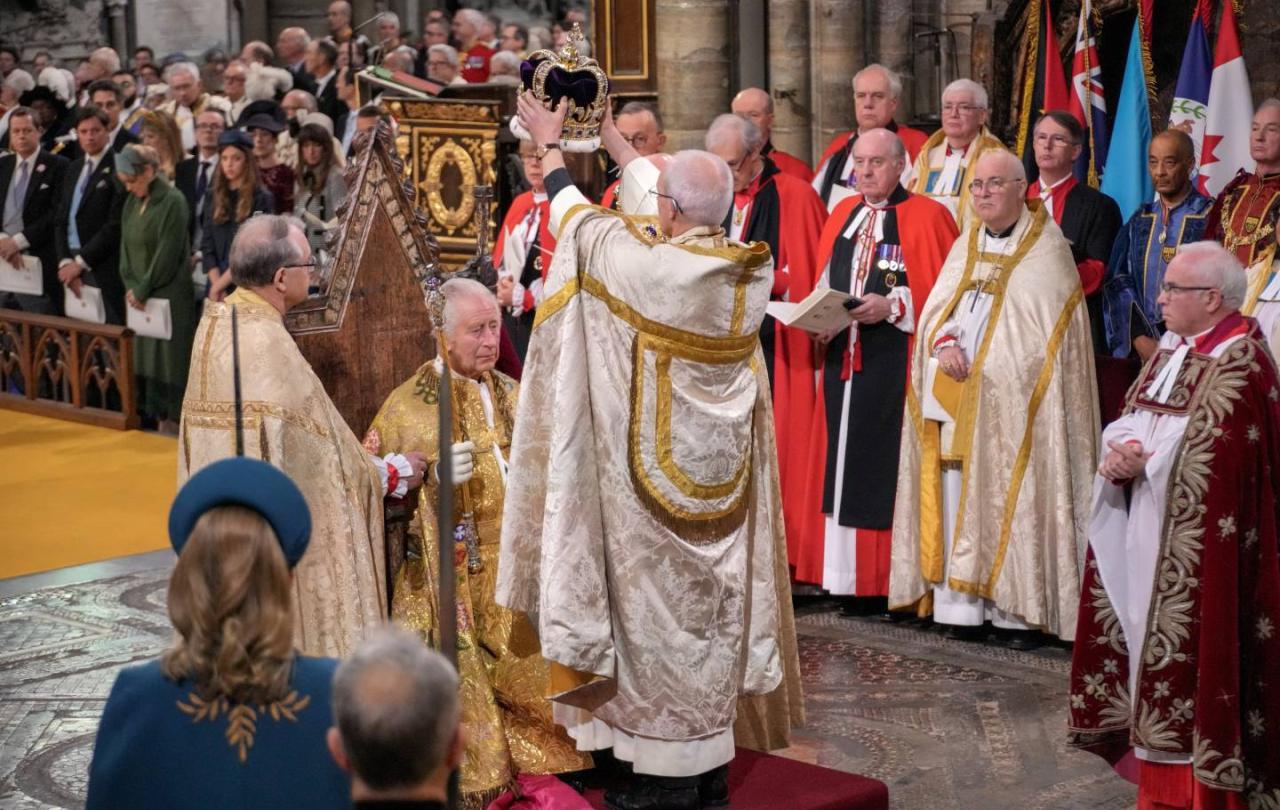
An archbishop raises a crown about the head of King Charles.
An archbishop in action at the 2024 Coronation.

It seems the Roman Catholics have put the Anglicans to shame by the speed with which they have managed to appoint a new Pope. Pope Francis died on Easter Monday, 21 April. Pope Leo was elected on the 8 May. Seventeen days. Pretty impressive. Very few large corporations would replace a CEO in that time, or nations elect a new leader.  

Justin Welby, however, resigned on the 12 November 2024. We won't know the name of his successor until the autumn, and that person won't start in place until the spring of 2026. Well over a year.  

The Church of England is playing the tortoise while the Roman Catholics are acting the hare. 

So why is it taking so long? Is this just fusty Anglican bureaucracy? A depressing instance of Anglicans taking ages over everything, whether sorting out our divisions over sexuality or choosing a new Archbishop? 

As always, there is more to this than meets the eye.  

The first thing to say is, of course, that events took everyone by surprise. Justin Welby would have had to retire before his 70th birthday in January 2026, and the assumption had been that he would announce the date at some point before then. A process was already in place to make the appointment so that a successor could be named before he departed and start soon after, as usually happens. No-one foresaw the events that led to Welby’s surprise resignation over his handling of the abuse committed by John Smyth, outlined in the Makin Review. In the usual course of things, there would have been a relatively smooth handover. What we have is unprecedented – a year with no Archbishop of Canterbury at all.  

There is, of course, the shambles at the Canterbury end, where the diocese has taken three abortive goes at electing their representatives for the body that makes the appointment, the Crown Nominations Commission. More on that here, but even that has not had a significant effect on the timetable, which is following its predicted course, despite bumps along the way. 

Even so, many will say, could the system not have been hurried up? Maybe so, and it might have been wise to find ways to hasten the process a little, but the more fundamental answer is that’s not the way the Church of England works and never has.  

The biggest reason is that the Church of England and the Roman Catholic churches have different understandings of what the Church is and how it is governed. In short, the Archbishop of Canterbury is not the Anglican equivalent of a Pope. 

Back in the days of the English Reformation, after Henry VIII’s ego-driven separation from Rome, which enabled him to divorce his wife who was unable to give him a male heir, and marry the younger and prettier Anne Boleyn, the English church found a kind of settlement under Queen Elizabeth I, several generations later. This proposed that the ‘Supreme Governor’ of the Church of England was not to be the Archbishop of Canterbury but the Monarch. It was a way of expressing the idea that the Church of England is the Church of the people of England. It was the people of England at prayer. ‘We hold,' said Richard Hooker, the great architect of this vision, ‘that… there is not any man of the Church of England but the same man is also a member of the commonwealth.’ 

If you are a citizen of England, you have a right to be also part of the Church of England – to have your children baptised (once the vicar is sure you know what you’re letting yourself and your child in for), your marriage solemnised, and your body buried in the national church. The Church - although in a local sense is gathered group of Christians who attend public worship - exists for the people of England, whether or not they go to church regularly or not. 

Because the Church of England is the church of the people of England, a much larger group of people need to be involved when an Archbishop of Canterbury is chosen. So far, there has been a wide period of consultation, involving the remarkable figure of 11,000 people who have given input – far more than most consultations of this kind. Moreover, the group that appoints the Archbishop is made up, not just of bishops, but lay people, priests, men, women, people representing the diocese of Canterbury, five representatives of the global Anglican Communion, others representing the national Church and so on.  

The Church of England in that sense, is no respecter of persons, and refuses to treat the Archbishop as a Pope or a CEO.

For Roman Catholics, the church centres much more around its bishops. So, when it comes to choosing their leader, it makes sense to simply put all the cardinals (the most senior figures in the Catholic Church) in a room until they come up with a name from among themselves. Anglicans have a much longer, messier, more democratic process. It is not an election by a majority vote from a small electorate quickly convened, choosing among themselves, but a process of listening to a wide range of voices, both inside and outside the church.  

Because he is not a pope, the Archbishop of Canterbury is in one sense, just another bishop (the next one may be a woman, but all Archbishops so far have been men). Yes of course, he’s an Archbishop, so higher profile than the others, but he is nonetheless a bishop who takes his place among the other bishops of the CofE. Archbishops of Canterbury are regarded with respect and honour by other CofE bishops and Archbishops around the worldwide Anglican Communion, as the (Arch)bishop of the first ‘Anglican’ church – Canterbury. Yet they have no legal jurisdiction at all outside England – or even outside their own Province of Canterbury in the southern half of England. He is not the ‘spiritual leader’ of Anglicans all over the world, like the Pope is for Roman Catholics.  

As such, to put it bluntly, his appointment must take its turn among all the others in the queue. The Crown Nominations Commission is made up of people for whom this is not their day job, who give their spare time to it, and who have a programme of episcopal appointments to be made - the next in the queue are St Edmundsbury & Ipswich and then Worcester.  Canterbury has to take its turn. To enable this one to jump the queue would be saying something that Anglicans have never said - that this role is much more important than any of the others and must be given special treatment. The Church of England in that sense, is no respecter of persons, and refuses to treat the Archbishop as a Pope or a CEO, without whom the church would fall apart. 

The reason the Church of England can survive without an Archbishop of Canterbury for a while, is because its life is not dependent on a central figure, a charismatic leader, or a head office which issues instructions for all the branches to obediently follow. That may work in McDonalds but doesn’t work in the Church of England. The life of the Church of England is in its parishes and dioceses, which carry on doing their thing, even when an Archbishop of Canterbury is not available.  

Of course, it might have been possible to speed it up a little. We have missed having an Archbishop speaking in to public life and providing a lead at the national level. But there are good reasons for taking time. And it’s not just inefficiency – it’s because the Church is made up of ordinary Christians, who all deserve a say – and that takes time.  

Celebrate our 2nd birthday!

Since Spring 2023, our readers have enjoyed over 1,000 articles. All for free. 
This is made possible through the generosity of our amazing community of supporters.

If you enjoy Seen & Unseen, would you consider making a gift towards our work?

Do so by joining Behind The Seen. Alongside other benefits, you’ll receive an extra fortnightly email from me sharing my reading and reflections on the ideas that are shaping our times.

Graham Tomlin
Editor-in-Chief