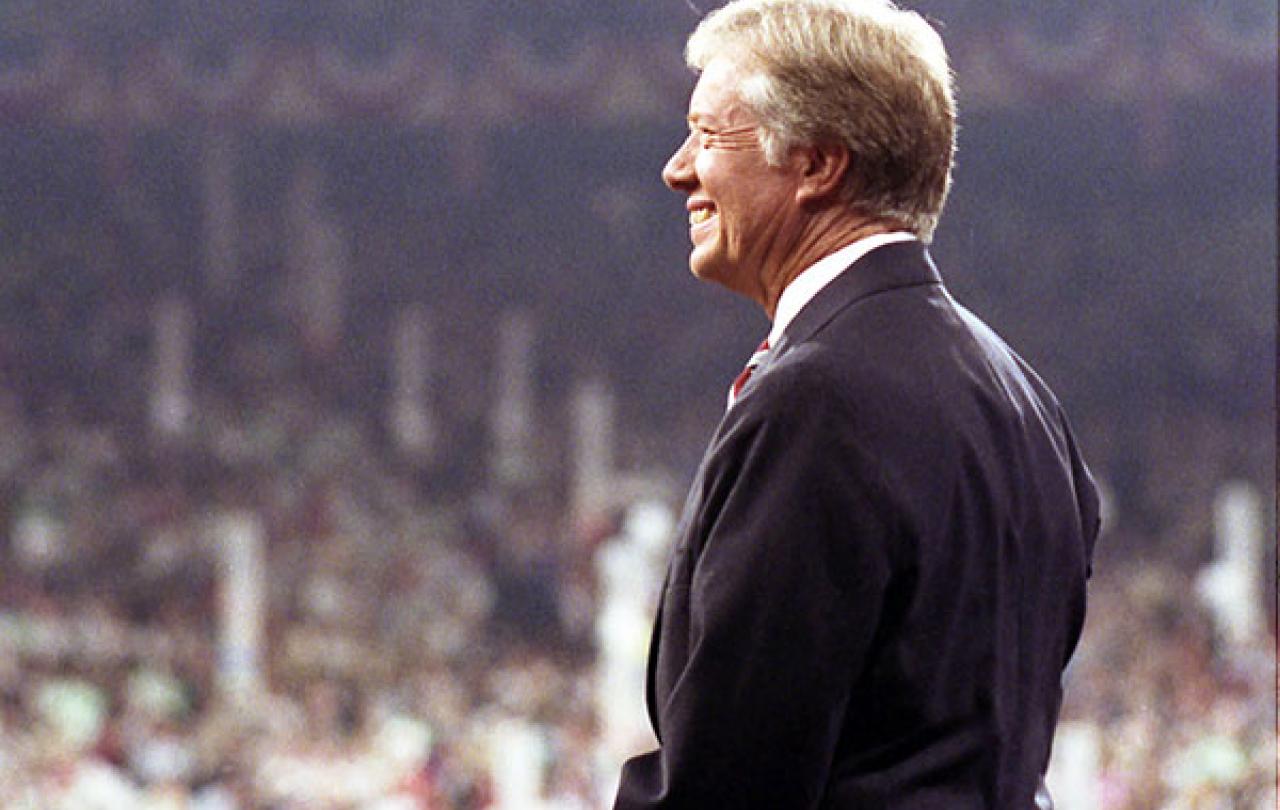
The year was 2014. Jimmy Carter was writing his concluding remarks for a new book of reflections to mark his 90th birthday. He and Rosalynn had already been married over 68 years. He wrote:
“The life we have now is the best of all. … We are blessed with good health and look to the future with eagerness and confidence, but are prepared for inevitable adversity when it comes.”
Amazing.
Of course, I am partial when it comes to Jimmy Carter. He was one of a small handful of people who I’ve found to be genuinely inspirational. Here was a man who seemed to epitomise decency, hard work, public service and humility.
Yet his failure to be elected for a second presidential term led to him leaving the White House to calls of derision and a common assessment that he was, ‘the worst president ever!’ By contrast, his subsequent work as a peacemaker, housebuilder and humanitarian was exemplary.
Since his death on December 29 a great deal has been written. From factual obituaries to celebratory eulogies the column inches have been vast. The tributes have been fulsome.
“He was a committed public servant, and devoted his life to promoting peace and human rights. His dedication and humility served as an inspiration to many, and I remember with great fondness his visit to the United Kingdom in 1977.”
King Charles
“… he taught all of us what it means to live a life of grace, dignity, justice, and service.”
Barak Obama.
“… he truly loved and respected our Country, and all it stands for. He worked hard to make America a better place, and for that I give him my highest respect.”
Donald Trump
In more recent years his time in office has been subject to a re-evaluation. His presidency in no longer seen as the debacle of a ‘hapless and weak’ leader that it was caricatured as for so long. Not given to short-termism and often ahead of his time, as Stuart Eizenstat wrote in 2018, ‘[he] delivered results, many of which were realized only after he left office.’
So, what are the lessons that Jimmy Carter’s life can offer budding politicians and, indeed, the rest of us too? What is there to be learnt from this life well-lived in which Playboy Magazine, the Guinea Worm and a ‘killer rabbit’ all feature?
Here are five takeaways from Carter’s life and experience.
# 1. You can never control what happens
There is an apocryphal story in which a journalist asks Prime Minister Harold Macmillan what the most difficult thing was about running the country. Macmillan’s insightful, if fictional, response was genius, ‘Events, dear boy, events!’
In many ways Carter’s election to the White House was clearly a reaction against the events that had engulfed the previous administration. He was very definitely not ‘Tricky Dicky’ Richard Nixon. Yet it was to be events that undermined his presidency.
From double-digit inflation of over twenty per cent to the oil crisis and the soaring price of fuel following the Iranian revolution, the economy was not in good shape. His policy was ridiculed as ‘stag-flation’ (low growth, high inflation) and the experience of ‘gasoline lines’ alienated many who had supported him.
The nation’s anxieties about energy were only further heightened by the Three Mile Island nuclear accident in 1979.
In many ways Carter was ahead of his time on environmental issues. He had solar panels installed on the White House roof. His successor, Ronald Reagan, had them removed.
Then, when an Iranian mob seized the US embassy in Tehran and 52 Americans were held hostage for 444 days, the clamour was for something to be done. The attempted rescue mission was an unmitigated disaster. Two aircraft collided on the ground in the Iranian desert and eight service personnel were killed.
It all added to the narrative that Carter was not up to the job.
He was president at a particularly difficult moment of history and was himself a hostage to events. Sometimes you can do your very best, make the best calls available to you and still lose.
Part of the reassessment of his time in power is that his economic strategy did work, it was just that Reagan benefited from it.
It is also believed that there were politics involved in the timing of the release of the hostages from Iran. Carter had completed the negotiations, but their release on January 20, 1981, minutes after Reagan’s inauguration was certainly no coincidence.
#2. Honesty is the best policy
During his presidential campaign in 1976, Carter famously pledged:
“If I ever lie to you, if I ever make a misleading statement, don’t vote for me. I would not deserve to be your president.”
There is no doubt that Carter’s reputation for speaking the truth underpinned many of his administration’s successes.
The Camp David accords brought an enduring peace between Israel and Egypt. His role as a trusted, truth-telling mediator for their leaders was pivotal for the process. It also anticipated much of his post-presidential work that ultimately led to his being awarded the Nobel Peace Prize in 2002. The Nobel citation lauded him for:
“… his decades of untiring effort to find peaceful solutions to international conflicts, to advance democracy and human rights, and to promote economic and social development.”
Carter, however, also learned that truth-telling was also a double-edged sword. In his first presidential campaign he did an extended interview with Playboy magazine. The interviewer raised the concern that some voters were uneasy about his religious beliefs and feared he would be an unbending moralist. Carter attempted to say that he was no better than anyone else. He confessed:
“I’ve looked on a lot of women with lust in my heart. I’ve committed adultery in my heart many times. This is something God recognizes I will do – and I have done it – and God forgives me for it.”
On the TV Saturday Night Live mocked him; secular pundits painted him as a ‘redneck Baptist with a hotline to God’, while Conservative Christians questioned whether he had the moral character to lead the country having granted an interview to such a salacious publication.
Then, while in office in 1979, concerned about the mood of the country, he held intense discussions with a cross-section of guests at Camp David to help address the situation. It resulted in a speech where he talked about the “crisis of the American spirit”. He suggested, “we are at a turning point in our history” and warned against choosing
“… the path that leads to fragmentation and self-interest. Down that road lies a mistaken idea of freedom, the right to grasp for ourselves some advantage over others. That path would be one of constant conflict between narrow interests ending in chaos and immobility. It is a certain route to failure.”
Initially well received, media coverage quickly turned it against Carter. They maintained he was blaming the American people for the failings of his own administration. They labelled it ‘the malaise speech’’. Now political pundits see its forewarning of political paralysis and fragmentation as ‘prescient’.
Over the decades Carter’s commitment to tell the truth has borne fruit. Truthful consistency over the years established a secure foundation for trust. Such trust has then provided the opportunity to work for good outcomes in difficult, dangerous and demanding situations.
#3. ‘All people are equal’
Carter grew up in relative poverty with no running water or electricity in Archery, Georgia. His mother was the community midwife, and his father farmed. Of the 200 residents only two families were white. The boys he played with and worked with were all African American.
In his 1971 inaugural address as Governor of Georgia, he made his stance and agenda abundantly clear:
“I say to you quite frankly that the time for racial discrimination is over.”
This was no mere sloganeering or political positioning. As governor he appointed more minorities and women to state government positions than all of his predecessors combined. This was a habit he continued as president appointing a then-record number to federal posts.
Civil rights activist, Andrew Young, said of Carter:
“All the liberals I had worked with got nervous in a room full of Black people, and Jimmy Carter didn’t”
#4. Reputation is about character, legacy is the result of hard work
It is a wonder that any politician aspires to high office. The attention of the media is relentless and their scrutiny forensic: mistakes are highlighted, misjudgements castigated and personal flaws relentlessly scorned.
Carter never courted the media, and they did him no favours. When he left the White House after his landslide defeat to Reagan, his standing and reputation were shot. But he did not take up lucrative opportunities in industry or the world of celebrity. Rather, through the Carter Center he established in Atlanta, he set about his peace-making and humanitarian work under the banner of ‘Waging Peace. Fighting Disease. Building Hope’.
The work accomplished is impressive from the monitoring of 125 elections in 40 countries to their leadership of a coalition of agencies committed to the eradication of the Guinea Worm parasite. With the latter, the 3.5 million cases reported each year in the 1980s, by 2023 had fallen to a mere 14. As James Fallows observed in The Atlantic:
“… as unglamourous as it sounds, [it] represents an increase in human well-being greater than most leaders have achieved.”
For over 40 years since leaving the White House, Carter put in the hard yards. His consistency of character, integrity and respect for others have ensured his reputation as well as his legacy. As Rolling Stone headlined in their obituary,
“the 39th president will be remembered for his extraordinary decency and philanthropic legacy.”
#5. A moral centre
Jimmy Carter was clear about how his faith defined, motivated and sustained him.
Speaking to a convention of Methodists he shared:
“I am a peanut farmer and a Christian. I am a father, and I am a Christian. I am a businessman and a Christian. I am a politician and a Christian. The single most important factor in my own life is Jesus Christ.”
It was his grasp of the message of Jesus that inspired and animated his life of service. It was his faith relationship with Jesus that nourished and energised him.
On another occasion he was quite clear:
“My faith demands — this is not optional — my faith demands that I do whatever I can, wherever I am, whenever I can, for as long as I can, with whatever I have to try to make a difference.”
That just leaves the tale of the ‘killer rabbit’.
While out fishing in 1979 a swamp rabbit began swimming toward his boat. Taking an oar, Carter chased the creature off with a few flicks of water. It was the sort of stupidly trivial incident that no one involved would ever normally remember – until the press got hold of it. The Washington Post ran the headline “President Attacked by Rabbit” along with a cartoon entitled “PAWS”, parodying the hit movie “JAWS”.
The story was a PR nightmare and was milked by a hostile press for a week. It reinforced their narrative of Carter as a helpless laughingstock, a bumbler flailing around and not up to the task.
The story was a cheap shot. But Carter appeared not to have been left bitter about it. When his biographer Jonathan Alter raised the story for discussion, “He smiled ruefully.”
Jimmy Carter (1924-2024). As his friend Bob Dylan said:
“He was a kindred spirit to me of a rare kind. The kind of man you don’t meet every day, and that you’re lucky to meet if you ever do.”
Join with us - Behind the Seen
Seen & Unseen is free for everyone and is made possible through the generosity of our amazing community of supporters.
If you’re enjoying Seen & Unseen, would you consider making a gift towards our work?
Alongside other benefits (book discounts etc.), you’ll receive an extra fortnightly email from me sharing what I’m reading and my reflections on the ideas that are shaping our times.
Graham Tomlin
Editor-in-Chief