


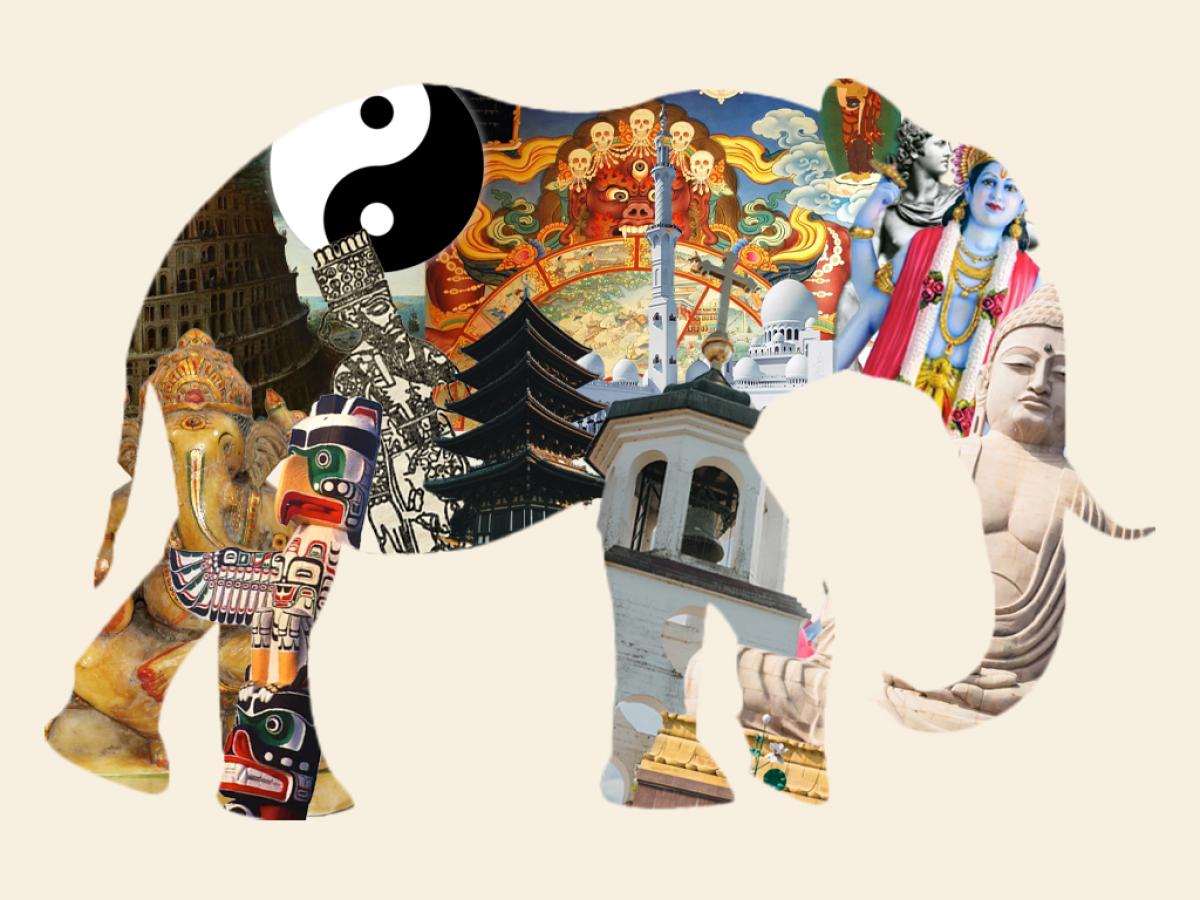
Elephants on mountain tops: thinking better about religious pluralism
In the first of a short series on pluralism, philosopher Barnabas Aspray explores the key questions about different beliefs.
9 min read
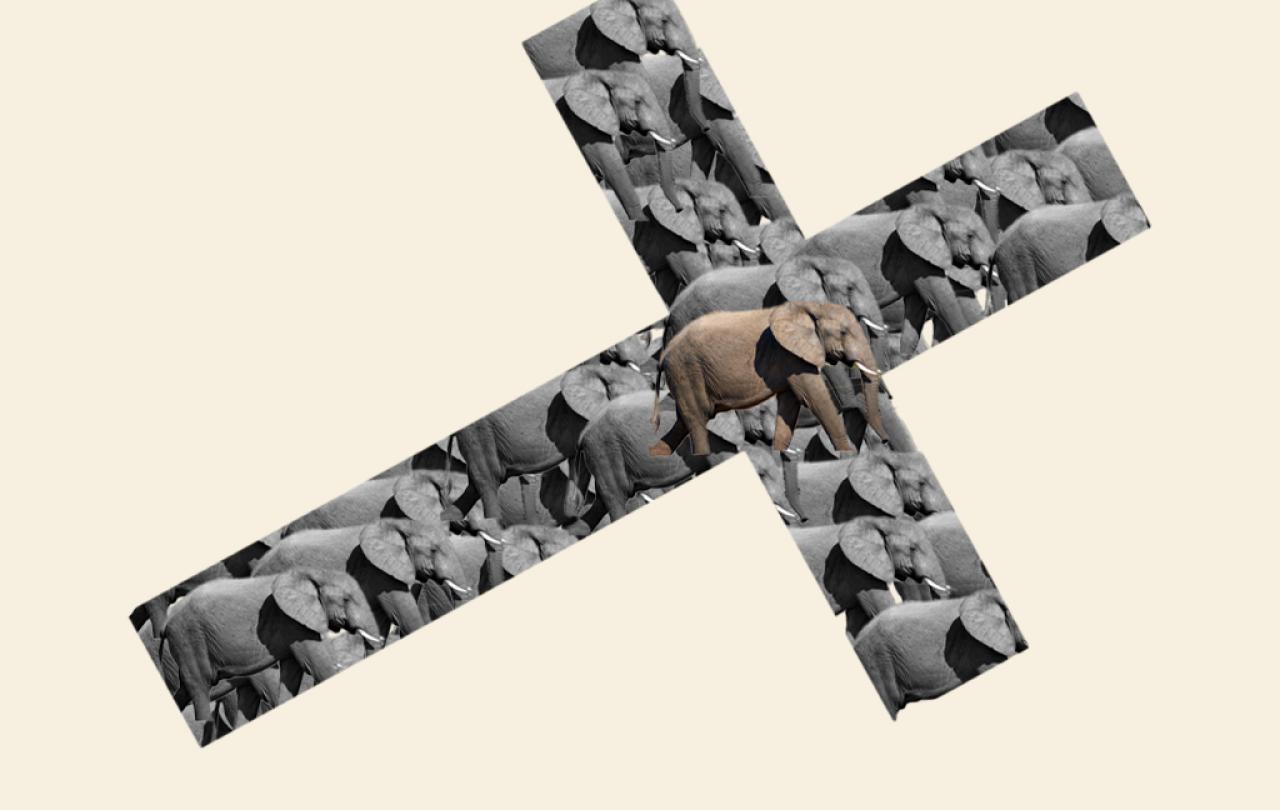
If Christianity is right, are all other religions wrong?
What is a Christian way to think about other religions? In the first part of this series, we established that there is no neutral standard or standpoint, and that we must always judge religions in light of some ultimate truth-commitment, even if for some that is only oneself. We must give up any pretence at the possibility of objectivity, or else we would be guilty of self-contradiction. Therefore, what I am now going to offer is a Christian approach to religious pluralism, with the caveat that it is not the only possible one and many Christians may disagree with it.
To be a Christian means to make Jesus Christ the ultimate standard of judgment and the light by which to discern truth from falsehood, good from evil. Jesus said, ‘I am the way and the truth and the life. No one comes to the Father except through me’ (John 14:6). Paul concurred: ‘there is one God, and there is one mediator between God and humankind, Christ Jesus’ (1 Tim 2:5). In other words, Jesus demanded absolute and total allegiance, and claimed to be the ultimate source of truth and spiritual guidance. He did not claim to be merely another wise teacher like Socrates, Confucius, or Mencius, whose sayings are followed because they make sense to the listener or because of the reputation of the speaker. Jesus wanted, not just to offer wisdom, but to invite us to leave everything and follow him, to submit to him as our master above all other masters.
The first point about this claim of Jesus is that it is far from strange or unique. The founder of every major world religion made similar claims about themself as the ultimate guide to truth. For example, Sri Krishna said, ‘I am the goal of the wise man, and I am the way. ... I am the end of the path, the witness, the Lord, the sustainer. I am the place of abode, the beginning, the friend and the refuge. ... If you set your heart upon me thus, and take me for your ideal above all others, you will come into my Being.’ Similarly, the Buddha said, ‘You are my children, I am your father; through me you have been released from your sufferings. ... My thoughts are always in the truth, for Lo! my self has become the truth.’ If Jesus had not claimed ultimacy for himself, he would not have founded a religion the way I am using the word (recall in the first part of this series, where I defined a religion as one’s commitment to what is ultimate).
Some people think that Jesus’ claim to ultimacy means that to follow Jesus means to believe all other religions are wrong. But this is a mistake. Jesus is claiming, not that you can find truth nowhere else, but that he is the ultimate authority or paradigm through which we view the world, to help us see what is true and what is false elsewhere. If Jesus is the truth, this in no way implies that every other religion is all lies or wrong from beginning to end. How could they be, when they agree on so much? It is a strange feature of the modern way of thinking that it loves to posit radical ‘either/or’ alternatives, without seeing the overlap, the layers, the inclusiveness of one thing in another, and the deeper synthesis which reconciles surface-level contradictions. A Christian perspective does not require believing that other religions are lies, but that they only have part of the truth where Jesus has it all. There is all the difference in the world between believing a lie, and believing only part of the truth. Let’s consider some of the other world religions. For a start, to be a Christian automatically implies agreeing with Judaism on a huge amount. Insofar as Judaism denies Jesus as the Messiah, there is a conflict. But this is not a positive belief of Judaism, only an absence where Christianity claims a presence. Similarly, for Christians to consider Islam ‘totally wrong’ is a massive failure of perspective, an inability to notice the enormous overlap Christians have with Muslims, not only on the One Transcendent Creator God, but on all kinds of ethical issues, prayer, worship, fasting and so on. Something similar applies to Hinduism, which is often mistakenly considered polytheistic only because of its reverent denial of the conceivability of Transcendence, from which some Christians would do well to learn. To notice first what we disagree on and let that obscure all the common ground is a failure of charity and graciousness, which makes it a fundamentally unchristian attitude.
There is all the difference in the world, as well, between calling Jesus the truth and calling Christianity a complete explanation for everything, as if Christians understood Jesus completely and had nothing more to learn. To believe in Jesus is not to understand even Christianity in all its fullness, let alone the ways in which Jesus is manifest dimly through cultures that have never heard of him, or who have heard of him only as a symbol of Western imperialism. St Paul says that for Christians, Christ is ‘before all things, and in him all things hold together’. That means everything has contact with Christ simply by being a thing, by existing. The apostle John writes: ‘All things came into being through him [the Word], and without him not one thing came into being. What has come into being in him was life, and the life was the light of all people’. So if anyone has life, they have their being in Christ, and the light of Christ reveals at least some truth to them.
For Christians, Christ is the fullness of the truth, and all else is only part of the truth. But Christians still have only part of the truth, because their knowledge of Christ remains incomplete and imperfect. Why could another religion not reveal something of Christ, as long as it didn’t contradict the trusted revelation of Christ in the Bible? How would we know, unless we took the time to listen and learn about other religions, without fear, without defensiveness, without needing to prove things or score points in an argument, also without compromising the ultimate authority of Christ as the supreme judge? Throughout the history of Judeo-Christian religion, the true insights of ‘outsiders’ have been accepted and become part of the faith of ‘insiders’. The Bible’s Book of Proverbs has chapters 22-24 lifted from Egyptian literature. The ideas of circumcision, a sacred temple, and a divinely appointed king all originated from practices in the surrounding nations, adopted and sanctified by Israel. St Paul quotes Greek poets as speaking truth about God. Justin Martyr recognised truths taught by Plato which enlarged the Christian understanding of God and the world. His maxim, “all truth wherever it is found belongs to us as Christians,” summarises the generous attitude Christians ought always to have in their search for wisdom and truth, without ever watering down the fullness of the truth in Christ.
Concluding thoughts for those on a journey
We cannot expect all religious people in the world to come to agreement quickly and without great labour of understanding, love, and forgiveness. In the meantime, I propose the following attitudes for everyone, whether Christian or not, who acknowledges their own limited and non-objective perspective and yet is serious about the quest for ultimate reality.
Provisionality: faith is a journey, truth is a destination. To call it ‘faith’ means that it is not certain, that it is provisional, that it can grow and change. Everything you believe is always provisional. Never say ‘I will never change my mind on this’ because you do not know the future. This is particularly true for Christians. Rowan Williams describes Christianity as a basic life commitment which one takes before having all of the facts and evidence. In other words, to be a Christian means to be betting your entire life that following Jesus is the best way to live. You can’t prove this, you can’t be certain of this. You can’t even evaluate its likelihood from any neutral or objective standpoint. But you only have one life, and how you spend it will be your bet.
Authenticity: live your beliefs to the max. That is the only way you may find them to be false, or the only way others will be attracted to them if they are true. Much of the confusion in the world is a result of hypocrisy. Do not add to it. Learn also to articulate your own beliefs clearly to yourself and others. This means getting to know them by diligent study.
Empathy: learn to see the world from other points of view. In 2017 the world’s top religious leaders issued a joint appeal: “make friends with followers of other religions.” Some people say there is too much talk and not enough action in the world. I say there is not enough real dialogue, not enough listening, which implies someone is talking. No harm can be done to anyone’s faith by listening, seeking to understand, not prejudging. And for Christians, it is a requirement, not an optional extra, because it is the basis of love. True tolerance, as John Dickson puts it, isn’t the easy acceptance of every viewpoint but the noble ability to love those with whom we deeply disagree.
Hope: the truth gives itself to be known. The universe does not fundamentally lead astray those who seek the truth with all their heart. This cannot be proven. That is why it is called hope. But certainty is not a luxury granted to anyone. You only have a choice between hope or despair, i.e. hope or its absence. Neither option makes more rational sense than the other, yet as life-attitudes they pervade your every choice and belief. Which one will you adopt as your own?
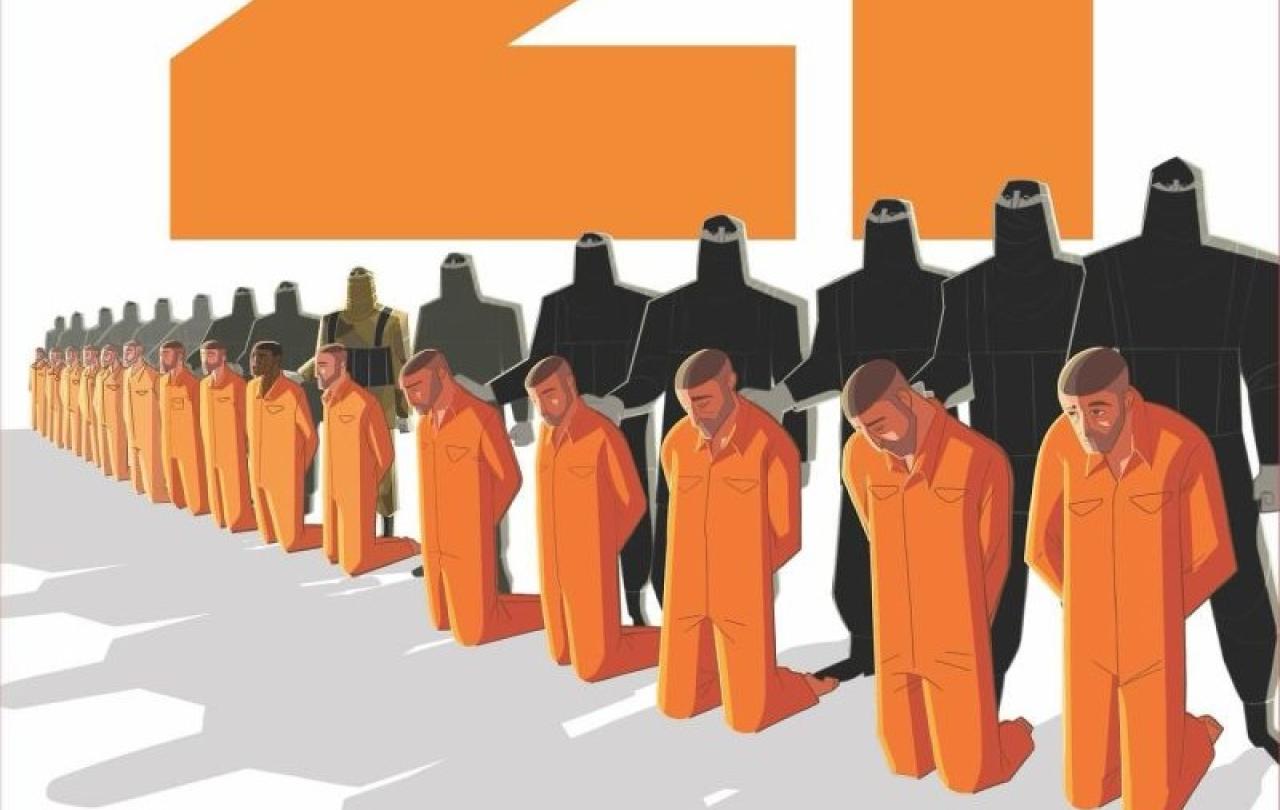
In 2015, 21 men were kidnapped, tortured, and eventually killed by ISIS. Twenty of those men were Coptic (Egyptian) and one, Matthew, was Ghanian. They were all Christians. And that is why they were killed.
Over the past decade, the story of their martyrdom has been widely told. And yet, the only piece of visual storytelling that existed was the propaganda video, filmed and released by ISIS. A film that was intended to scare the world and dehumanize the men, a film that glorified violence and hatred.
We’ve known the story of the men’s execution, but we’ve only known it as told by their executioners.
That’s no longer the case. On 15 February 2025, ten years since their death, the story of the 21 is being re-told by a team of over seventy artists from 24 countries, directed by Tod Polson, and in collaboration with the global Coptic community. The short film, The 21, will premiere on the anniversary of the men’s death and be featured at film festivals throughout 2025.
We knew a story, now we’re hearing their story.
I was able to talk through the details, how and why this short-film was made, with one of its producers – Mandi Hart of MORE Productions. After watching the film a handful of times, and needing ten minutes to recover after every viewing, I had lots to ask Mandi. Firstly, I wanted to know all about the visual aesthetic.
This film is animated, which feels like both a defiance and a kindness. It’s a defiant choice because it ensures that this film stands in contrast to the film that was released ten years ago, where pure terror was the only story-telling objective. Nothing about this film is reminiscent of that one. And that’s a kindness to us, the audience. We’re not totally spared, however, as carefully selected moments of the original footage are woven into this short film, reminding us that these men – the ones who were killed and the ones who did the killing - were as real as you and I. But, on the whole, we’re spared the worst of the horror. As Mandi noted,
‘animation allows your imagination to fill in the gaps. It’s just as powerful a form of story-telling, if not more so’.
Mandi’s right. This film will stop you in your tracks. More than anything, though, the visual aesthetic is an ode to the men who were lost and the community they belong to.
Director, Tod Polson, travelled to Egypt to meet with Coptic iconographers and learn about the intricate ways they communicate in symbolism, iconography and art. Mandi told me that even details as subtle as the width of a line used or the placement of the eyes on a human face have deep wells of meaning held within them. Polson also visited Minya, the Egyptian region that was home to many of the martyrs, and gathered inspiration from the church that was built there in their honour. The film’s aesthetic derives from all of this, it’s drawn in alignment with what Polson learnt. In other words, the story is told in the language of the martyrs. Through the work of the seventy plus artists, this story is weaved into the story – the Coptic story, the Christian story. It’s rooted and yet timeless, a decade old and yet ancient.
For the men standing on the beach, an assassin standing behind them, the veil between the seen and unseen was incredibly thin.
The film is a masterclass in learning the language of the ones to whom you’re paying tribute. The artists have honoured the martyrs on their own terms and according to their own story. It’s a special thing.
It’s also a challenging thing. It’s a harrowing event, after all. It feels as though, through this film, we’re brought closer to the torture the men endured, given details that the mainstream media left unreported. Details such as, the floor they were forced to sleep on was continuously pumped with water, the relentless taunting and manual labour, the beatings, the fact that they were actually put in orange boiler suits, taken to the beach, and filmed three times. It was on the third time that they didn’t return.
40 days, that’s how long the twenty-one were held for.
960 hours.
57,600 minutes.
3,456,000 seconds.
The longevity and intensity of the torture is nearly impossible to fathom. The fear they must have felt is mostly unimaginable. Mandi mentioned that she was probed by a continual set of questions as she studied this story, these men, and those days. The questions went along the lines of: what would she be willing to die for? Would she be brave enough to stand her ground? Would she be faithful to what she believes to be true? Would she choose a life without Jesus or a death because of him? It’s a hypothetical set of questions for Mandi, and for me too. But not for the 21 men.
Finally, I wanted to ask Mandi about the inclusion of supernatural facets of the story – the improvable, un-fact-check-able stuff. If I was to be brave, I guess I would say the truest stuff. The way the heavens seem to open, rage, and weep; the subtle appearances of Jesus’s scarred and bloody feet; the mention of a prayer-fuelled earthquake in the prison; the glimpses of a supernatural army guarding the 21 men as they walked to their death. It’s quite weep-worthy, really. The closer these men get to their execution, the brighter and more vivid the ‘unseen’ becomes.
Yet, it feels like quite a brave storytelling choice, to meld the provable with the improvable facts of the story.
‘Only to us’, Mandi reminded me. ‘we, the cultural West, struggle with the supernatural stuff. It’s an affront to the ‘rational’. But we’re the minority. The majority, who have less cultural power, they don’t struggle with this stuff at all... ’
This led us to speak about the seen and the unseen elements of reality, how – as Christians – we believe that all that we see is not all that there is. In fact, the things that cannot be seen are the realest things. And how, for the men standing on the beach, an assassin standing behind them, the veil between the seen and unseen was incredibly thin. It’s comfort that often makes the veil thicken out, Mandi reminded me, it’s the left hemisphere of our brains that tells us that all that we see is all that there is. When our safety and comfort are stripped away, what happens? For the twenty-one martyrs, it seems as though the veil became thread bare. As Mandi quite remarkably noted, ‘the human soul knows more than the mind is comfortable admitting’.
The 21 is a short film about death, the death of 21 innocent men. It’s important that we give these men our attention, look them in the eye and weep with those who weep. But I think, in a way, this short film also tells the story of life. Life after death, life that death doesn’t put an end to. Life that confounds death, even. And in that way, this film tells both a particular story and a universal one, both their story and the story – the Christian story.
Seen & Unseen is free for everyone and is made possible through the generosity of our amazing community of supporters.
If you’re enjoying Seen & Unseen, would you consider making a gift towards our work?
Alongside other benefits (book discounts etc.), you’ll receive an extra fortnightly email from me sharing what I’m reading and my reflections on the ideas that are shaping our times.
Graham Tomlin
Editor-in-Chief