
Article
Creed
Feminism
5 min read

The good, the bad and the Barbie

At the Barbie movie, Lauren Windle fraternises with her childhood enemy, and leaves pondering change and imperfection.

Lauren Windle is an author, journalist, presenter and public speaker.

Barbie stands between Ken and a rival with her hands raised.
Peacekeeper Barbie.
Warner Bros.

Barbie and I always had an unspoken understanding that our relationship would be mutually destructive. She made me feel inadequate; I was too short without a synched-in waist and pneumatic boobs. And I chewed her off her toes. One all. 

I have spent the better part of two decades not thinking about my adversary, until once again she reared her (not at all) ugly head. I always celebrate on July 21. It is, after all, my birthday. But this year, the date was eagerly anticipated by millions and not because they share my love of Colin the Caterpillar cake. Last Friday was ‘Barbie Day' and it was all anyone could talk about. 2 – 1 to Barbie. 

If you missed the news that there’s a Barbie movie now in the cinemas, clamber out from underneath that rock and let me tell you about it. The film, starring Margot Robbie and Ryan Gosling, caused quite a stir with, what I can only assume is, the biggest marketing budget since Nike release Air Jordans. Both Warner Bros and Barbie’s parent company Mattel have thrown money at making sure we all know about their candy-coated flick. The campaign has been so effective that production sparked a global shortage of fluorescent pink paint. 

The box office is now raking in cash as people flock to see the fuchsia film. When I attended a morning viewing this weekend, I was one of the few people who hadn’t come dressed head to toe in pink. Not a chance Barbie. 

On taking my end-of-row seat (to facilitate a quick getaway) I settled in for one hour and 54 minutes of fraternising with the enemy. I’ll level with you, Barbie had made some effort to change. The vibrant colours (mainly in a rosy hue) were still in place, along with the glossy hair and impossibly smooth legs. But there was a new self-awareness and self-deprecation that hadn’t featured in our childhood tea parties.  

Finally, my arch nemesis is on the right side of history, right? I’m not sure that’s the case. 

I had expected a vapid tale with fun flourishes. The story certainly delivered on both of those but with a lot more I hadn’t anticipated. From where I was sitting (popcorn in hand, legs stretched out into the aisle), it was a satirical story of feminism, patriarchy and the joy and anguish of fully embracing life on life’s terms. If you saw that coming, you probably have the gift of the prophetic, because it was certainly not on my radar.  

If you don’t think too much about the plot, the film is easy to enjoy. Helen Mirren offers a witty commentary which is like someone handing you a cup of tea with two sugars when you usually just take milk. It was a welcome surprise that you wouldn’t have asked for but were delighted to discover. It was a visual feast for the eyes with everything – especially the inhabitants of Barbieland – looking perfectly polished. There are also a number of very funny jokes – albeit with adult undertones.  

All good so far, but now let’s suppose that you, like me, will think about the plot. When the word is defined correctly, I am delighted to identify as a feminist. That does not mean that I support every feminism-associated declaration of the last 100 years, but it does mean that I passionately champion women and the correcting of previous (and some current) oppressions. This would make me a prime candidate for loving the Barbie movie. Finally, my arch nemesis is on the right side of history, right? I’m not sure that’s the case. Sometimes, in an attempt to show willing, we can allow the pendulum to swing a little too far in the wrong direction. 

Mattel’s campaign to rebrand Barbie from a ditsy blonde to an empowered achiever has been well documented. People didn’t want the lack of ambition that came with “shopping mall Barbie” or “beach Barbie” and they certainly didn’t want to have to live up to her unrealistic beauty standards. Apparently if a Barbie doll was to scale, she’d be 5ft 9 with size three feet, and only enough space in her waist for half a liver. 

Rather than continuing along these lines, portraying the company as inspiring for girls and women, they take the mick out of it. They highlight that Barbie has been a part of the problem. But in making their point, they outrageously infantilise men. Of course, this is satire, and comedy allows space for exaggeration, but it still didn’t quite sit right for me. Not one man offered a positive portrayal of masculinity (although Michael Cera’s Allan is a joy to watch). On the whole, men were either oblivious, obsessed with their own success, or childish and sometimes sit in board meetings wishing they could just tickle each other. 

The very brief summary – without revealing too much of the plot – is that Barbie is very happy in Barbieland, a perfect paradise where women do the lion share of the work and take all the leadership roles. But something starts to change, and the real world begins to seep in. After “causing a rupture” between the real world and Barbieland, “the patriarchy” is introduced into this female-led eutopia and the Barbies must banish it in order to restore the sorority-dominated lifestyle they previously enjoyed. Not a problem – when Ken found out patriarchy wasn’t about horses he lost interest anyway.  

In ten years, I think many of the critics who have lauded this film as a classic will cringe at their enthusiasm. 

In a world where even Caitlin Moran is writing a book posing the question “What About Men?” I fear this film will age badly. The vast majority of people, including women, don’t want to propel women by doing men down. In ten years, I think many of the critics who have lauded this film as a classic will cringe at their enthusiasm. 

Finally, let’s frame this with the ways the Bible has influenced the film. Oh yes, the biblical message hasn’t just underpinned Harry Potter and The Lion, the Witch and the Wardrobe, it’s apparent in the Barbie movie too. If we replace Barbieland with Eden we can see a stark comparison between the film and the creation story. In this utopia, Barbie is given authority over the land. She is given a helper in Ken. But their paradise is threatened by human fragility and quest for more knowledge. After it comes crashing down the inhabitants just want to get back to their previous state. 

The film demonstrates the desperation to 'return to Eden', in the face of an imperfect and broken world. But it also highlights the beauty that can be found in allowing yourself to experience life on life’s terms; to cry, feel pain and embrace the ache associated with change. For that, I respect its efforts. Although I think Disney’s Inside Out manages to achieve the same without belittling men. 
 

Explainer
Creed
Identity
Leading
6 min read

Why read Martin Luther today?

Innovative ideas around identity shaped the world around him.

Robert is professor emeritus of Systematic Theology at Concordia Seminary, St. Louis.

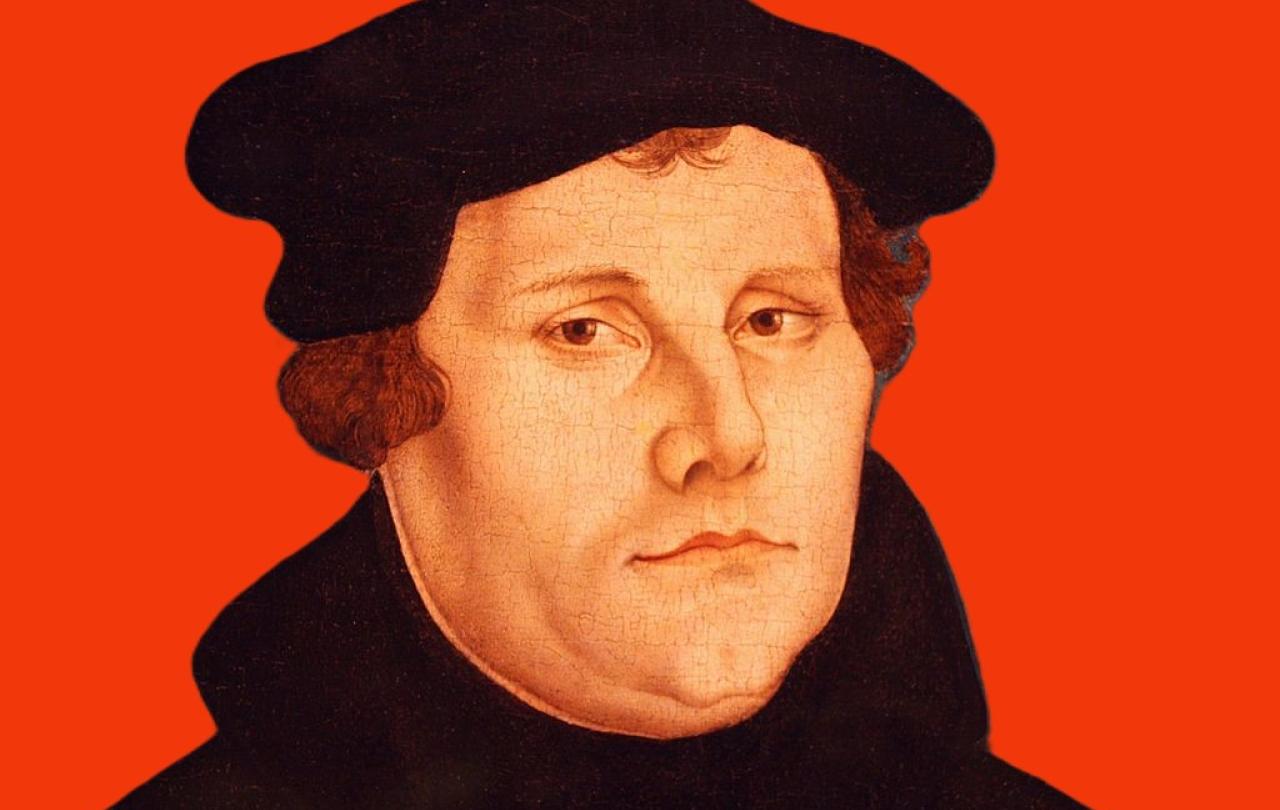
A head and shoulder painting of Martin Luther against a red background
Luther, by Cranach the Elder.
Public domain, via Wikimedia Commons.

Tensions build as the German election approaches. Money is flowing, bargaining going on behind the scenes. (We are talking the election of 1519 here). There is the favorite, Karl—they called him Carlos in the Spanish dominions he had  inherited from his maternal grandparents, Ferdinand and Isabella—, grandson of the German emperor, Maximilian of Austria, and there is the challenger, the King of France, Francis I, and there is the wild card, the duke of Saxony, one of the seven electors who would elect the next emperor, Frederick, called the Wise.  Frederick had no imperial ambitions, and he tipped the election to his distant cousin, the then young man we call Charles V.  Two years later, that gave Frederick the leverage to win a hearing for his most prominent professor at the pride of his heart, his new university in Wittenberg, Martin Luther. 

Charles regarded this Augustinian friar, who had been excommunicated at the beginning of 1521 by Pope Leo X, as a dangerous heretic.  He wanted to declare Luther a criminal, open for execution on the open road by whoever might find him and run him through.  Frederick advised the young emperor not to treat a German subject like that, so Charles arranged for Luther to come to the imperial diet in Worms in May 1521 to recant.  Luther explained to the emperor that he really could not recant since his writings contained many truths.  He continued, “I am bound by the Scriptures I have quoted, and my conscience is captive to the Word of God.”  Later reports say that he added the words, “I cannot do anything else. Here I stand. God help me!”  Whether he said “here I stand” or not, that is what Martin Luther did at Worms and continued to do for the next quarter century until his death. 

Upon what was he standing?  As a “doctor in Biblia,” a “teacher of the Scriptures,” Luther had taken up the latest methods of the so-called humanist movement for exploring ancient texts in their original languages.  Jurists turned to Justinian’s Code in sixth century Latin. Physicians were reading Galen’s medical advice in ancient Greek. Theologians immersed themselves in the Bible in Hebrew and Greek.  Luther had put the tools of these methods to use as he lectured in the 1510s on the Hebrew Psalms, and then the apostle Paul’s letters to the Romans and to the Galatians.  There he found a new way of viewing himself, the God whom he found speaking to him in the pages of the Bible, and his fellow human creatures.  He used the world “righteousness” in the way we might use “personal identity” today.  He heard from the biblical writers a different way of identifying who he was at his core by listening to God’s regard for him.

Just as our DNA is a gift, not something we have to work to earn, so Luther’s core identity came from outside himself.

Luther certainly did not deny that human performance helps give each human being a variety of identities as we go about what he saw as callings from God in our exercise of responsibilities in our homes, in our economic life, in our societal networks and political structures.  He believed that in these spheres of life we are active in shaping the way other people view and identify us.  But at his core, Luther found the person behind the masks of his everyday life to be unable to perform everything that would make him the good person he wanted to be, the good person he thought God wanted him to be.  Just as our DNA is a gift, not something we have to work to earn, so Luther’s core identity came from outside himself.  It came as a gift from God, his Creator.  He received it passively, and his trust in the God who gave him this passively bestowed identity set his entire life in order.  Because he trusted God to be his support and to justify who he was, he felt freed to perform his responsibilities toward other human creatures actively. 

Luther believed that on his own he had not been able to trust God, to love him and give him proper respect.  Like the modern psychiatrist and philosopher, Erik Erikson, Luther believed that trust forms the basis of human personhood and personality.  He saw that his trusting some Absolute and Ultimate formed his character and enabled him to function as a human being.  He recognized in the God presented by the Old Testament prophets of Israel and the New Testament evangelists and apostles the ultimate and absolute person, who approached the human creatures who had turned their backs on him by becoming one of them as Jesus of Nazareth.  In the mysterious ways of the Creator, Jesus’s death covered the transgressions and offenses, the mistakes and failures, of all human beings, and in his resurrection God gave new life, a new identity, true righteousness to those who trust in him. 

Luther found that message liberating.  It freed him from being imprisoned in a cycle of always insufficient attempts to be the person he wanted to be to please his Creator.  He rested in the unconditional love of this Creator, who had come face to face with humankind as the rabbi from Nazareth, crucified but back from death itself.  That freed Dr. Luther to be bonded to those within his reach who needed his care and love.  He need not manipulate them by doing them the good he needed to make himself look good in God’s sight and feel satisfied with himself.  He now could do them the good that they truly needed.  That gave his tempestuous spirit a sense of joy and peace. 

He lived out a rather peaceable life under the ban of church and empire, but safely ensconced in the lands of his Saxon electors.  Family life brought him much joy.  His judgment that God had given human beings the gift of sexuality for companionship and support as well as procreation made him uncomfortable with his own vows of celibacy, but not so uncomfortable that he would have married had not a nun named Katharina von Bora, who had left the cloister, laid claim to him.  Together they created a bustling household with their six children being raised in the cloister where Martin had lived as an Augustinian Brother, large enough to house students and guests from places far from Wittenberg.  Katharina served as his counsellor and theological conversation partner as well as the efficient manager of this ever-changing parade of co-inhabitants of their home. 

Music filled their home.  Luther’s firm tenor voice and his lute and his flute led family and visitors in evenings of song, sometimes giving voice to hymns he had written.  His sense of tone and rhythm coupled with sensitivity to the fine points of spoken and written speech made him a scholar of great skill and a translator who “looked into the mouths” of the people in the marketplace and render the Bible in their tongue.  His curiosity stimulated or at least supported colleagues at the university across the disciplines, including a botany instructor who took students the woods to look at leaves and colleagues in mathematics and astronomy who were playing with the new calculation of the heavens by Nikolaus Copernicus. 

Luther’s lively engagement with life and his dramatic search for peace in the pages of the Bible produced a man who enjoyed life despite his struggles with “melancholy,” a widespread disease of his time, and the threats of violence to his person that never disappeared.  His robust wrestling with the biblical texts provides even today stimulating, even provocative reading for anyone, who is looking for the heart of the matter, the matter of self and life. 

Join with us - Behind the Seen

Seen & Unseen is free for everyone and is made possible through the generosity of our amazing community of supporters.

If you’re enjoying Seen & Unseen, would you consider making a gift towards our work?

Alongside other benefits (book discounts etc.), you’ll receive an extra fortnightly email from me sharing what I’m reading and my reflections on the ideas that are shaping our times.

Graham Tomlin

Editor-in-Chief