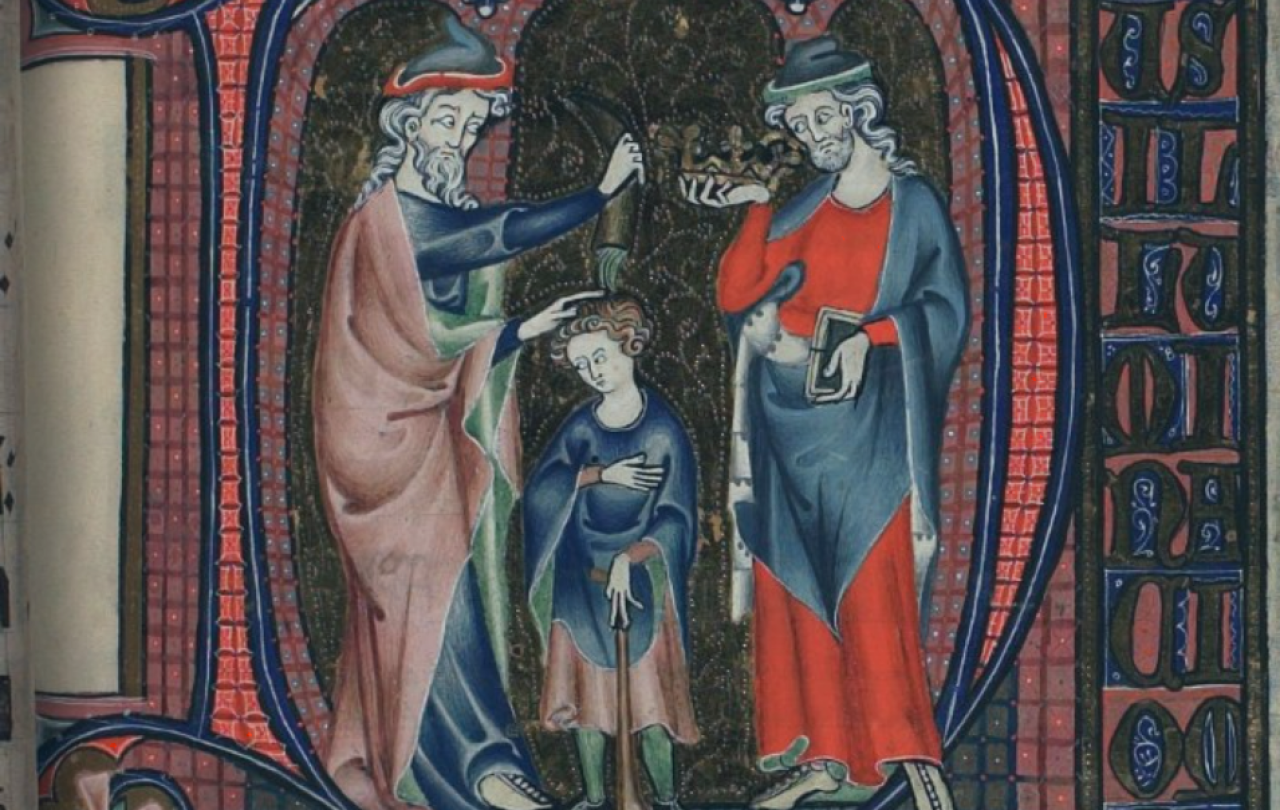
At the most solemn moment of King Charles III’s coronation on 6 May, the Westminster Abbey choir will sing Handel’s thrilling setting of words from the first chapter of the first Book of Kings:
Zadok the priest and Nathan the prophet anointed Solomon king.
It provides a reminder that the anointing of the monarch with holy oil is carried out in direct imitation of a practice described in the Bible in connection with the inauguration of the kings of ancient Israel.
This is not the only link which the coronation will make with stories found in the Bible. Legend has it that the Stone of Destiny, on which Charles will be seated when he is crowned, started life as the pillow on which Jacob slept when he had a dream of the ladder leading up to heaven as described in Genesis. Jacob set the stone up as a pillar to commemorate the place where God had talked to him. Later stories identify it as the pillar beside which Abimelech was crowned king of Israel and King Josiah made his covenant with the Lord to keep his commandments and statutes.
The theme of monarchy looms large in the collection of books making up the Hebrew Bible which tells of God’s dealing with the chosen people of Israel and forms the Christian Old Testament. The word ‘king’ occurs 565 times and ‘kingdom’ 163 times. Six of the so-called historical books have the monarchy as their main subject matter, including the aptly named first and second books of Kings. The life of one particular king, David, occupies more space than that of any other figure, including the great patriarchs, Abraham and Moses.
By popular request
Kingship is presented in the early books of the Old Testament as both the popularly requested and the divinely appointed answer to the anarchy and disorder prevailing under the judges who ruled the people of Israel for the first two hundred and fifty years or so after their arrival in the promised land of Canaan around 1250 BCE. The Book of Judges emphasizes the corruption and lawlessness under this form of government, noting: ‘In those days there was no king in Israel: everyone did what was right in his eyes.’
The inauguration of the Israelite monarchy, which took place around 1020 BCE, is described in the Book of Samuel. A crucial role is played by Samuel, the last of the great judges who becomes the first king-maker and presides over the coronations of both Saul and David, the first two Israelite kings. Samuel is portrayed as prophet, seer and intermediary between Yahweh/God and the people, to whom the elders of Israel come asking for ‘a king to govern us like all the nations’. Samuel puts this request to Yahweh who is initially reluctant to accede to it and tells him to spell out to the people the dangers of kingship in terms of the accretion of private wealth and military might. These warnings are ignored, however, and the people continue to insist that they must have a king ‘to govern us and go out before us and fight our battles’. When Samuel reports this to God, he is told, ‘Hearken to their voice and make them a king’.
On king making
If there is a certain initial unease in God’s mind about the desirability of kingship, the institution is subsequently given divine blessing, with the king been seen as God’s chosen one – Messiah in Hebrew, or Christos in Greek. There is a sense of partnership between Yahweh and the chosen people of Israel in the making of kings. The emphasis is on a three way covenant between God, king and people. This concept of covenant is one of the most distinctive and central features of Israelite kingship, as is the idea that the monarch mediates and represents divine rule and stands for justice, fairness and truth.
During and after the long period of exile that followed the ‘Babylonian captivity’ of Israel in 597 BCE, Jews increasingly pinned their hopes on the future coming of a new Messiah, a king from the house of David, raised up by God to deliver Jerusalem from where he would reign, restoring and re-uniting Israel and bringing about a new world order of justice and righteousness, as looked forward to and promised in the Psalms and the writings of the prophets.
The theme of kingship, so fully explored in the Old Testament, continues to figure prominently in the New Testament, although its central focus is on the kingdom of God, inaugurated and proclaimed by Jesus, with its dethroning of the rich and powerful and exaltation of the humble and meek. All four of the Gospel writers use royal titles and monarchical allusions in their descriptions of Jesus. He is identified as the anointed king, the Messiah or Christos, leading his followers to be known as Christians. From his birth in Bethlehem in the house and family of King David, and his baptism where he is identified by God as his beloved Son, to his trial and crucifixion for being ‘King of the Jews’, the royal theme runs as a clear thread through his life and death.
Jesus himself redefines the concept of kingship. This is signalled most dramatically by his choice of a donkey on which to make his entry into Jerusalem on the first Palm Sunday. He deliberately opts for an animal associated with humility, humiliation even, rather than a proud charger or stallion more fitting for a king on a triumphal progress. In washing his disciples’ feet on the first Maundy Thursday, he further shows that he is, in Graham Kendrick’s memorable words The Servant King displaying meekness as well as majesty. When Pontius Pilate repeatedly asks him whether he is indeed the King of the Jews, he gives the cryptic answer 'You have said so'. Jesus never repudiates the idea of kingship but gives it a wholly new meaning of humble servanthood which has been the inspiration for Christian monarchy ever since.