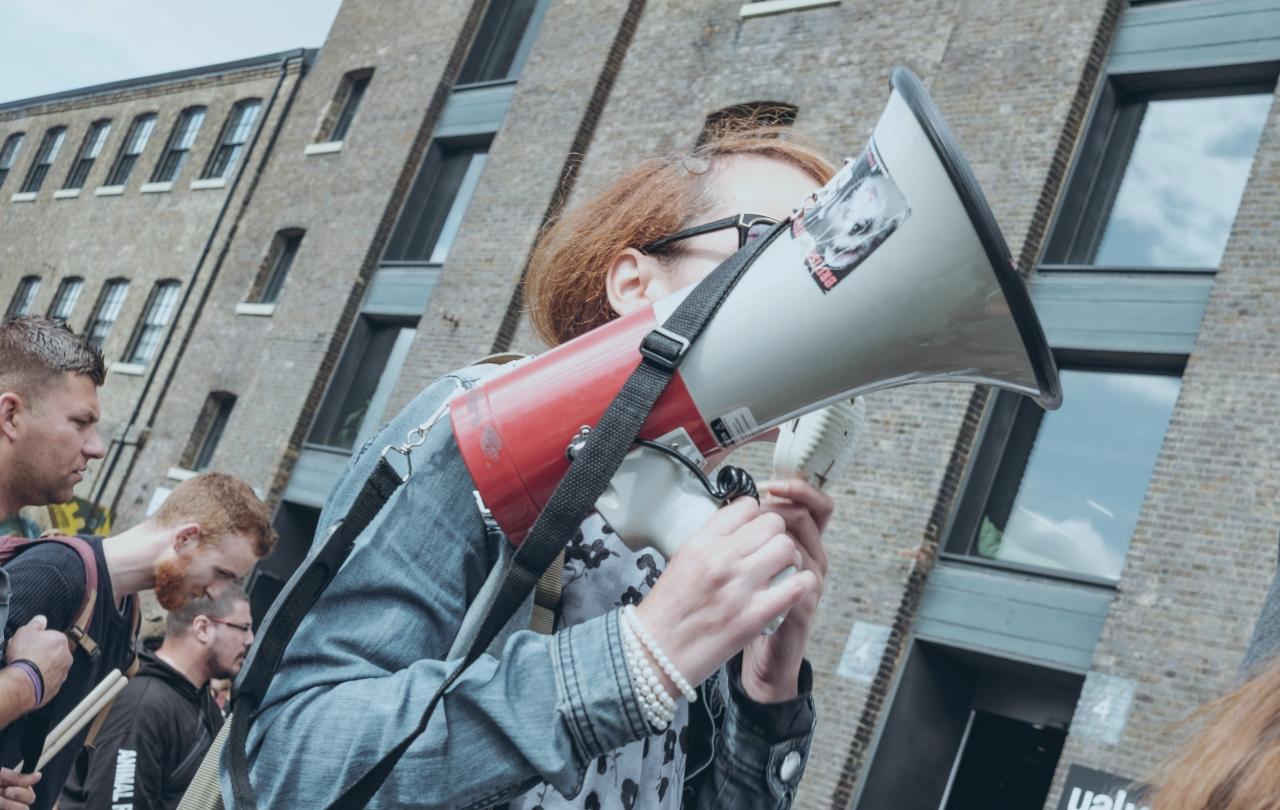
During my term as a Green Party District Councillor, I was once publicly congratulated by the local Extinction Rebellion (XR) group for taking on the new role of ‘Cabinet Member for Climate Change’.
A week or two later, I was questioned at a Council meeting about whether I was part of XR – opposition Councillors wanted to know if I’d be using their “extreme rent-a-mob tactics” in my role.
The local XR group are kind and knowledgeable and are making things happen. But to my Council questioners, this seemed to matter less than the fear of the ‘other’ – in this case, what they perceived to be a mob of environmental extremists that might do harm to the Council. It works both ways – I’ve also seen activist groups paint all elected Councillors with the same brush, assuming none of us care. It feels like there is little grace and a lot of judgement going round.
I’ve been curious why local non-activist residents and Councillors might not be keen to engage with activist groups (the term ‘activist’ is a broad one, and this article isn’t long enough to analyse it, but activist groups are generally engaged in activities to bring about social, environmental or political change).
Some tell me that they’re put off by what they perceive to be self-righteousness, judgement, anger, and the ‘hippy’ identity. I am put off by some of these things too, however much the media might falsely amplify these qualities – but still, perceptions close down relationship and possibility, and this is one of the things that keeps me at arm’s length from the ‘activist’ label, particularly when it gets caught up in group identity and expectation too. At a time when we need to see change in so many things – the state of the environment, politics, social equality – I’ve been wondering why I feel a distance from the ‘activist’ identity.
As well as getting elected, I’ve taken part in marches, signed petitions, joined social and environmental action groups. I want to walk alongside others who are doing something about the things that matter. But I have struggled to find the in-between of ‘slacktivism’ on the one hand (supporting causes largely online with little commitment), and intense commitment to a particular group or tribe on the other. And I am tired, because despite the protests, volunteering, and organising, the challenges seem bigger than ever. These efforts are important, but protesting the status quo isn’t enough.
I look at the NGOs, political groups, roles, funding proposals, slogans, meetings and glossy branding that are often part of activism and civil society more broadly – and are tools I’ve used myself – and I find myself doubting that these things can really bring about the change we need in our relationship with each other and the planet. We need more than better branding, or more funding, or more campaigns. As Audre Lorde said, the “master’s tools will never dismantle the master’s house.” I find myself distancing from the urgency of activism, volunteerism, and campaigning in their current forms.
I’ve felt public discourse and action become less patient, more certain, more fragmented, with little room for curiosity and open conversations.
As well as form, I also feel a disconnection from engagement with and discussion of the issues of our time. In my involvement in social and environmental action over 20 years, I’ve sensed the shift brought about by rapidly evolving technology and media, which mean social and moral norms are evolving too. I’ve felt public discourse and action become less patient, more certain, more fragmented, with little room for curiosity and open conversations – sometimes explicitly through cancel culture or more subtly through othering and unintentional judgement. I think of a song by Sam Fender called White Privilege which includes the lines
“Everybody's offended… I'm not entirely sure the nitpicking can count as progression… Nobody talks to each other for fear of different opinions…”
Perhaps that closing down of conversation is in part down to social media and its algorithms which respond well to noise, performance, and oversimplification – it is not a space designed to help us relate across difference and understand each other, yet this is vital if we are to create the change needed in ourselves and in the world.
I want to be part of meaningfully and wisely addressing the world’s sickness, not desperately and loudly treating its symptoms. I have been wondering if there’s another way I might think about creating change.
Author, educator and social critic bell hooks (who prefers her name written in lowercase) wrote her book All About Love because she was
“thinking about how we love and what is needed for ours to become a culture where love’s sacred presence can be felt everywhere”.
She laments the lovelessness that is pervasive in our society. She goes on to say,
“profound changes in the way we think and act must take place if we are to create a loving culture”.
Sometimes, the issues at stake demand that we weep, raise our voices, get angry. Jesus turned over trading tables in the temple when he saw the sacred space had been turned into a marketplace – he got angry. But ultimately, he asks that we love our neighbours, including our enemies.
And yet sometimes I wonder whether we know how to love in the world as it is today. hooks says,
“In the realm of the political, amongst the religious, in our families, and in our romantic lives, we see little indication that love informs decisions, strengthens our understanding of community, or keeps us together.”
In her lectures on ending racism and sexism, she notices that her audiences, especially the young,
“become agitated when I speak about the place of love in any movement for social justice”
despite the great movements for social justice having emphasised love. Her listeners seem
“reluctant to embrace the idea of love as a transformative force.”
We need to see love as a transformative force though. We say we believe in it; we make films and write poetry about it, we see it guide communities during collective experiences like global pandemics, we turn our faces towards it, we seem to want it. Perhaps this is where the hope is – that we want love in its various forms, even if we are embarrassed to say so. Love is not naïve, it does not ask us to be nice and polite, or eternally optimistic. Its presence does not remove negativity, disagreement, people who let us down. But I think it gives us the eyes and tools to work together, and to stand in compassion before judgement.
If we take love and affection for our neighbour and places seriously, understanding what it looks like in practice, then movements for change can begin right where we are – in our language, in our community, in relationships that ripple out. In a placeless and disconnected age, perhaps this is the kind of activism that would help us heal ourselves as well as the world. Author Simone Weil said that
“the gospel makes no distinction between the love of neighbour and justice.”
I am becoming drawn to a love-led activism, an activism that is made from the hard day-to-day work of listening, and patience, and loving what’s sometimes hard to love. It might mean taking time to build relationships with people who aren’t like us. It might mean breaking out of our institutions and tribal groups, hearing each other across difference, and imagining new possibilities together rather than form ever-tighter clubs. It might mean getting soil not screens between our fingers, rooting in relationship, slowing down, paying attention. Whatever it looks like, it must appeal to both activists and non-activists, because we must all be involved in calling forth new worlds.
The Bible is full of calls to love justice, to defend the weak, to provide for the poor and hungry, to defy the authorities when we need to – but to do all this, as Paul says, “rooted and grounded in love”. Micah says,
“what does the Lord require of you but to do justice, and to love kindness, and to walk humbly with your God?”
As bell hooks knew, justice goes hand-in-hand with love. It is hard for one to exist without the other.
We can choose to open up conversations or shut them down, to walk with others or retreat behind ideological lines, to stand in judgement or relationship, fear or love.
Perhaps it doesn’t matter whether we’re catalysed by anger, indignation, love, or care – but it matters what we go on to do with that spark. We can choose to open up conversations or shut them down, to walk with others or retreat behind ideological lines, to stand in judgement or relationship, fear or love. I think about what might come next when I stand down as a District Councillor at the next election, following a pull to do justice, and to love kindness more than belong to a political tribe. If we choose, we could build a loving culture, weaving a social fabric where activists and non-activists can see past current paradigms and feel able to work together, holding each other up as neighbours whilst nurturing beauty, hope and the becoming world. It may have no clear identity, it may not suit the noise of social media, but this is work that I want to be a part of.