Article
Comment
Leading
Politics
7 min read

Leaders wanted for these testing times

We need leadership that is famous for fifteen miles not fifteen minutes.

Elizabeth Wainwright is a writer, coach and walking guide. She's a former district councillor and has a background in international development.

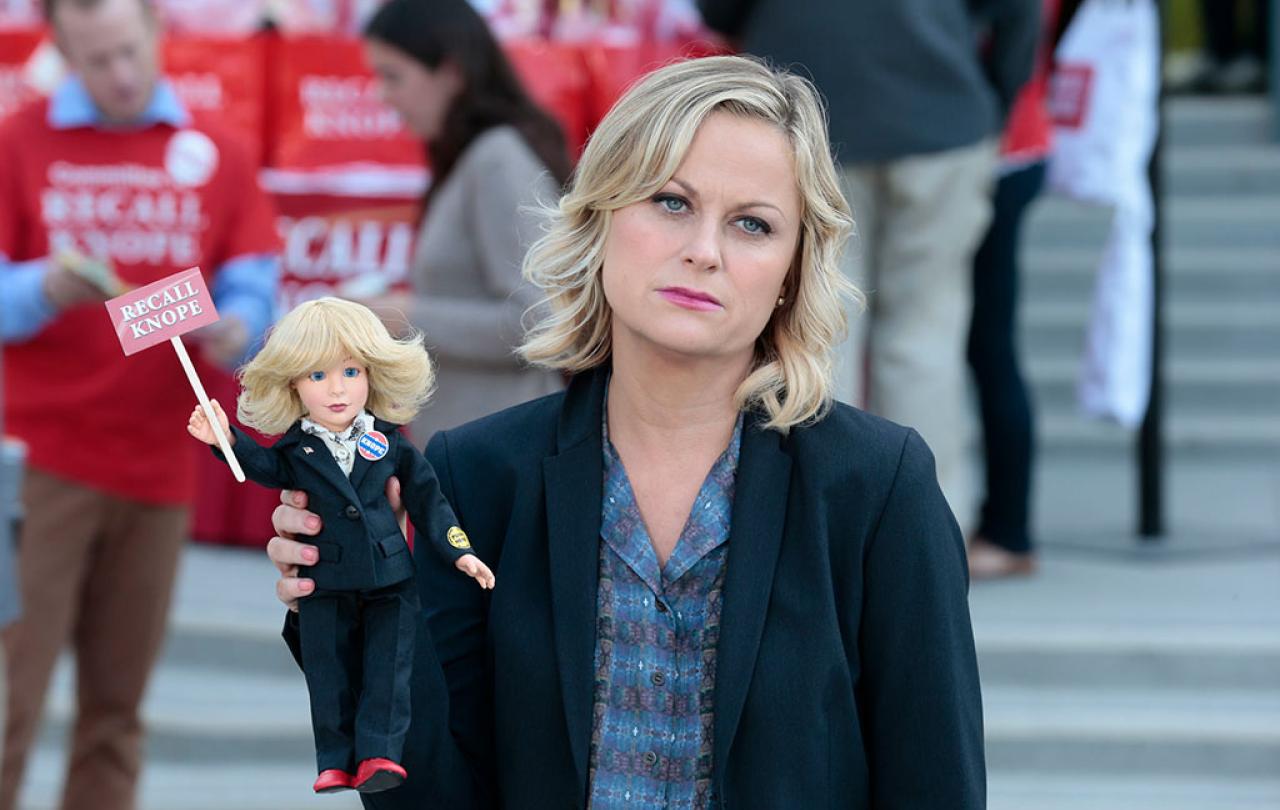
A deflated looking woman stands aside from a protest rally, holding a small doll of herself that reads Recall Knope'.
Local leadership: Leslie Knope serving Pawnee, Indiana.

We are in a year of elections – locally, nationally, and in the US, and I have been wondering whether it’s true that we get the leaders we deserve, whether political leadership has always felt this way – this detached, divisive, even dangerous? More about ambition than integrity, about individuals more than our common life? Where might we find leaders that can take us into an increasingly hard to navigate, uncertain world?  

I find myself thinking back to local leadership and difficult conversations I was involved in as a district councillor. These were often conversations about priorities, and money – mainly, the fact that there wasn’t enough of it, and what there was continued to be pared back and back until only the absolute essentials were covered. Many council tax bills have recently gone up, usually with an explanation of the reason for the rise. Local authorities in Scotland recently voted for a council tax freeze but only after the promise of funding from the Scottish government to make up the shortfall. During my time on the council, we would write letter after letter to government ministers seeking clarity about grants or cuts. When extra funding was announced we were pitted against other councils to bid for meagre pots of money, taking time away from officers who were already stretched too thin. Each councillor, each officer, each member of the community we served had their own idea about how to approach budgeting and spending. Sometimes those ideas aligned, but often they did not. Councils are in an impossible situation.  

And yet decisions made at this level impact us all. National leaders might set the direction, but local leaders steward and implement and envision and listen – they are close to the people they serve, their decisions impact us all day-to-day: councils are responsible for things like children’s services, highways, housing people, parks and pools, and lots more

The people who have played the biggest role in my life have been the people that made me feel valued, seen, heard, capable. 

Conversations about how to fund local authorities are difficult at any time, but especially so now, with crises coming from every angle – cost of living, climate change, ongoing post-covid recovery, austerity, and so on. To be a leader now – nationally yes, but especially locally, means making sure that essential services keep functioning despite lack of funding or clarity from government, and whilst also tackling climate change and all the other pieces of our fragmenting world. To be a leader now who shows vision and humanity and care despite the seemingly cynical and hurting spirit of the age – is, I think, a test of the meaning of leadership. This test of leadership doesn’t just face local and national government though. It faces all of us right now as we contemplate an unknowable future.  

Essayist Ralph Waldo Emerson believed that “our chief want is someone who will inspire us to be what we know we could be”, and we are all capable of helping others be what they can be – whether a neighbour, a colleague, a community, a team, an organisation, others we come into contact with; we can all lead. Author, poet, and civil rights activist Maya Angelou said that “people will forget what you said, people will forget what you did, but people will never forget how you made them feel.” The people who have played the biggest role in my life have been the people that made me feel valued, seen, heard, capable. They have seen who I am, and who I could be, and they walk with me as I move in that direction. I think the best leaders do this too.  

It is not glamourous, but, like a lighthouse that shines by just staying where it is, it calls people, lights the way, watches, serves, guides. 

In contrast, the worst leaders seem to cling to traditional ideas of power, to control more than setting people free, to achieving their goals through any means necessary. I think of authoritarian regimes that rig elections and limit freedoms, and corporations that pursue profit at the expense of employees and the environment, and political campaigns that prioritise controlling the narrative over informing people. These embody warped leadership traits. And these warped ideas of leadership are given airtime, they fuel our news and our social media feeds and our anxiety. They make us angry, but they can also disempower us and close off the possibility that there is another kind of leadership, one more aligned with the Old English root of the word ‘leader’, meaning ‘one who guides and brings forth’. There are, though, places we can look that point to that other kind of leadership – to something more beautiful.  

One place is my own doorstep. Here, there are people that see a need and organise people to fill it – whether hunger, loneliness, lovelessness, this is a kind of roll-up-your-sleeves leadership, the kind that is famous for fifteen miles not fifteen minutes. It is not glamourous, but, like a lighthouse that shines by just staying where it is, it calls people, lights the way, watches, serves, guides. 

I try to hold on to the fact that we do not need to wait for national elections to call forth the kind of leaders we want. 

Another place is the gospel, where again and again Jesus turned traditional ideas of leadership upside down. He taught that it must serve, not be served; that it can be great through humility not self-importance. He criticised religious leaders for seeking prestige and personal gain. And Jesus did not just teach this stuff, he lived it – he washed the feet of his disciples, he empowered them rather than wielded authority over them. He lived as a shepherd that leads and tends his flock with his love. He laid down his life for his friends, for all of us. And this I think is where leadership starts to look a lot like love. Jesus showed how true leadership that transforms individuals and communities, that heals division and brings people together, is led and motivated by love, not power. He taught that leadership without love is hollow and even harmful. He showed that leadership, and the love that fuels it, guides and inspires and cares for people. We need these kinds of leaders now more than ever. My own experience tells me that hard conversations become easier to navigate when care, humility, and listening are present.  

In the UK, many of us are trying to get the measure of Rishi Sunak and Kier Starmer. An Ipsos poll in February explored how the public view these and other political leaders – a significant number were unclear about what they both stood for, but Starmer was ahead of Sunak in various leadership traits including experience, capability, strength. I want to know what other traits we’re seeking and demanding of our leaders nationally, locally and in ourselves. On the council I served on, I saw elected councillors asleep in meetings, ill-prepared, voted in because people did not think their vote or questions or care made a difference. On some level at least we do get the leaders we deserve – those we are prepared to be curious about, and call out, or encourage, or demand more of; more than just the ability to stay awake during meetings, more than just capability and strength, but also aliveness, care, compassion, humility, love.  

We need to demand more of our national leaders, especially now. But I try to hold on to the fact that we do not need to wait for national elections to call forth the kind of leaders we want. We can call them forth in ourselves, in each other, in our communities – these are the leaders that impact us closely, every day. I think of some of the best leaders I have known: theirs was a leadership of passion more than position, invested in people more than prestige, offering both humility and vision – a combination that feels hard to find in our current political landscape. They call to mind what writer and aviator Antoine de Saint-Exupéry said, that: “if you want to build a ship, don’t drum up the men to gather wood, divide the work, and give orders. Instead, teach them to yearn for the vast and endless sea.” Good leaders will help us see and navigate this endless ocean, these present storms – cost of living, conflict, division, ecological and economic unravelling. They remind us, like the gospel does, that the ship is a means to an end – one of new horizons, of togetherness, of love for this beautiful wide world. 
Review
Culture
Music
Politics
6 min read

As the congregation gathers Bruce Springsteen leans hard into hope

Chords of confrontation and communion

Elizabeth Wainwright is a writer, coach and walking guide. She's a former district councillor and has a background in international development.

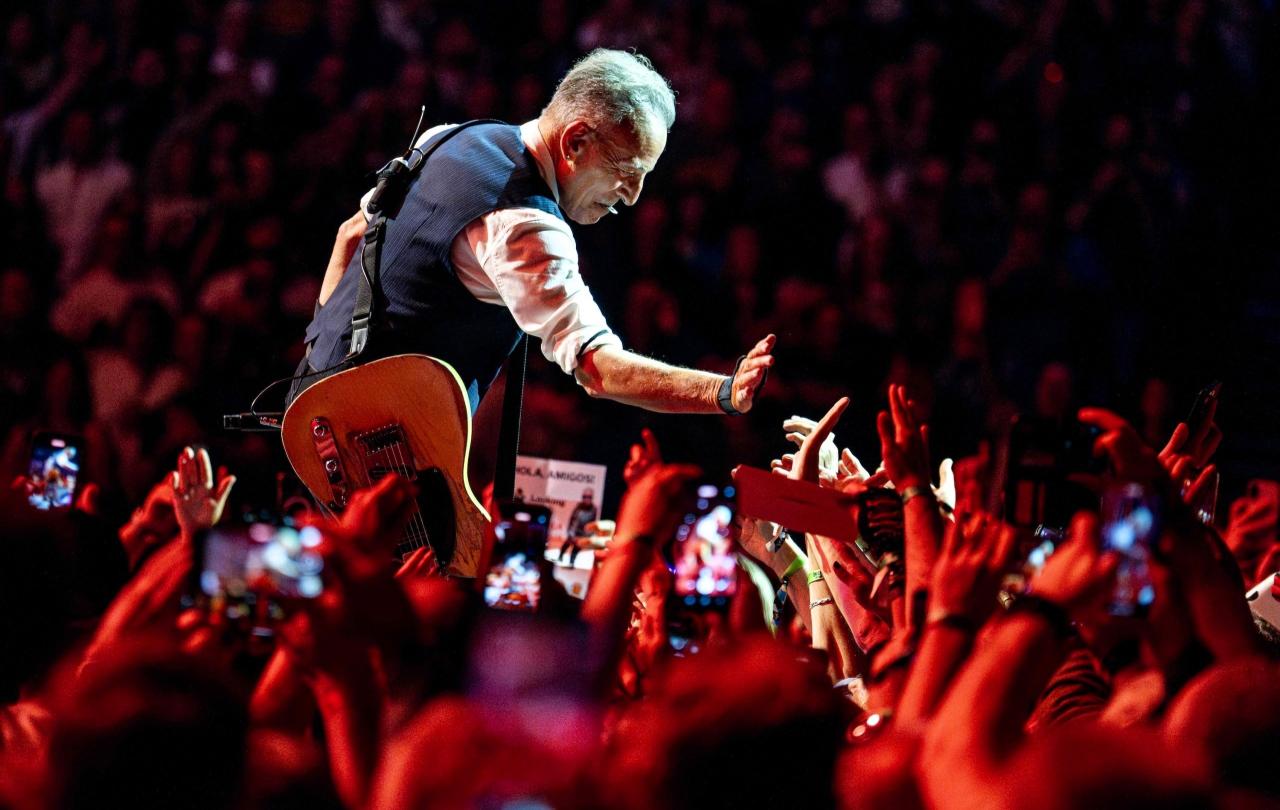
Bruce Springsteen crouches down and holds a hand out to a sea of outstretched hands
Springsteen plays Manchester.
Brucespringsteen.net.

I finally got to experience a Bruce Springsteen concert recently. Which is to say, for three hours, I touched a land of hope and dreams.  

We walked along a canal to get to the arena – my husband, my father-in-law, and me –Manchester shimmered with the arrival of summer, and light bounced off red brick and still water. We neared the arena and the air felt dense with anticipation. T Between us we carried heartbreaks, elections, hopes, failures, and a collective return to music that had accompanied and clarified it all. We were drawn by loyalty and nostalgia and joy, but also I sensed by a hope that Bruce would meet the moment — the frayed, furious, anxious now — with something that mattered. 

We found our seats and gripped our drinks as the lights dimmed. Thousands of people stopped individual conversations, and hushed, and then joined voices into a deep and reverent chant. “Bruuuuuuuce”. To my right, the glow of a screen, the woman holding it sending a text – “yes babe, 1pm, lovely” – and it seemed incongruent and true. In the tension before the release, in the dark before the light, we hold our breath even as the ordinary carries on. The ordinary carries on even as the world fractures and glows. The ordinary is what Bruce often sings of, it is one reason why fans feel heard and seen by him. That night though, all the ordinaries he sang of formed something extraordinary.  

Then there was light, and Bruce walked slowly from the side to the front of the stage, his guitar suspended across his body, his face a relaxed, broad smile, his bandmates and companions beside and behind him. Then there was music. No videos, no pyrotechnics; just old songs that felt as if they existed for the now. My City of Ruins, Death to My Hometown, Land of Hope and Dreams, The Promised Land. The song Long Walk Home was introduced as a “prayer to my country”. It is a country that he embodies, despairs of, and loves. He sings of his home with fury, sorrow, tenderness, and love.  

Riffs and rhythms that were decades old were being made urgent again. Springsteen’s music holds both grit and glory, and hard-won joys leave space for sorrow. I write this and lines by Mary Oliver come to mind: “We shake with joy, we shake with grief / what a time they have these two / housed as they are in the same body.” What a time they had, joy and grief, that night with Bruce.  

The evening unfolded not as spectacle but as liturgy; all of us involved in something like devotion – in part to Bruce, but also to moral clarity, to the power of poetry, to the promise of who we could be. At times the crowd seemed silent, ushered into something deeper – not entertainment or escapism, but something like confrontation and communion. We were being offered the joy of music and memory, but also an opportunity to reckon with who we are.  

Between songs, Bruce spoke. He apparently rarely does so in his gigs. His voice slowed and deepened – not chit chat, not to entertain, but to bear witness and stand defiant and call us to the best versions of ourselves. “I’ve spent my life singing about where we’ve succeeded and come up short in pursuit of our civic values,” he said. “I just felt that was my job.” He proceeded to describe how those values are being torn apart, and why they matter. The crowd roared. He was making civic values shine, speaking about them with urgency. He acknowledged both the dream and the failure, but still he believes in the promised land and he asks us to as well. Before he belted out Rainmaker, he said, “when conditions in a country are right for a demagogue, you can bet one will show up.” He spoke of America, and really of the world – what it is, what it is becoming. His honesty and poetic rage situated us, then became a map for how to keep going.  

We can be glad to be alive even while we are honest about sorrow, injustice, broken politics, fractured families, and tired hearts. 

I found myself wondering: why is it that Bruce can sing and speak about justice, warped politics, and who we are becoming, and be met with cheers, while so many churches avoid doing so, preferring instead to whisper in neutral tones while the world burns? That night, I stood in a crowd of thousands and I heard a kind of moral clarity that orientates the soul and made me cry. It wasn’t partisan, it was human. Why can it feel riskier to speak specifically and prophetically in a sermon than in a stadium? I wonder if it’s because Springsteen has always rooted his politics in people’s real lives – in work, family, grief, memory. He doesn’t gesture toward abstract ideologies for fear of alienating people, or in the hope of retaining fans: he tells stories and gives names to problems and injustices, singing about crooked institutions, boarded-up factories, buses that never come, lovers who don’t come back.  

The evening felt, for me, like the kind of church I long for and sometimes touch: no tidy answers, no insincere lyrics, no vague calls for justice, but rather honesty and specificity and the chance to stand alongside strangers and feel something challenging, beautiful, true.  

I scribbled a question as the music soared: can a chord be mystical? Because that’s how it felt. As if there are progressions – minor then major, dissonance into harmony – that can reach past language and speak directly to the part of us that longs for love more than cynicism, to the part of us that still dares to hope even when there is very little obvious reason to do so, to the part of us wondering how to be truly alive.  

Near the end, Bruce quoted the American writer James Baldwin:

“In this world, there isn’t enough humanity as one would hope. But there’s enough.”

There’s enough. It was a small phrase but it hung in the air like incense. For Bruce, there is enough humanity to keep singing for, and about. Now, he seemed to ask the crowd, what will you do with that enoughness, with that humanity?  

In the final stretch, Bruce leaned hard into hope with songs like The Rising and Born to Run. The energy in the room felt like resistance – not against something, but for something. He didn’t pretend everything’s fine, but he sang anyway. “It ain’t no sin to be glad you’re alive.” 

We can be glad to be alive even while we are honest about sorrow, injustice, broken politics, fractured families, and tired hearts. Gladness is being asked to stand its ground now, and to do something with our improbable aliveness. For the final song, Bruce played Bob Dylan’s Chimes of Freedom. It is a song about lightning and exiles and freedom, about the trembling of the soul and about a sky that “cracked its poems in naked wonder.” He sang it slowly, tenderly, like a prayer – which can also be a trembling of the soul, a song of naked wonder. Perhaps he prayed to God, perhaps to some other sacred thing: our better angels, or the fragile hope of who we might yet become. 

In a BBC documentary about Bruce Springsteen’s history with the UK, someone says “there’s something in Bruce fans, you know you can implicitly trust them.” As we filed out of the arena, it felt like 25,000 of us briefly knew each other, trusted each other, could take on the world together. Perhaps we just had.  

Soon it was just me, my husband, my father-in-law, and the silent dark canal as we walked back into the night. We were tired, we were awake. I thought of Bruce’s belief in the promised land, and of Baldwin’s line: there’s not enough humanity, but there’s enough. These are beliefs that can feel risky. So can belief in God. But enough is plenty. Enough can turn up the volume and let the spirit be our guide. With 25,000 other people, I’d turned that volume up and I could hear the spirit defiant, unifying, guiding. It is – has always been – time to go and sing of it, despite everything.