Written by David Clay. This article first appeared in Mockingbird, 11 November 2025. By kind permission.
Having evolved into a month-long monstrosity of various parties and trunks-or-treats, Halloween has left my daughters with an absurd surfeit of candy. It’s enough to keep several dentists in business. Even so, my children still fear the annual imposition of the dreaded “dad tax,” which they argue is illegitimate due to their lack of representation. My kids have long since learned that no matter how impressive their hoard of candy, it always runs out eventually.
What seemed like an abundance the night before is revealed to be limited supply. In other words, my children are always shocked to discover scarcity.
Most people for most of history produced about enough to keep themselves alive. The Domesday Book (1086 AD), a survey of England commissioned by William the Conqueror, shows that peasants (i.e., people with limited or no land ownership rights who were beholden to a local lord) made up 95 per cent of the population. While peasants in some cases achieved prosperity, this was the exception to the rule of subsistence labor, usually agricultural in nature. For almost everyone, the possibility of starvation was anything but theoretical.
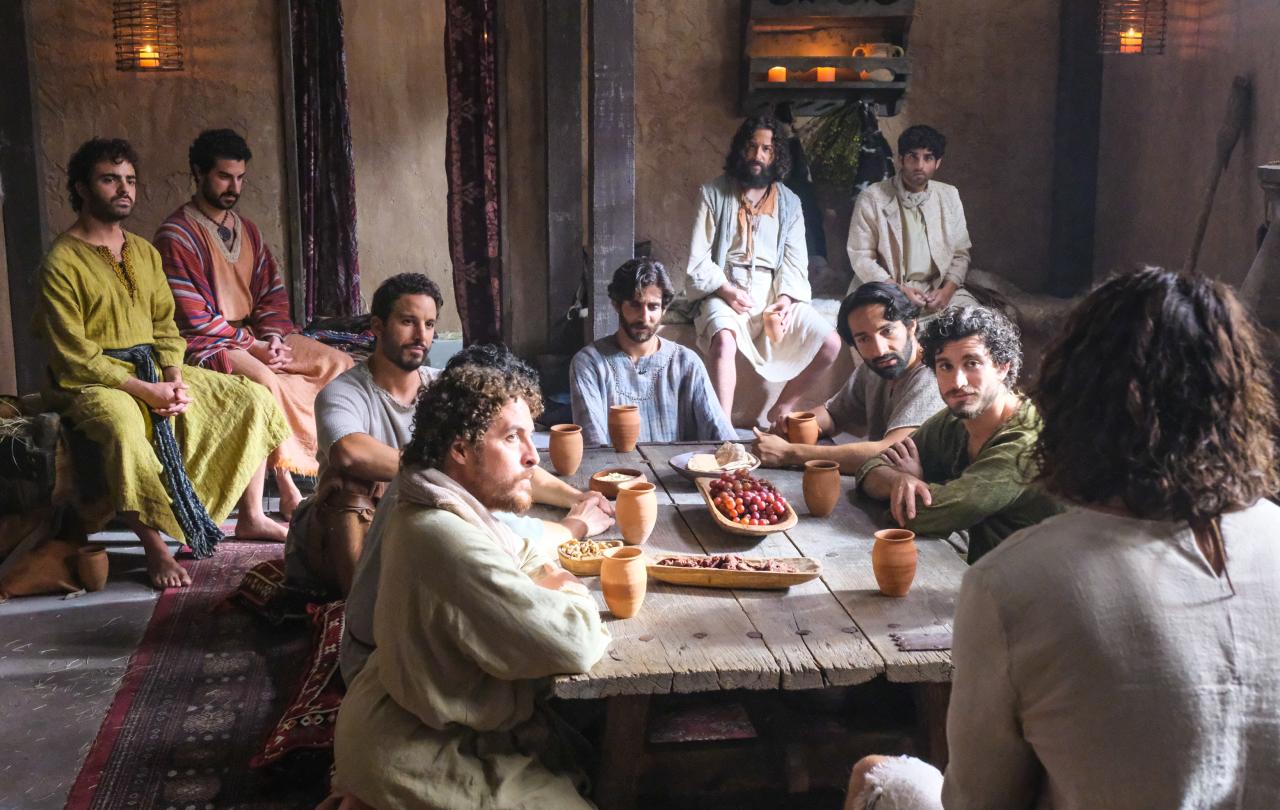
In that respect, the situation in early medieval England was little different from that in first-century Palestine. There as well, nine out of ten people made just enough to survive — and, sometimes, not even that much. Both Josephus and the New Testament mention the mid-century famine (44–48 AD) that devastated Judea. There was no social safety net in that time and place. People could and did starve to death.
It was to people permanently conscious of scarcity, then, that a certain self-styled rabbi — until very recently a day laborer himself — said,
“Do not be anxious about your life, what you shall eat or what you shall drink, nor about your body, what you shall put on. Is not life more than food, and the body more than clothing? … But seek first his kingdom and his righteousness, and all these things shall be yours as well. Therefore do not be anxious about tomorrow, for tomorrow will be anxious for itself. Let the day’s own trouble be sufficient for the day.”
Jesus’ audience would have agreed that provision ultimately comes from God. But “don’t be anxious about tomorrow”? In a world where starvation is always just a bad harvest away? Jesus, with a straight face, is instructing his audience to live as if abundance, not scarcity, is the ultimate reality in life. Not for the first time, he seems more than a little disconnected from what it’s actually like to live on this planet.
Insofar as some of us moderns in industrialized societies are a little less worried about starving or dying from exposure, this is thanks to human ingenuity (thank you very much) coming up with ways to radically increase our productivity. An undeniably magnificent achievement — but also one that’s exacerbated other forms of scarcity.
Think, for instance, of the “attention economy,” the battle to secure ever-shrinking attention spans. The very computational tools that have made our contemporary standard of living possible have also hooked us up to a constant pipeline of far more information than we could ever possibly process. So much so that the act of paying attention, seemingly a basic feature of being human, is valued at an increasing premium.
Or, consider time. The mid-twentieth-century economist John Maynard Keynes speculated that automation and enhanced productivity would naturally result in less stress and more leisure time. What he did not foresee is that increasing productivity increases expectations of how productive we should be. Time, in all times and places, is the ultimate “vanishing asset,” but the proliferation of time-management strategies and gadgets tells us, I think, that time seems even more limited when we are expected (or expect ourselves) to hustle and grind.
I don’t think it’s much of an exaggeration to say that scarcity is the single most pressing reality in human experience. In some form or another, this is true of every human culture. We combat scarcity with the urge to simplify, to streamline, to do more with less, to find life hacks, or invent new technologies.
Jesus, however, tells us to ignore it. Or, at least, to behave as though scarcity is not that interesting or important. God feeds the birds and clothes the lilies; you’re more important than a bird or lily to God; ergo, God will take care of you. Stop stressing.
This doesn’t feel aspirational or inspirational. It feels insane. I have a mortgage. I have three girls to put through college. I need money, energy, focus, and time, not the bizarre exhortations of some mystic. Does Jesus even know about inflation?
But the weird thing is that, yeah, he does. Jesus is very much not detached from the realities of everyday life in his time and place. He is up on current events like collapsing towers and the machinations of Herod Antipas (“that fox,” Jesus calls him. Not a compliment). He seems a little bored by politics, but he’s definitely not naive about the power structures and major players in Galilee and Judea. He makes a conniving, dishonest middle manager the hero of one of his stories. Politics, taxes, sectarian violence, collapsing infrastructure — the Gospels describe Jesus interacting with a world very different than our own, but one that’s still immediately recognizable.
The difference is that I tend to think of inflation data, budget fights, geopolitical maneuvering over scarce resources, and supply chains as “the real world,” while the kingdom of heaven is something lovely but also a bit airy, a little insubstantial. Jesus saw things in exactly the opposite way. The kingdom is Reality, while the lords of the gentiles, the payment of taxes, even the pressing daily concerns for food and clothing, are all fleeting or at most secondary. And the kingdom is abundant, for its King doesn’t give stones when his children need bread.
What does it mean to live as if abundance and not scarcity is the final word? I don’t know. What I do know is that what really feels insane, some days, is thinking I can conserve enough time, money, energy, focus or whatever else to build a life in which I find fulfillment or peace. There are cracks in my no-nonsense, economically rational world that beckon me to ask, what if I have no money, time, energy — nothing but my daily bread — only to find that I already have all I need?
Support Seen & Unseen
Since Spring 2023, our readers have enjoyed over 1,500 articles. All for free.
This is made possible through the generosity of our amazing community of supporters.
If you enjoy Seen & Unseen, would you consider making a gift towards our work?
Do so by joining Behind The Seen. Alongside other benefits, you’ll receive an extra fortnightly email from me sharing my reading and reflections on the ideas that are shaping our times.
Graham Tomlin
Editor-in-Chief