Explainer
Culture
Royalty
4 min read

How faith helped the monarchy flex

Understanding how the British monarchy has evolved, means understanding its foundation in faith. Ian Bradley explains.

Ian Bradley is Emeritus Professor of Cultural and Spiritual History at the University of St Andrews.

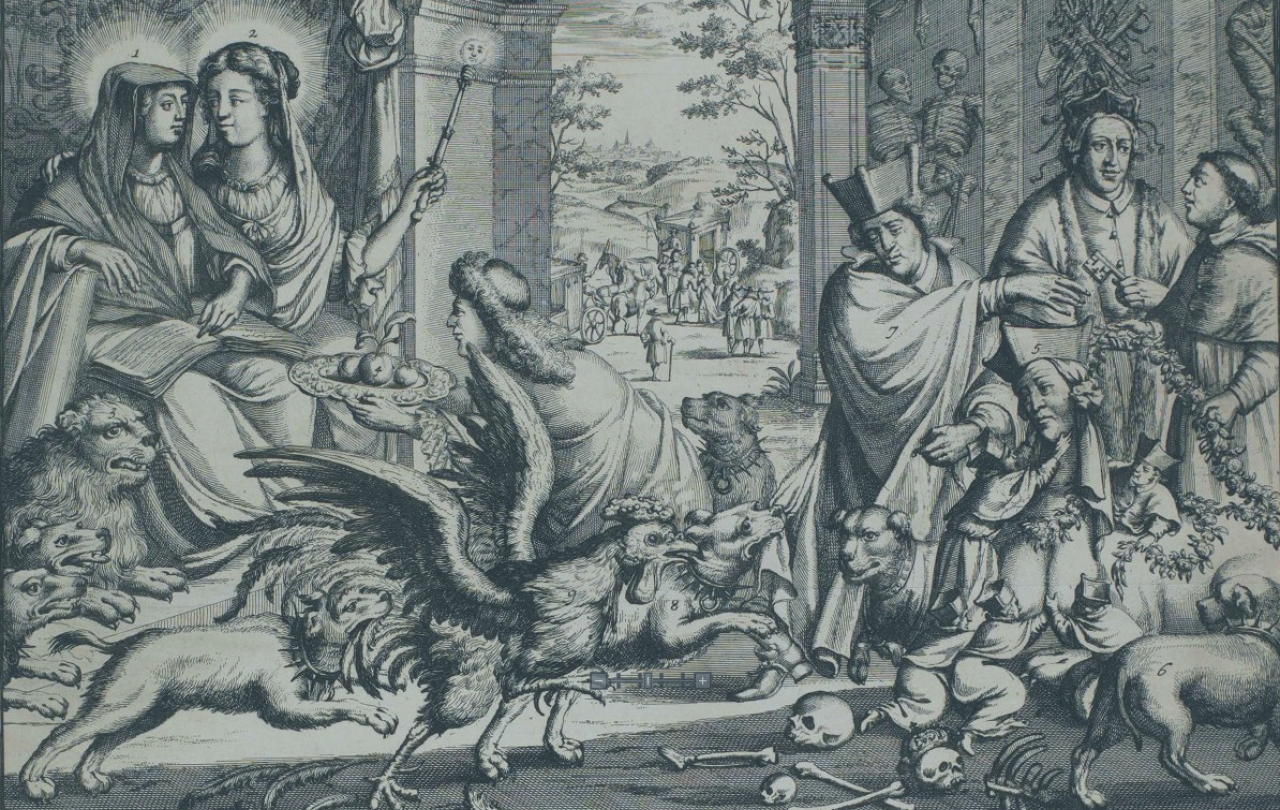
an etching shows William and Mary is a classical scene, priests stand to their right while dogs chew bones at their feet.
A broadsheet illustration celebrates William and Mary, and the Glorious Revolution of 1688.
Lambeth Palace Library.

Christian monarchy has played a central part in the history of the British Isles, promoting the rule of order, justice and mercy in conformity with the values of the kingdom of God and cementing a close alliance between the institutions of crown and church.  

Both these aspects are well illustrated in the life and deeds of the first English king to convert to Christianity. Aethelbert, who ruled Kent from 587 to 616, seems to have come to faith through a combination of the influence of his wife, Bertha, the daughter of a Frankish Christian king, and the preaching of St Augustine, who arrived in Thanet in 597, having been sent from Rome by Pope Gregory. According to one account, 10,000 of Aethelbert’s subjects followed him in converting and underwent a mass baptism. Among his first actions as a Christian king were to issue the first set of laws in the English language and to grant land to Augustine on which to build an Abbey, which later became Canterbury Cathedral.  

Reign responsibly 

Exemplified by such figures as Arthur and Alfred, Christian kingship brought new titles as well as new responsibilities for Britain’s rulers. The first to be appropriated was that of ruling through the grace of God, or Deo Gratia, the idea that is still expressed on every coin of the realm through the abbreviation DG. The late eighth-century Anglo-Saxon king Offa described himself as ‘by the divine controlling grace king of the Mercians’. From the mid-tenth century, several English kings also began styling themselves Christ’s Vicar or deputy. Edgar, Alfred’s great grandson who ruled from 957 to 975, so described himself when founding a new monastery at Winchester in 966. Some years later Ethelred II stated that ‘the king must be regarded not only as the head of the church but also as a vicar of Christ among Christian folk’. 

Cult kings 

The Middle Ages saw the flowering of the cult of Christian monarchy as both splendid and servant-like, pious and chivalrous, full of knightly virtue, gung-ho triumphalism and miraculous powers, as exemplified in the widespread belief that the king’s touch could cure those suffering from scrofula. While Medieval monarchs cultivated magnificent splendour, they also espoused the theme of the servant-king and acknowledged their utter dependence on God’s grace. Both these elements were reflected in the civic triumphs staged around Epiphany or Advent for the entrance of monarchs into the cities of their realms with the king being portrayed as the type of Christ and the queen as the bearer of heavenly glory. Deliberately modelled on Jesus’ entry into Jerusalem, they served as a reminder of the journey to be undertaken by all souls, including royal ones, towards death and the throne of heaven.  

Moderate monarchy 

The crown played a crucial part in the English Reformation which was initiated by Henry VIII with the help of his loyal lieutenant Thomas Cranmer. Together they created what was effectively a nationalised state church of a moderately Protestant hue with the monarch at its head, bishops and a conservative liturgy in English. Subsequent sovereigns made their influence felt on the emerging Church of England, with Edward VI steering it in a more Protestant direction and playing a key role in the preparation of the first English Prayer Book of 1549, and Elizabeth steadying it to produce the Anglican via media which has remained one of its distinguishing characteristics to this day.  

The monarch's headship of the Church of England was a key part of the Reformation settlement. It was established in the 1534 Supremacy Act which declared King Henry VIII 'the only supreme head in earth of the Church of England' with full authority to intervene in its affairs. Elizabeth I modified the monarch’s title from ‘Supreme Head’ to 'Supreme Governor', which it has remained ever since. Alongside it goes the title of ‘Defender of the Faith’, represented on coins as F.D., originally given to Henry VIII by the Pope in 1521 for his defence of the traditional sacraments of the Catholic Church against the novel teaching of Martin Luther. Although revoked after the Reformation, it has continued to be used by and about all monarchs since, although its meaning has never been precisely defined. 

Media monarchy 

Stuart monarchs tended to push Christian monarchy in a more absolutist direction, being enamoured of the doctrine of the Divine Right of Kings, although they also did much to forward Christianity in their realms. James VI of Scotland and I of England made a particularly valuable contribution in his patronage of the version of the Bible which still bears his name and is also known as the Authorised Version. He was adamant that it should not be a narrow reflection of a single theological position but rather an irenicon, or instrument of peace, breadth and moderation in the new United Kingdom over which he reigned. 

Modified monarchy 

The so-called Glorious Revolution of 1688-9, when James II was deposed because of his Catholicism and perceived absolutism and William of Orange invited by Parliament to occupy the vacant throne, effectively signalled the triumph of a covenant theory of monarchy over that of divine right. The constitutional settlement that followed it rested on a concept of limited monarchy and was based on an essentially secular concept of social and civil contract. However, neither the Reformation notion of the godly prince ruling the godly commonwealth nor the close connections between Crown and Church were swept away. Indeed, they were strengthened, with the role of the United Kingdom monarch as protector of Protestantism being expressed in the accession and coronation oaths still taken today. 

Modern monarchy 

Christian monarchy developed in nineteenth and twentieth century Britain to focus much more on philanthropy, civic duty and spiritual leadership demonstrated through attendance at religious services and public exhortation. The close relationship between the crown and the churches, and especially the Church of England, has remained strong while being extended in recent decades to other faith groups as the monarch has increasingly taken on the role of ‘Defender of Faith’. Television has made the monarch’s Christmas Day broadcast a significant national moment of spiritual reflection.
 

Article
Art
Culture
Film & TV
5 min read

The constant pull of David Lynch’s direction

What made the director’s films so universally resonant?

Sonny works creatively with videography, graphic design, fashion, and photography.

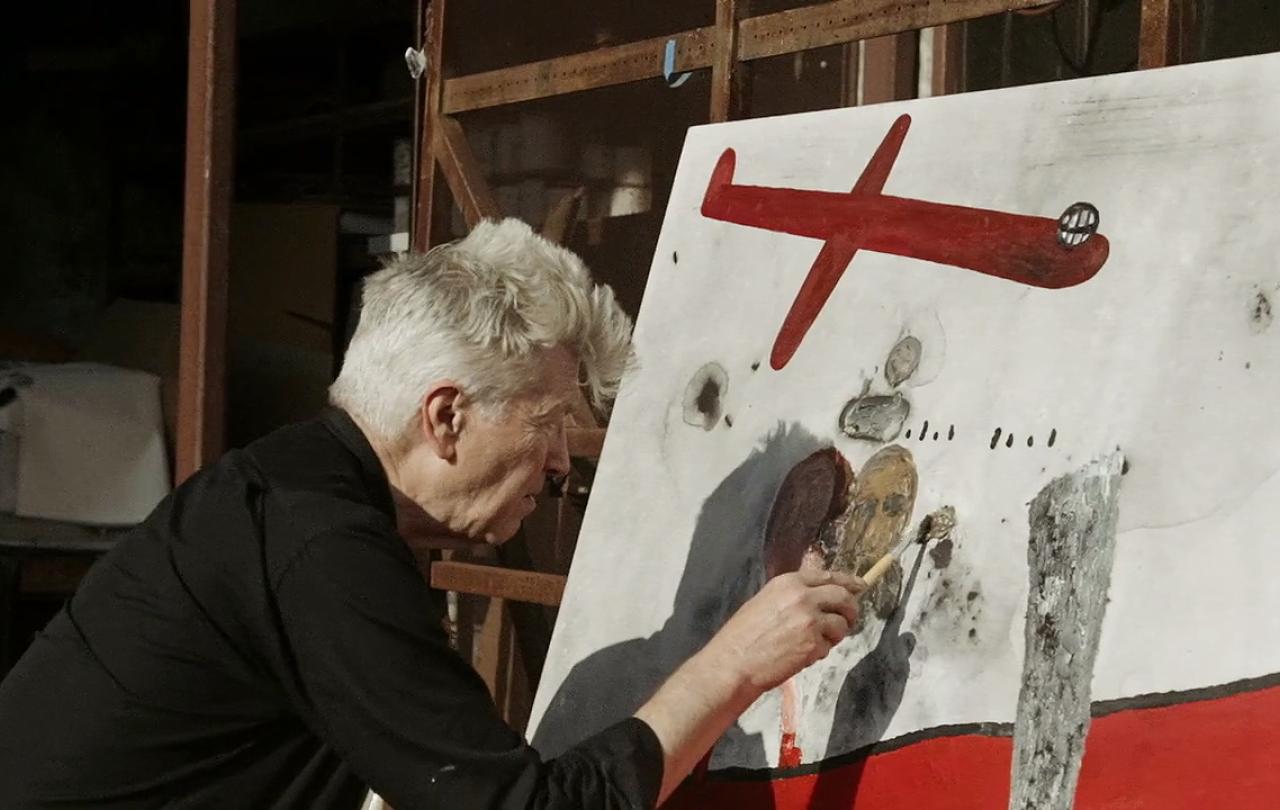
A man paints a canvas with red images.
Lynch painting.

At the age of 16, initially wanting to experience the infamous performances of actors, John Hurt and Anthony Hopkins, I decided to watch The Elephant Man (1980). This was the film that opened up the weird and wonderful world of director, David Lynch, a world I immediately wanted to dive headfirst into.  

I did so by watching the film that became the catalyst for world-renowned director and producer, Mel Brooks, offering Lynch the chance to direct The Elephant Man. The film in question? His very first, Eraserhead (1977).

It was, and remains to this day, the most singular cinematic experience of my life. 

I’m of the opinion that almost all filmmakers fall in to one of two categories; those who become artists through the medium of filmmaking, and those who are already artists who choose the vehicle of filmmaking to create their art. David Lynch is, for me at least, the ultimate embodiment of the latter. Proof of such can be found in his status as a renaissance man.  

Originally a painter, a practice he continued throughout his life, his desire to transition to making films was borne out of wanting to see his paintings move. He was also an actor, a musician, and sound designer. Not to mention, a furniture designer who regularly built props for his films, author of several books and designer of his very own comic book.  

The television show, Twin Peaks, is perhaps the best example of just how impossible it was to bind Lynch to a single artistic form. The seminal TV show revolutionised what television could be, as it was the first show to stray from the episodic storytelling format, instead choosing to follow one continual storyline through an entire series. 

David Lynch exists within an exclusive category of artists, those whose names have become an adjective. Lynchian, similar to Kafkaesque, Brechtian or Daliesque, is recognised as an official word in the Oxford dictionary. An eponymous adjective is an honour reserved for only the most unique and distinct of artists.

Although it could be argued that the term – Lynchian - is now too loosely applied to anything deemed to be somewhat counter-cultural within mainstream cinema, its true meaning relates to the often indefinable style and voice of the man himself.  

He invoked the spiritual depths of us, the existential longings and cravings, the questions that seem intrinsic to the human condition, the wonderings that feel as though they originate from somewhere deep within us, our souls, perhaps. 

I’ve come to think that it’s the ultimately the spiritual essence of Lynch’s films that make them truly unique, and him a worthy recipient of an eponymous adjective. Lynch’s films exist within their own world, frequently reminiscent of a dream.  

Sometimes euphoric, often a nightmare. 

He was an avid practitioner and advocate of transcendental meditation, so it’s perhaps not too surprising that when speaking on his creative process, Lynch attributed many of his creative ideas as emerging from his own subconscious through the practices of meditation and daydreaming. He’s often compared ideas to the act of fishing, they aren’t created, they already exist, you’ve just got to have the right bait to catch them.

I wonder if this process is what makes the worlds housed within Lynch’s films unlike any others. He invites us into his own subconscious, by allowing it to bleed out onto the screen. 

Despite his allusivity in style and format, what I’ve always found most confounding about David Lynch’s work is its universality.  

I feel as though the term ‘fringe artist’ has scarcely been better applied to anyone other than Lynch. 

How has a man who’s created some of the boldest, most avant-garde and, at times, downright disturbing art of the last century picked up four Oscar nominations (and an honorary win), a Masterclass and a Disney movie (The Straight Story)?

Surely translating your own subconscious, something we view as idiomatic to each individual person, onto the screen is a guaranteed recipe for alienating your audience?  

So why does Lynch’s work, instead of pushing us away, so consistently pull us in?  

I could pontificate on the different potential techniques Lynch employed to keep his work just grounded enough to allow us to relate to it. His films being rooted in instantly recognisable symbols of Americana, for example. Or perhaps his deployment of easily digestible genres and conventions, Twin Peaks is a melodramatic murder mystery TV show, Blue Velvet (1986) and Mulholland Drive (2001) are, at their core, noir films and even Wild at Heart (1990) is a textbook road movie.  

But Lynch’s work has taught me to dig far deeper than that. 

He invoked spiritual depths of us, the existential longings and cravings, the questions that seem intrinsic to the human condition, the wonderings that feel as though they originate from somewhere deep within us, our souls, perhaps.

That, for me at least, is the answer to his universality. 

But how did he do it? 

As has already been mentioned, it’s by mining his own subconscious and the spiritual within himself, and allowing it to flow into the worlds he created. But, most importantly, he never definitively characterised these things, he simply let them exist, depicted them. His work doesn’t come to us with the answers, it comes to us with questions. David Lynch’s questions: questions about the world. Questions about himself.

The very same questions we all ask ourselves on a daily basis: is evil within us or is it the product of what is around us? How can we allow light to prevail over darkness?   

His work allows us to sit, ruminate, and respond to those questions. 

I didn’t anticipate how profound of an effect David Lynch’s passing would have on me. It’s undoubtedly the strongest feeling of loss and grief I’ve felt from the passing of someone in the public sphere.

So deep were my feelings that I felt I needed to process it through the writing of this piece.  

And despite the myriad of feelings and thoughts that have been swirling around my head since originally reading the news headline, I find myself continually returning to the very first thought I had. It was a quote from American comedian, Theo Von. When mourning the death of fellow comedian, Norm Macdonald, Theo said, 

‘It feels like you’re losing a book that nobody has copies of.’ 

I feel despair that I’ll never be able to see the world through David Lynch’s eyes again. But I find great comfort that he, through his art, has passed his vision onto us, ensuring that we’ll always be able to see the Lynchian in our world.