Snippet
Comment
Eating
Fun & play
Resurrection
2 min read

How do you drink religiously?

A Dry January ad catches the eye.

Jonathan is a priest and theologian who researches theology and comedy.

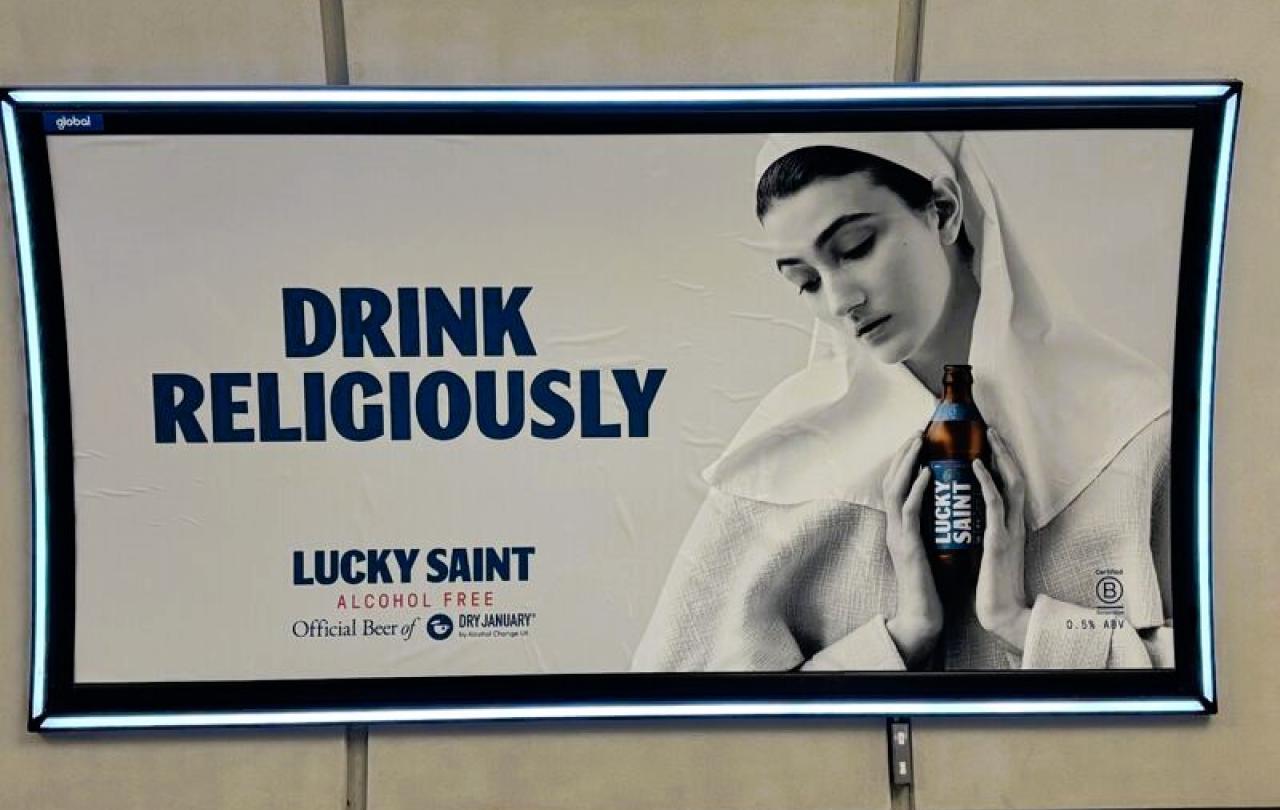
A subway billboard ad show a nun cradling a beer.
Lucky Saint.

On a recent trip across London, I was slightly surprised to be exhorted multiple times to “Drink Religiously.” For those of you, like me, not from the capital, this is an ad campaign for Lucky Saint non-alcoholic beer.  It features an image of a nun in a classically pious pose, cradling in her hands a bottle of the apparently blessed brew. 

Further research (by which I mean a quick Google search), revealed the beer is a new arrival on the scene, and is the “official” beer of dry January. And the name? Well the website claims it is “a wry nod to the virtuousness of drinking alcohol-free.” 

Christian nerd that I am, this ad got me thinking. What should we make of the suggestion to “drink religiously”? 

Well firstly using the imagery of religion to advertise beer feels a little new. Doing things “religiously” has not tended to be seen as a positive, and so it hasn’t been a key part of the advertising strategy of brewers: an advert that tells you to drink sinfully sounds a lot more plausible. Maybe this is over-reading things, but the ad is emblematic of what we are increasingly observing – our culture feels more open to God, or at least to religion, than it was. Even if all we do with that openness is sell stuff. 

That said, the ad also works because it assumes we all know what religion is, so much so that we know what “drinking religiously” would involve. Religion, in the language of the ad, is concerned with moral uprightness. Obviously religious people, if they are going to drink, are going to drink alcohol free beer, because we all know that alcohol is morally bad, or so the implied argument goes. They even use that rather unfashionable word virtue. There’s more than a hint on the website that drinking this beer makes you just a little bit better than everyone else. 

But what might Christian religious drinking be? Well, I can only speak for myself, but the ad made me think about Communion – that strange moment in church services where Christians drink wine to remember, and somehow partake in, Jesus’ blood. 

Now, Communion is an incredibly rich topic and has layer upon layer of meaning. But one thing we remember as we eat bread and sip wine, is that we are precisely not better than other people. That to be “religious”, or better still to be Christian, is not to be more virtuous than others, if anything it is to be more aware of our need. 

When we come to take Communion, we come with empty hands, and are fed. We come acknowledging not our luck but our weakness, and are given drink. We come with our need and are met by the God who gives us more than we can imagine, because he gives himself. 

What might it mean to “drink religiously”?  

Call me a cynic, but I think it might be something other than just enjoying the taste of beer without risking a hangover. 

Perhaps it might mean to meet with Jesus Christ in a sip of wine on a Sunday morning. 

But then I haven’t actually tried Lucky Saint, so who knows, maybe drinking it really is a religious experience. 

Cheers. 
Article
Community
Creed
Sin
3 min read

In the city of broken windows

Our fractures become fractal, breaking bigger and bigger windows.

Jamie is Vicar of St Michael's Chester Square, London.

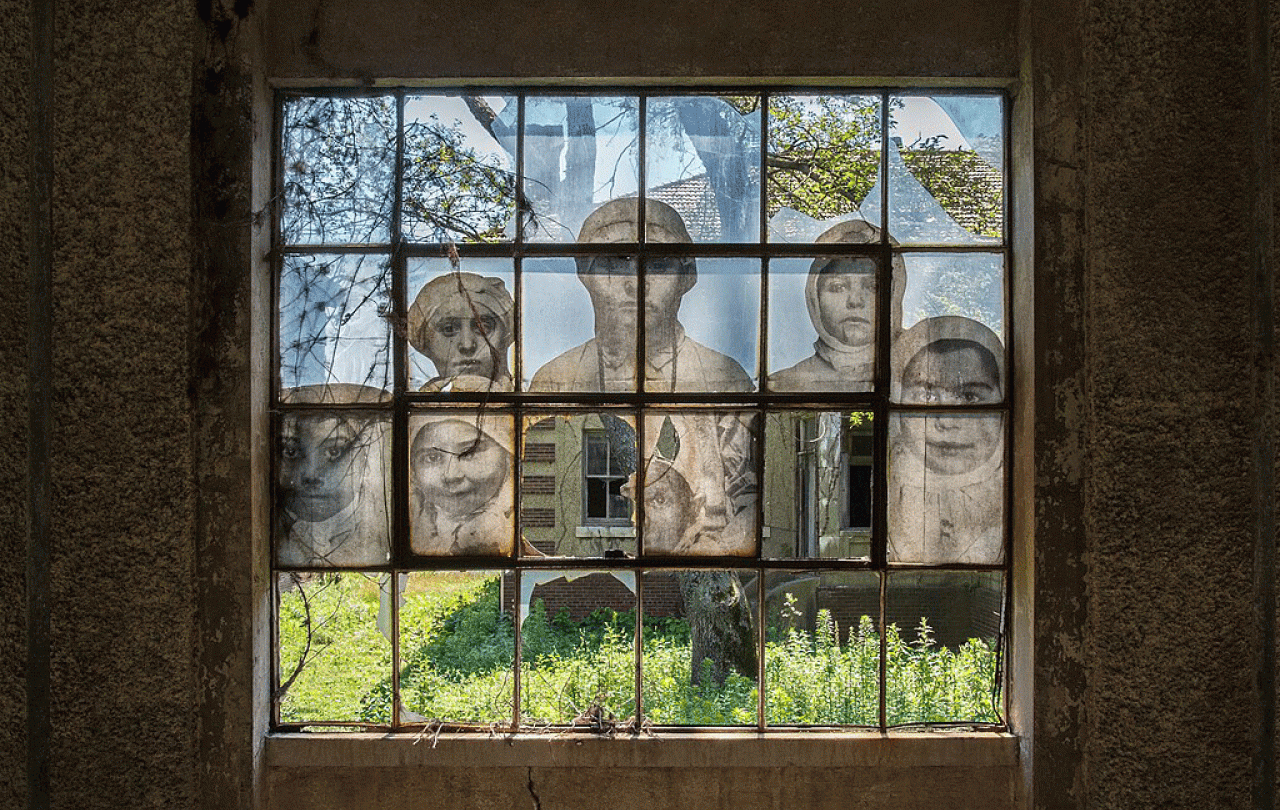
a multi-paned window mural shows people while amid it are broken window panes.
A broken window mural, Ellis Island Immigrant Hospital.
Rhododendrites, CC BY-SA 4.0, Wikimedia Commons.

We weren't expecting a knock on the door from our next-door neighbour on New Year's Day. It was pouring with rain, and said rain was pouring into the boot of our car, with the window smashed. Thanks for letting us know. Annoying, inconvenient and expensive. But just how expensive is a smashed window? 

The 'broken windows theory', that visible signs of crime, antisocial behaviour and civil disorder begets more serious crimes, was introduced American sociologists James Q. Wilson and George Kelling: 

'Social psychologists and police officers tend to agree that if a window in a building is broken and is left unrepaired, all the rest of the windows will soon be broken. This is as true in nice neighborhoods as in rundown ones. Window-breaking does not necessarily occur on a large scale because some areas are inhabited by determined window-breakers whereas others are populated by window-lovers; rather, one un-repaired broken window is a signal that no one cares, and so breaking more windows costs nothing. (It has always been fun.)' 

This is not an academic theory. Where I live in London, i took the local council 1,315 days to replace a local resident's broken window. The sense of decay extends beyond borders, with fewer than half the residents thinking they live on clean streets, with rubbish and weeds gone unchecked. It is also one of the worst boroughs in London for varying types of crime, and over the past few years often being the worst. It's hard not to think the little things and the big things are linked. In other news, the now-resigned CEO of the council has pleaded guilty to drink-driving, failing to stop after a car crash and driving without insurance, and not guilty to possession of cocaine. 

Our problems in society all found their greenhouses somewhere inside of us.

Crime is on the move. As homes have become more difficult to burgle, crime has been pushed out onto the streets with shoplifting and bike theft. The Economist recently reported that 'stolen bikes and e-bikes have also become the getaway vehicle of choice for thieves, according to the Merseyside police. In one way or another, some 80 per cent of acquisitive crime in Liverpool involves a nicked bike.' It's going to be fascinating to see the wider impact, but simply by stopping suspicious riders and marking thousands of bikes across Liverpool, reported thefts have fallen by 46 per cent between July 2023 and July 2024 compared with the previous year. 

These problems can't be solved by overstretched police or the council. Everyone's responsible so no one's to blame. Practical implementations of the broken windows theory have not been without controversy. But for those of us who live in urban environments, to look out from our homes is to see a city of broken windows. The impact is more than weeds 'uprooting' pavements: it's an uprooted society. Correlation and causation might be blurred, but that's the point. In Christianity, sin is understood as having a polluting effect. Just as fossil fuels in China will pollute the atmosphere for someone in Scotland, sin is not hermetically sealed. Our problems in society all found their greenhouses somewhere inside of us. 

Jesus said 'what comes out of you is what makes you 'unclean'. For from within, out of your hearts, come evil thoughts, sexual immorality, theft, murder, adultery, greed, malice, deceit, lewdness, envy, slander, arrogance and folly. All these evils come from inside and they make you 'unclean'.' They pollute our lives. And they pollute the world around us. 

The Christian church, much like many institutions, is reckoning with prioritising competency at the expense of character. Little sins are not so little when they permeate and promote a culture where certain sins are permissible. Our fractures become fractal, breaking bigger and bigger windows. 

All this sounds pretty bleak and Dickensian when of course there's always another city to see: full of life, vibrancy and joy. But we'd be wilfully ignorant to ignore the disorder of broken windows and broken lives all around us. It might overwhelm us, or our eyes might glaze over as we see those broken windows. But we'd do well not to ignore the broken windows within us too. For our sake, and the sake of our streets.