Review
Culture
Film & TV
Monsters
5 min read

Here’s what Death of a Unicorn gets very wrong

‘The unicorn was a Christ-allegory’ and other lies.

Iona is a PhD candidate at the University of Aberdeen, studying how we can understand truth. 

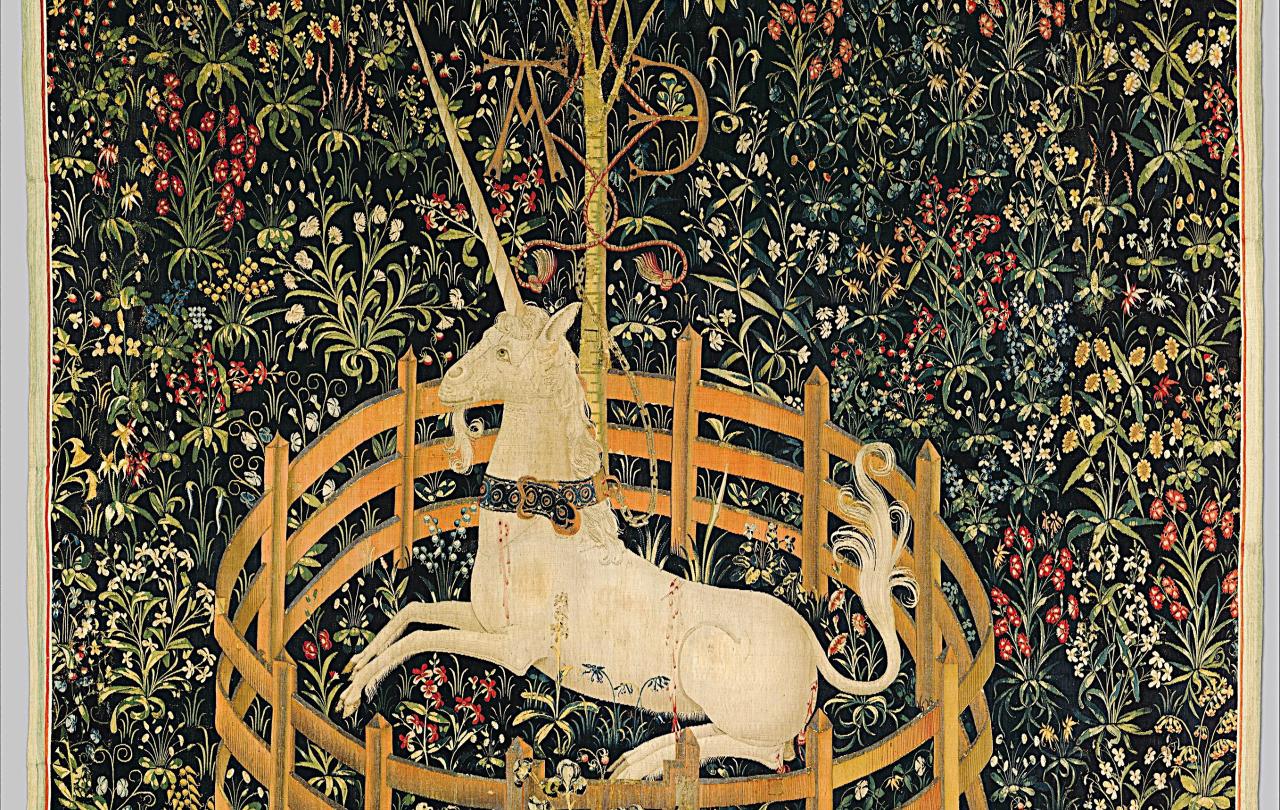
A tapestry depicts a unicorn resting within a fenced enclosure.
The Unicorn Rests in a Garden (from the Unicorn Tapestries).
Public domain, The Met Museum.

I don’t do horror or gore. And yet, I just saw the gory creature feature comedy horror Death of a Unicorn. I have not seen such a clichéd movie in a very long time (probably since Don’t Look Up…). Death of a Unicorn gives us a strained father-daughter relationship, the artsy young girl with silver rings on every finger and dyed hair, cartoonishly evil rich people, their creepy but stupid blonde son, the put-upon butler… and… the unicorn. However, the biggest cliché of them all is perhaps the desperate attempt to subvert expectations and tell a new story about a familiar trope… and failing.  

Given the title of the film, one would be forgiven for assuming that unicorns play a significant role in it. One would be mistaken. The conceit of killer-unicorn is a fun one. I wish the film had played with it more. Instead, the unicorns themselves barely feature and are not particularly interesting or subversive. The perception of the unicorn that is put forward by the characters likewise is trite and tired.  

The film features another classic scene: the ‘plucky young woman digs out her laptop and falls down a google rabbit hole to research paranormal/fantastical phenomenon’. In her research Ridley comes across a set of medieval tapestries depicting a unicorn hunt. These tapestries do exist in real life and are indeed now housed at The Met. The Met’s fictional website in the film informs Ridley that the fifth tapestry in the series ‘The Unicorn Surrenders to a Maiden’ only survives in fragments (true) and that scholars believe the missing part of the tapestry most likely showed the unicorn going on a murderous rampage (very much not true). From this, Ridley deduces that, since unicorns do indeed appear to be real, the warnings of old ought to be heeded. In the film, Ridley is proved right, the unicorns do turn out to be murderous monsters out for the blood of those who would abuse the remains of their dead foal.  

While the real Met website does indeed show us the torn tapestry, it features no such conjecture about the gory violence the unicorn might have inflicted prior to being subdued by the maiden.  

In one of her desperate attempts to reason with the megalomaniacal pharmaceutical tycoons, Ridley slips in a sentence about the unicorn serving as an allegory for Christ. This is a claim that is repeated all across the internet in various fora, fan sites, even some old scholarship. But that is exactly what this theory is: outdated scholarship… mixed with a healthy (unhealthy?) dose of paternalistic attitudes towards the past and half-misremembered folklore about Christian symbolism. It is true that medieval art is rich in symbolism. It is also true that medieval European cultures were deeply steeped in Christian religious traditions. However, as Barbara Drake Boehm writes in her recent book on the tapestries ‘the Cloisters Hunt for the Unicorn tapestries have … fallen victim to a tendency to perceive Christianity in every stitch’. The fact that one of the hunters has a scabbard that invokes the ‘Queen of Heaven’ (the Virgin Mary), or that another carries rosary beads, are most likely simply indicative of the fact these were common items ‘within the majority-Christian society in which the tapestries were created’. (A Blessing of Unicorns, The Metropolitan Museum of Art, 2020).

This contrived and at the same time lazy interpretation speaks of a deeply patronising and arrogant attitude to the past. 

One doesn’t need a degree in art history to figure out that such an allegorical relation would make no sense either. If the unicorn was representative of Christ and the hunt of his Passion, why does the unicorn fight back? If the untouched maiden in whose lap the unicorn reposes is the Virgin Mary, mother of Christ, why does she help the hunters trap and kill the unicorn? The tapestry that supposedly shows the unicorn resurrected and at peace in its captivity does not even appear to belong to the same narrative as the other tapestries. And why would a resurrected Christ-figure be shown in supposed captivity?  

This contrived and at the same time lazy interpretation speaks of a deeply patronising and arrogant attitude to the past. ‘Ah, well, back then they were all religious fanatics that believed in silly things like Jesus and unicorns.’ The implication being that in our modern, enlightened state we couldn’t possibly be accused of believing in silly simplistic mythical accounts of the world… Yeah. Not only is this of course false, it also distract from the very real things we could learn from the past.  

The film in the end wants to have it both ways. It wants to ridicule medieval people (based on lazy stereotypes) as well as perpetuating some of the most backward attitudes woven into the tapestries. So, what is the real true meaning of the tapestries and of unicorns? I don’t know. I can’t offer ‘real true’ interpretations (because they don’t exist). What I can offer is a careful and close engagement.  

What strikes me about the myth of the unicorn is what the unicorn does stand for. Over the centuries the unicorn has been used as a symbol for purity, innocence, humility, and sometimes fertility. In medieval poetry the (male) bard would often cast himself as the unicorn, beguiled by his beautiful lady, desiring nothing more than to rest his head in her lap. Little of this particular metaphor has survived into the modern pop-culture. What seems to have survived is the strong connection with young virgins. This particular trope features heavily in the film too though the film makers attempt to gloss over the sexual implications of ‘virgin’ by speaking only of ‘maidens’ (which still means the same thing but doesn’t have the same sexual baggage for modern ears).  

Now, that is indeed an interesting aspect worth unpacking. Why is it that unicorns are so attracted to young women who have not had sex? Why the obsession with virginity and the implied association that – for a woman! – having sex sullies something pure? What does it mean that both the hunters in the tapestries and the rich people in the film use a woman’s body and sexuality to trap the unicorn and commit their violence? Where’s the film that deals with those questions? Until they make that one maybe I’ll stick with My Little Pony, I’m told that has significantly less disembowelment.  

Celebrate our 2nd birthday!

Since March 2023, our readers have enjoyed over 1,000 articles. All for free. This is made possible through the generosity of our amazing community of supporters.
If you enjoy Seen & Unseen, would you consider making a gift towards our work?
Do so by joining Behind The Seen. Alongside other benefits, you’ll receive an extra fortnightly email from me sharing my reading and reflections on the ideas that are shaping our times.
Graham Tomlin
Editor-in-Chief
Article
Culture
Education
Politics
6 min read

Does Gen Z crave the dictator?

If young Brits are turning away from democracy, here’s how to stop it.

Krish is a social entrepreneur partnering across civil society, faith communities, government and philanthropy. He founded The Sanctuary Foundation.

A cat with a small black moustache marking snarls while sitting in front of a tablet.
Kanashi on Unsplash

I knew something was seriously wrong when I hosted a live interactive online assembly for a couple of thousand sixth formers last year. Given a range of emojis the one that was chosen most to represent how they felt about politics wasn’t a thumbs up, or sleeping face, - it was the pile of poo emoji. The vast majority also expressed a deep distrust in government believing they neither listened to nor cared about them. It was then that I realised democracy was in trouble—and not just on the global stage. Here in the UK, a deeply worrying trend is emerging: more than half of Generation Z (those aged 13-27) believe the country would be better off under a dictator. 

Recent controversial polling from Craft, commissioned by Channel 4, reveals that 52 per cent of Gen Z believe the UK should be run by a strong leader who does not have to bother with parliament or elections. Even more alarmingly, 33 per cent think the country would be better off if the army were in charge. If that doesn’t make us sit up and take notice, consider this: nearly half (47 per cent) of Gen Z believe our society must be radically changed through revolution. 

These numbers are staggering. For those of us who have grown up with a strong commitment to democracy, it is unthinkable that the generation raised with the most freedom, the most access to information, and the greatest digital connectivity could be so willing to give up their right to vote, protest, and hold leaders accountable. But before we rush to condemn, we need to ask the hard question: why do so many young people apparently feel this way? 

A lost faith in politics 

What if it isn’t so much that Gen Z has turned against democracy, but that they feel democracy has turned against them? Think about it. Their schools are crumbling. Their teachers are stressed. If they need mental health support or special needs support, they have either a long wait or a hard fight on their hands and probably both. If they want to go to university, they have to take on a debt that will last longer than the time they have been alive. And pity help them if they want to buy a house - statistics suggest they will probably have to wait until they are 33 years old to even think about getting onto the property ladder.  

You might think that these struggles would force Gen Z to become more politically active. But this generation remains the least politically engaged group in the UK. Whilst it is true that currently many are too young to vote, there is also a large proportion who is too disconnected to see the relevance of formal politics. Voter turnout for young people has been abysmal in the last three UK general elections: 

  • 2015: 43 per cent 
  • 2017: 54 per cent (a temporary spike due to Jeremy Corbyn’s appeal) 
  • 2019: 47 per cent 

Compare that to the 70 per cent plus turnout for over-65s, and the message is clear: young people aren’t voting, and in return, politicians aren’t speaking to them. Which only exacerbates the problem. Despite the Labour Party manifesto promise that they would introduce voting at 16, they seem to be in no hurry to introduce the reform.  

While Gen Z engagement with traditional politics is low, their political leanings have shifted. Over the past two decades, Gen Z has moved slightly to the centre-left, while older generations tend to lean centre-right. Today, age is a stronger predictor of voting behaviour than social class, which is a dramatic shift from previous decades. Though Gen Z is more liberal overall, they are also more radical in their discontent—and that’s where the real danger lies. 

When young people feel unheard, they don’t just disengage—they seek alternatives. Their frustration has left them susceptible to radical ideas and strongman narratives. While previous generations turned to grassroots activism, protests, and community engagement, Gen Z is more likely to be influenced by leaders they can follow online -  like Andrew Tate, Jordan Peterson, and Nigel Farage, who offer clear, confident, and often extreme critiques of the system. 

The result? Despite strong examples in the positive activism of Greta Thunberg, Marcus Rashford and Malala who have used democratic means to make a positive difference, there is a growing number of young people who see democracy as weak and ineffective, and dictatorship as strong and decisive.   

A wake-up call 

But there is hope. By engaging young people directly there is an opportunity to change the trajectory. That’s what we discovered at our online interactive event for sixth formers.  One of the most powerful voices at the event was Sophia, a recently turned 18-year-old Ukrainian refugee, who spoke about her experience fleeing war. She told her story of being separated from her father who was in Ukraine fighting for democracy. She shared how Ukrainians are fighting—not just with weapons, but with their lives—for the very democracy that young Brits are so ready to discard. Her message to British students was simple: “You don’t know how lucky you are.” She challenged them to see democracy not as a broken system, but as one that requires their participation to work. 

It was a powerful moment. And it proved something vital: when young people hear real stories, from real people, they begin to see the consequences of the choices they are flirting with. As a result of that event, thousands of young people signed up to vote at the electoral commission.  

Rebuilding trust in democracy 

So what can be done? Here are three crucial steps. 

Make politics relevant to Gen Z. Young people do care about issues like climate change, mental health, and social justice. But they are turned off democratic political solutions by the bureaucracy, mud-flinging and dragging timescales. By taking time to explain to them the processes, to involve them in the campaigns and to improve accessibility to politics and highlight the difference they can make, we may find that our most disconnected demographic could become democracy’s greatest asset.  

Rebuild Gen Z’s trust in leadership. Scandals and dishonesty have left Gen Z cynical. We need leaders who are transparent, accountable, and willing to listen. We need parties who will do what they said they would do in their manifestos and on the doorsteps. We need Members of Parliament who are committed to spending time with the young people they are supposed to represent so that relationships of trust can be deemed possible again. 

Empower Gen Z. There are initiatives out there—like our interactive live assembly and the G-EPIC project—that prove a simple truth: when young people feel heard, they engage. When they are inspired, they engage. When they are empowered to participate in the political process, they engage. Perhaps if we create more spaces for them to speak, lead, and act, they will step forward to shape the future.   

History shows that democracy is never guaranteed—it must be fought for and protected by every generation. It also requires constant effort to ensure it serves all communities without scapegoating, persecuting, or marginalizing. And history warns us that without democracy, most dictators quickly become tyrants.   

The challenge before us is urgent: we must help Generation Z recognize the power they hold to shape their world—before they surrender it to leaders who would take that power away from all of us. 

Join with us - Behind the Seen

Seen & Unseen is free for everyone and is made possible through the generosity of our amazing community of supporters.

If you’re enjoying Seen & Unseen, would you consider making a gift towards our work?

Alongside other benefits (book discounts etc.), you’ll receive an extra fortnightly email from me sharing what I’m reading and my reflections on the ideas that are shaping our times.

Graham Tomlin

Editor-in-Chief