Review
Culture
Film & TV
Leading
6 min read

Great storytelling elevates this Star Trek hero to messiah status

Before Captain Kirk, came a compelling commander

Giles Gough is a writer and creative who hosts the God in Film podcast.

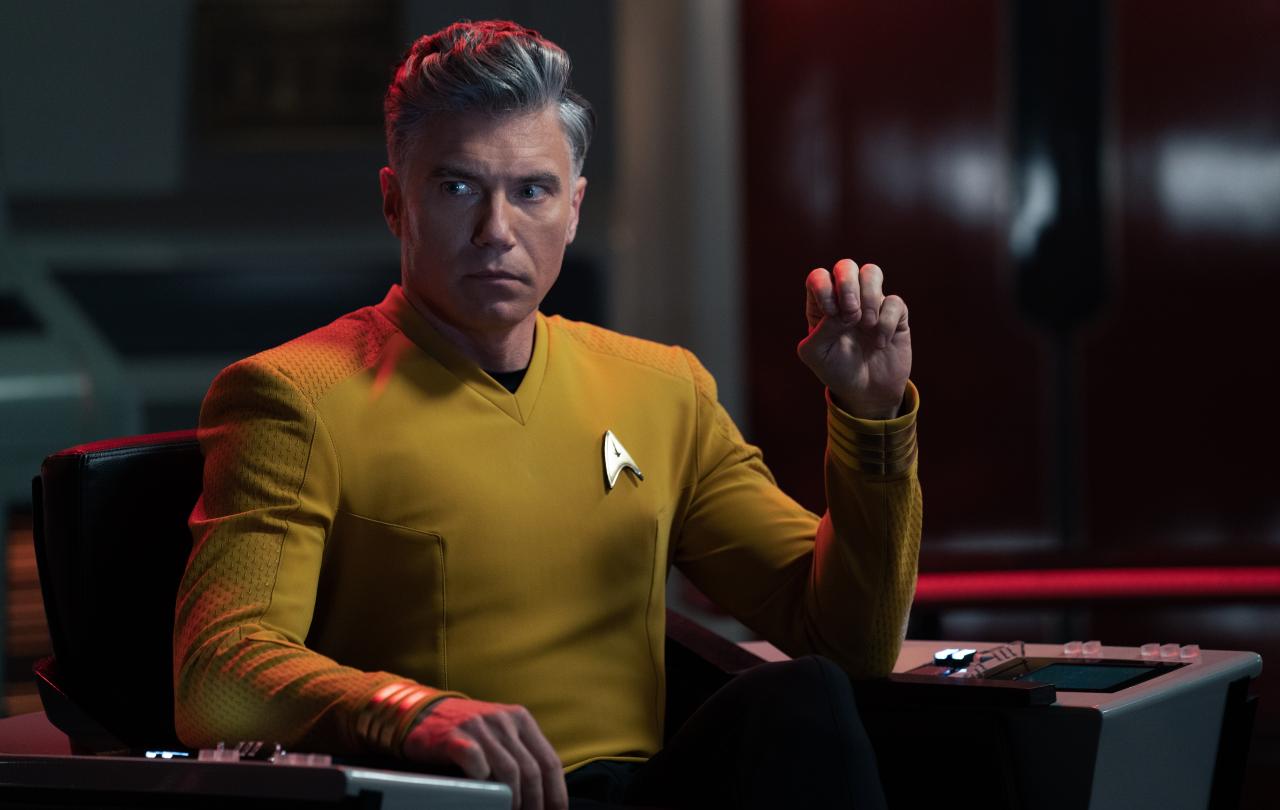
Captain Pike of Star Trek.
The other captain.

Last month saw the release of the third season of Star Trek: Strange New Worlds, the prequel series that follows the crew of the USS Enterprise before one James T. Kirk took the captain’s chair. Not only does the show have the heady mix of fun and serious subject matter, it also has something quite rare for Star Trek; a messiah figure. 

Ever since its first airing in 1966, Star Trek has presented a utopian view of the future. The show’s creator, Gene Roddenberry created a world where humanity had grown up and had moved past its petty squabbles. In Roddenberry’s twenty-third century, prejudices around race, class or sex were non-existent. There were, however, some groups that could not get a look in. One topic that got very little representation was sexuality, the other was religion.  

Representation of differing sexualities would become something that Star Trek would eventually excel at depicting. Religion, however, has not fared quite so well. Star Trek’s staunchly secular universe is clearly a reflection of Gene’s views. What is interesting though, is the way that in a franchise so resistant to even the idea of God, is how concepts related to him seem to seep into the storytelling. The use of a Messiah figure, specifically a character who sacrifices their life to save others is hardly new in Star Trek. At least two captains come to mind. But there is something particularly novel about Captain Christopher Pike.  

For those who are in need of a bit of trivia, Pike, not Kirk, was the first captain of the Enterprise to be depicted. In an unaired pilot, Captain Pike is portrayed by matinee idol, Jeffrey Hunter. This captain is seasoned, world weary, and very serious. Perhaps a little too serious as the network at the time didn’t like the show in that form. They did however, take the unconventional step of ordering a second pilot, which was lighter, and more colourful in tone. Reports differ wildly as to whether Hunter quit or was fired, but one way or another, he did not return to reprise the role of Captain Pike when the show went to series. Instead, the character of Pike was replaced with James T. Kirk, played by a young William Shatner.  

This then presented the show with a problem. The production company had an entire episode’s worth of footage costing $645,000 (around $6.5m today) that was unusable in its current state. The novel solution to this problem was to write a framing story where Spock mysteriously commandeers the Enterprise and kidnaps now Fleet Captain Pike. When Spock turns himself in for court martial, he presents video footage in his defence. Footage which just so happens to be selected shots from the unaired pilot. There was just one problem with this. Jeffrey Hunter was unavailable for filming, so they had to cast another actor in the role. As the episodes would show Jeffrey Hunter’s Pike on screen, it would make the recasting look obvious. So actor Sean Kenney was slathered in burns makeup, put in a restrictive wheelchair and only able to communicate through a series of beeps, with Roddenberry writing in an explanation of how Captain Pike had been seriously injured in an explosion on a ship saving some cadets, and was now suffering from ‘locked in syndrome’. 

When Star Trek: Discovery’s second season came around, they chose to include characters such as Captain Pike (now played by Anson Mount) and Spock (Ethan Peck) to serve as a backdoor pilot for Star Trek: Strange New Worlds. Rather than steering clear of the convoluted backstory, they leaned into it, having a confident, able-bodied Pike receive a premonition of his own terrible fate. He is told at the time that he can escape if he gives up, but if he goes ahead in completing the mission, it will seal his fate. In that moment, Pike rallies himself by saying: 

“You’re a Starfleet Captain, you believe in service, sacrifice, compassion and love. No, I'm not going to abandon the things that make me who I am because the future…it contains an ending I hadn't foreseen for myself”. 

Discovery simply had too much plot in it to resolve Pike’s story satisfactorily, so when Strange New Worlds launched, it gave Pike the chance to fully unpack his trauma.  

The first episode of Strange New Worlds sees Captain Pike considering retirement from Starfleet. After all you can’t have an accident in space if you never go on a spaceship right? However, he’s drawn back into captaining the Enterprise in order to rescue his first officer, Una, who is trapped on a primitive planet. After saving her, Pike resumes command of the Enterprise. Una is aware of Pike’s vision of the future, and is desperate to dissuade him of walking into a situation that will leave him so disfigured. At which point, Pike tells her he knows the names of all the cadets he saves on that day.  “Stay the course, save their lives” he tells her.  

In the season one finale of the show, Pike meets a young boy, Maat, who is eager to join Starfleet, and Pike realises he is one of the cadets that he is unable to save. He is about to write a letter to the boy, trying to tell him about his future, when a future version of himself arrives. Throughout the course of the episode, Pike learns that if he avoids his fate and stays in command of the Enterprise, he will inadvertently start a war with the Romulans that will result in Spock’s death.  “Every time we change the path, he dies” his future self tells him. This furthers Pike’s resolve to stay the course.  

When viewed through this particular lens, Captain Pike’s story in Strange New Worlds is in effect, one long extended Garden of Gethsemane scene. In both cases we see a man, fully aware of the impact his sacrifice will have for the future, but at the same time, still feeling nervous, scared, and wanting to reject the bad hand he’s been dealt. But in both cases, both Jesus and Captain Pike recommit themselves to their mission and their fate. There are no shortage of heroes in sci-fi/fantasy, who sacrifice themselves in the heat of the moment. But a character who has multiple chances for escape, one who has time to consider the torturous weight of his own destiny, and still decides to go through with it? This elevates the character from a simple ‘hero’ to a ‘messiah figure’.   

As a result of this, watching Strange New Worlds has now taken on an experience similar to watching The Chosen, the multi-season show centred around Jesus and his disciples. Both shows have an effortlessly charismatic central character who leads those around them with grace and humility, and the more you fall in love with these characters, the more you’re reminded that something absolutely horrendous is going to happen to them. Whilst we know it must happen, it still makes us anxious at the thought of going through it.  

Over thirty years since Gene Roddenberry’s death, it’s hard to tell what he would have thought about the evolution of one of the first characters he wrote for Star Trek. On the one hand he might have rejected it out of hand for its parallels with the story of Jesus, a religion he disdained. Or he might just love it for what it is; really, really good storytelling. 

Support Seen & Unseen

Since Spring 2023, our readers have enjoyed over 1,500 articles. All for free. 
This is made possible through the generosity of our amazing community of supporters.

If you enjoy Seen & Unseen, would you consider making a gift towards our work?
 
Do so by joining Behind The Seen. Alongside other benefits, you’ll receive an extra fortnightly email from me sharing my reading and reflections on the ideas that are shaping our times.

Graham Tomlin
Editor-in-Chief
Article
Art
Culture
Trauma
War & peace
5 min read

Forgotten soldiers and new narratives are shaping how we mark our wars

Writing our history of conflict is as much a war of images as of words.

Susan is a writer specialising in visual arts and contributes to Art Quarterly, The Tablet, Church Times and Discover Britain.

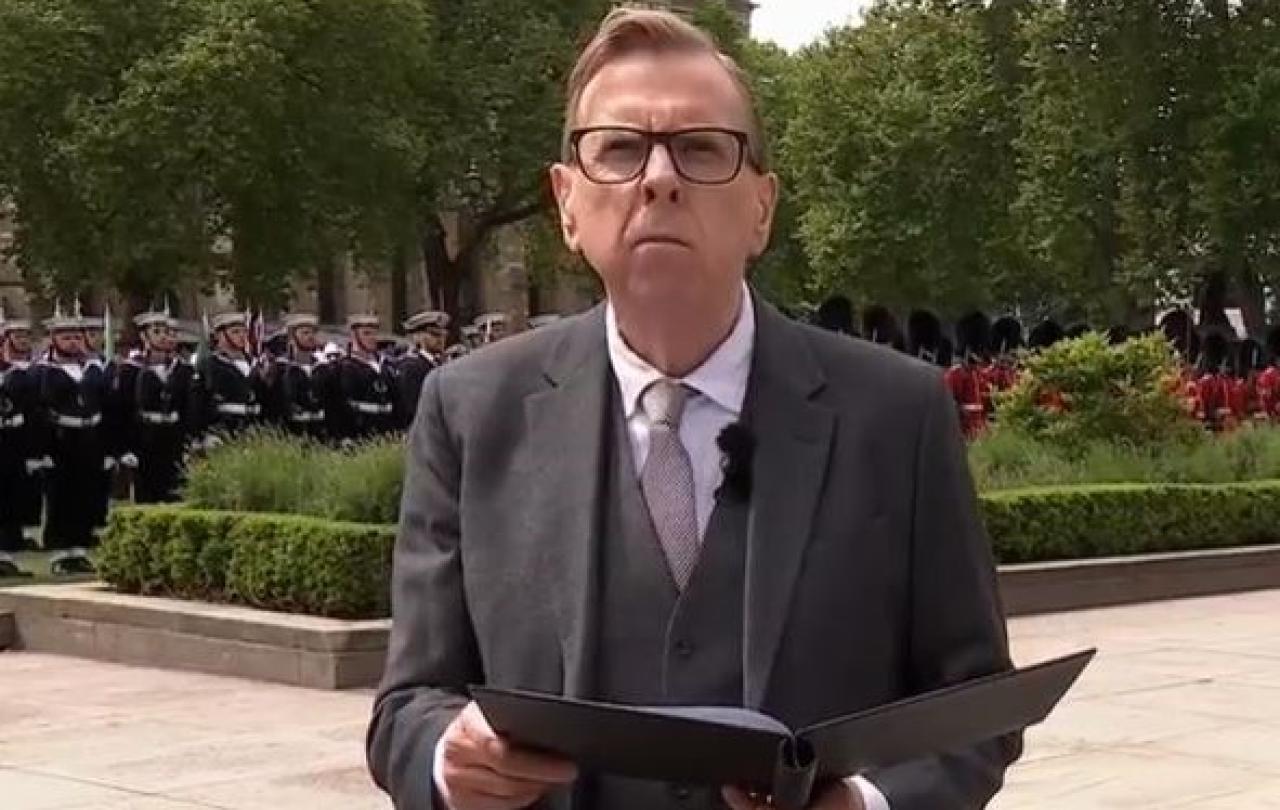
An actor reads a speech at a commemoration
Timothy Spall recites Churchill.
Sky News.

Heading into an intense summer of World War Two remembrance, with May’s commemoration of the 80th anniversary of VE Day followed by marking the end of war in the Far East in August, it is remarkable how well the essentially Edwardian model of honouring the war dead has stood the test of time. 

In The Edwardians Age of Elegance exhibition, at the King Gallery’s, a room is devoted to the passing of the extravagant turn-of-the-century era into the sombre age of war memorialisation, following World War One. George V commissioned traditional English artist Frank O Sullivan to paint the inaugural service for the Unknown Warrior in Westminster Abbey. The long canvas, with a domed frame at the centre to accommodate Edwin Lutyens’ freshly unveiled, lofty Cenotaph, captures the solitary King walking behind a flag draped coffin, mounted on a gun garage, as the parade passes the war memorial. Initially a temporary wood and plaster structure, Lutyens’ Portland stone monument commemorated over a million soldiers lost in the Great War, some buried near the battlefields near where they fell, and nameless others whose remains had been obliterated by mechanised warfare. 

Attended by widows, ex-servicemen and armed forces personnel, the 1920 Armistice Day ceremony marked a shift away from solely glorifying commanders and officers, placing the sacrifice of ordinary combatants centre stage. The monarch symbolised his gratitude to his people, rather the other way around. 

Ceremonial Great War gun carriages featured in the London VE Day parade on 5th May. And the King’s Troop, Royal Horse Artillery provides gun carriages and teams of six black horses for state funerals. Following World War Two, and complete mechanisation of artillery, George VI instituted a troop of horse artillery for ceremonial occasions, enshrining the continuation of practices from a previous era’s warfare. 

Layering memorialisation upon memorialisation was also evident in the 5th May ceremonies when actor Timothy Spall read an extract of Churchill’s Whitehall speech, given to the crowds when European hostilities ended.  

“In the long years to come, not only will the people of this isle, but of the world wherever the bird of freedom chirps in human hearts, will look back on what we have done and they will say do not despair, do not yield to violence and tyranny, march straight forward and if needs be, die unconquered.”  

Narratives around the present and recent past are codified with a focus on forecasting how future generations will view events when looking back.  

While Europe celebrated in early May 1945, the one million troops of the Fourteenth Army continued fighting the Japanese Army through Burma and the Pacific. Dubbed the Forgotten Army and the Forgotten War, their campaigns were underplayed in the Allies’ wartime narrative. Singapore’s fall to Japanese forces in February 1942 was seen as a shameful defeat. Remoteness from London of the Far East campaign, and the vastness of the theatre of war, made it near impossible to report on by radio and print journalists. Letters to and from the Fourteenth Army took months to reach their destinations.  Soldiers and civilians held as prisoners of war by Japanese forces were forbidden to make images or create records of their captivity, making contemporaneous images of their incarceration rare. But drawings of camps and hospitals by Jack Chalker hidden in hollowed out bamboo sticks, acted as preparatory works the artist to later make paintings such as his painting Medical Inspection, Chungkai Hospital Camp 1943, created in 1946, and now held by the Royal Army Museum. 

As traditions of commemorating the war dead evolve, new grey areas come to light, demanding space in the official narrative 

Contrasting the paucity of images of the war in the Far East, with the array of works depicting the Blitz in London - created with  American audiences in mind, in the hope of winning support for the Allied cause - together with photographic images of North African and Middle East operations, it is little wonder the Forgotten War struggles to be remembered. Veterans of the Far East campaign and POWs were far more likely to join ex services organisations such as the British Legion and Burma Star, than those who served in Europe. Marginalised from victory and peacetimes narratives, the Forgotten Army chose to remember together. 

Before Victory over Japan’s 80th anniversary is commemorated on 15 August, with the famous cover photo of an American sailor dramatically embracing a woman in a white dress showing on repeat, the 80 years since the dropping of atomic bomb on Hiroshima and Nagasaki will have to be faced. Mainly civilians died as a result of impact and sickness from the bombing of Hiroshima on 6 August and Nagasaki on 9 August, with estimates of between150,000 -246,000 deaths. Whether the only use of nuclear weapons in warfare was justified, as it prevented loss of life from not having to wage a military campaign to occupy mainland Japan, or the horrific sacrifice of so many civilians was a war crime, remains a morally grey area. 

As traditions of commemorating the war dead evolve, new grey areas come to light, demanding space in the official narrative. Actress Sheila Hancock wrote recently about the trauma and fear of being an evacuee, sent away from her London family as a small child, to an emotionally neglectful home in the ‘safer’ countryside. Forced adoption of children born to lone mothers, and the stigmatising treatment expectant women received at the hands of Christian denomination- ran mother and baby homes, is a wartime and postwar story now demanding to be heard. 

Lesser documented stories of marginalised civilians, and combatants in faraway places take time to emerge, fighting to be heard above familiar images of plucky cockneys in bombed out buildings and amorously celebratory sailors. Shaping a multifaceted history of conflict is as much a war of images as of words. And as families become more transnational, the search for a shared narrative can replace clinging to the right or official story. 

The idea of army chaplain, the Reverend David Railton, to commemorate an Unknown Warrior with honour, still resonates over a century later. Railton’s battlefield altar cloth, known as the Padre’s or Ypres Flag, covered the coffin on its journey from Boulogne to Westminster Abbey. 

Stretching and fraying to include the stories of groups previously overlooked, the Edwardian fabric of military remembrance is proving remarkably strong. 


The Edwardians: Age of Elegance, the King’s Gallery, until 23 November.

Support our work

Since Spring 2023, our readers have enjoyed over 1,000 articles. All for free. 
This is made possible through the generosity of our amazing community of supporters.

If you enjoy Seen & Unseen, would you consider making a gift towards our work?

Do so by joining Behind The Seen. Alongside other benefits, you’ll receive an extra fortnightly email from me sharing my reading and reflections on the ideas that are shaping our times.

Graham Tomlin
Editor-in-Chief