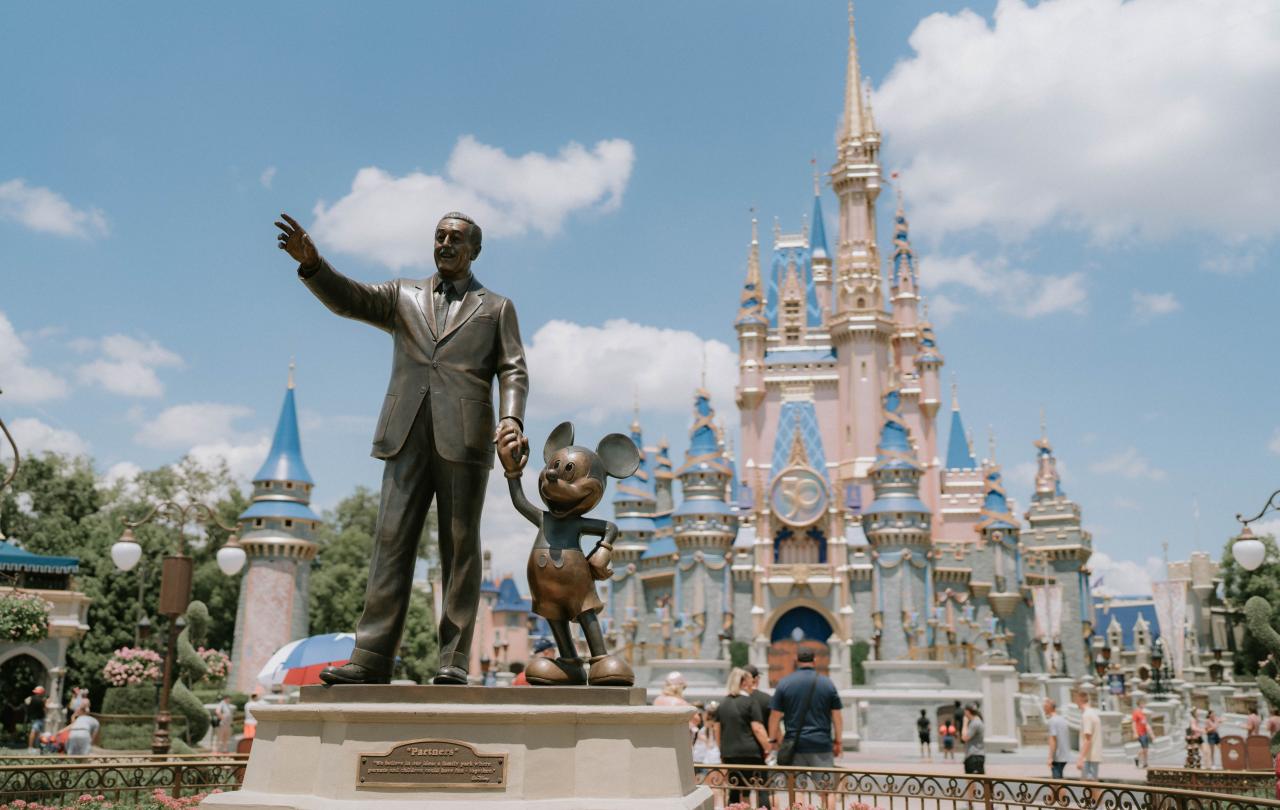
Walt Disney once said, “remember, it all started with a Mouse.” An incredible fact considering that after a century of Disney, it is impossible to describe and interpret our modern world without mentioning Disney, the Christian church included. Once, Disney came up during an interview I took for a pastoral role at an American megachurch. Those with experience in low church American contexts won’t be surprised at what comes next.
During the interview, the church’s creative director casually mentioned taking his entire creative team to Disney World. It hadn’t been a pleasure trip; church employees toured Disney’s backstage creative department for inspiration they could bring back to the church. For this church, the Disney company – its vision and practices – was an index for its own.
Now, my hunch is this little anecdote will offend the sensibilities of readers who are practicing Christians in high church traditions. I might also guess it will equally offend secular readers who see Disney as the archetype of corporate greed, pushing glib, crass sentimentalism as art. Christian readers might share some of these criticisms as well. Together this is what, back in 2001, sociologist Alan Bryman recognized as the ‘Disneyization’ of society.
Disney... is not a purveyor of morality, but of product that must (like any good neoliberal agent) sail with the prevailing winds of market-based morality.
Disney In the crosshairs
Bryman’s work demonstrates how most criticism of Disney tends to expand into criticism of modern life itself. . Walt Disney himself dedicated Disneyland at its opening in 1955 with the words:
“this park is dedicated to the hard facts that made America.”
To talk about Disney and the modern world is ironically enough to talk Walt at his word. It means reflecting on modern America and globalization, and the economics, aesthetics, ethics, and politics which characterize it.
I have more to say about this. But first, we need to tackle just where Disney sits today in the social and political moment.
Disney today finds itself in a familiar position: fixed in the crosshairs of US conservatives waging the culture war. (Ironically, both culture war and Disney are some of America’s prime exports.) But Disney today is as wise to the market as it’s ever been. It is not a purveyor of morality, but of products that must (like any good neoliberal agent) sail with the prevailing winds of market-based morality.
Disney promotes prevailing values domestically and does the same for values of the Chinese Communist Party internationally. For example, in its Stateside parks, Disney recently decolonized or altered some of its attractions. It re-themed Splash Mountain attraction, a water ride based on Walt Disney’s Song of the South film. The 1949 film is banned on Disney’s streaming platform. It traded in racist tropes and revisionist historical propaganda (often called the 'Lost Cause') which originated in the American South after the Civil War. Disney also altered a scene from the Pirates of the Caribbean ride which depicted women as victims of sex trafficking.
These are surely good changes. But conservatives tend to categorize these changes, together with LGBTQ inclusivity efforts, under the appropriated phrase ‘woke’. Armed with a weaponized slogan, vapid reactionaries continue to influence popular sentiment on Disney. Meanwhile, Disney CEO Bob Iger met with the US Government’s House select committee on China. To discuss Disney’s censorship practices and production in the Chinese market.
To talk about Disney in the present, immediate sense is to (among other things) grapple with the political power of corporations, the moralities that sustain market practices, and the formative power of binge-watching on human beings. But what about Disney in the broader sense? The Disney that is a window into the (failed) promises of modernity? These are promises and possibilities that continue to haunt us as well as shape us.
I can find no better word to describe Disney’s parks. Liturgy, both in the Greek and Christian sense, speaks to how the parks provide a public service and fuel a religious experience.
The “Liturgy” of Walt Disney
At the end of his life, Walt Disney had more in common with Elon Musk than JK Rowling. He was more obsessed with harnessing technology in service of “progress”. His ultimate dream (called EPCOT or Experimental Prototype City of Tomorrow) was envisioned as the sum total expression of his theme parks. Disney wanted to take all the lessons of Disneyland and redirect them towards the construction of a permanent, liveable World’s Fair expo in the backwater of Florida’s swamps.
But EPCOT today is something of a simulacrum. It houses a World Showcase where you can stroll the streets of Paris, Piazza San Marco, or a Mayan pyramid that houses a water ride. Disney even hosts student worker programs to ensure that if you order fish and chips in its England, you will be served by someone from York, Surrey, or Manchester. But this is not what EPCOT was supposed to be. Walt envisioned it as a real time, fully functioning “city of tomorrow” where all the best and brightest of American Post-War technological might and efficiency would make the human society something called “better”. In short, EPCOT was Disney’s public works project.
The ancient Greeks had a word for projects like this: “liturgy”. The English word comes to us from combining the Greek noun for “people” leitos or laos with the Greek verb for “working” ergos. Nowadays, we tend to associate liturgy with Christian tradition, particularly the external rites and forms of worship for the church. But the idea of Christian liturgy emerged from this Ancient Greek practice of private financing of public projects. George Tridimas shows how these “works for the people” were originally a Greek form of politics. To the Athenians, liturgies were a symbiotic practice: the wealthy elite competing for the honor and power associated with a project, while each project served everyday citizens of Athens.
I can find no better word to describe Disney’s parks. Liturgy, both in the Greek and Christian sense, speaks to how the parks provide a public service and fuel a religious experience. They are a public works project that continue to shape the American consciousness, directing its worship, which is inevitably exported too, through the medium of culture. If you doubt the religious factor of the parks, ask again why a church might find itself believing a tour of Disney serves its task of Christian proclamation and formation. This isn’t just crass entertainment, but a profound (yet often uninterrogated) influence.
The parks exist as an inhabitable space that suspends the contradictions of modern life and actually resolves them in a simulated fashion.
This is why I think Disney biography Neal Gabler puts his finger on the essence of Disney’s parks. He argued that the parks aren’t successful because they provide an 'escape' from reality, but because they provide a ‘better' reality than the one outside. In this sense, the Disney imagineers don’t just tell good stories, they master physical space. The parks continue to attract guests the world over not because of popular franchises, but because,as a public works project, the entire parks experience is a high-control, surveiled effort to provide public efficiency, thematic immersion, crowd control, transportation—all of it.
The parks exist as an inhabitable space that suspends the contradictions of modern life and actually resolves them in a simulated fashion. To treat the parks as a tasteless venture into plastic sentimentalism obscures how the parks attempt to satisfy, at nearly every turn, the modern contradictions that shape our human experience. To say this experience is a religious one would not be far from the truth, the Athenian liturgy and Christian liturgy converging into one.
This is one reason why, however tragic it may be, churches in America continue to emulate Imagineers. The architecure of churches constructed within and without Christendom have communicated transcendence. And in spite of America’s embrace of Protestantism, we should not be surprised that American Christian traditions continue to emulate Disney’s mastery of physical space in the key of modernity. I understand criticisms of all things Disney, from parks and art to economics and adult Disney fans. But the parks are a liturgical experience, both in a religious sense and in a public sense. To understanding the staying power and influence of Disney means grappling, at a human level, with the park experience as a simulated resolution of modern life, rather than an escape.