Review
America
Culture
Film & TV
5 min read

Cutting America to the bone

Civil War warns against worshipping civic and political violence.

Chris Wadibia is an academic advising on faith-based challenges. His research includes political Pentecostalism, global Christianity, and development. 

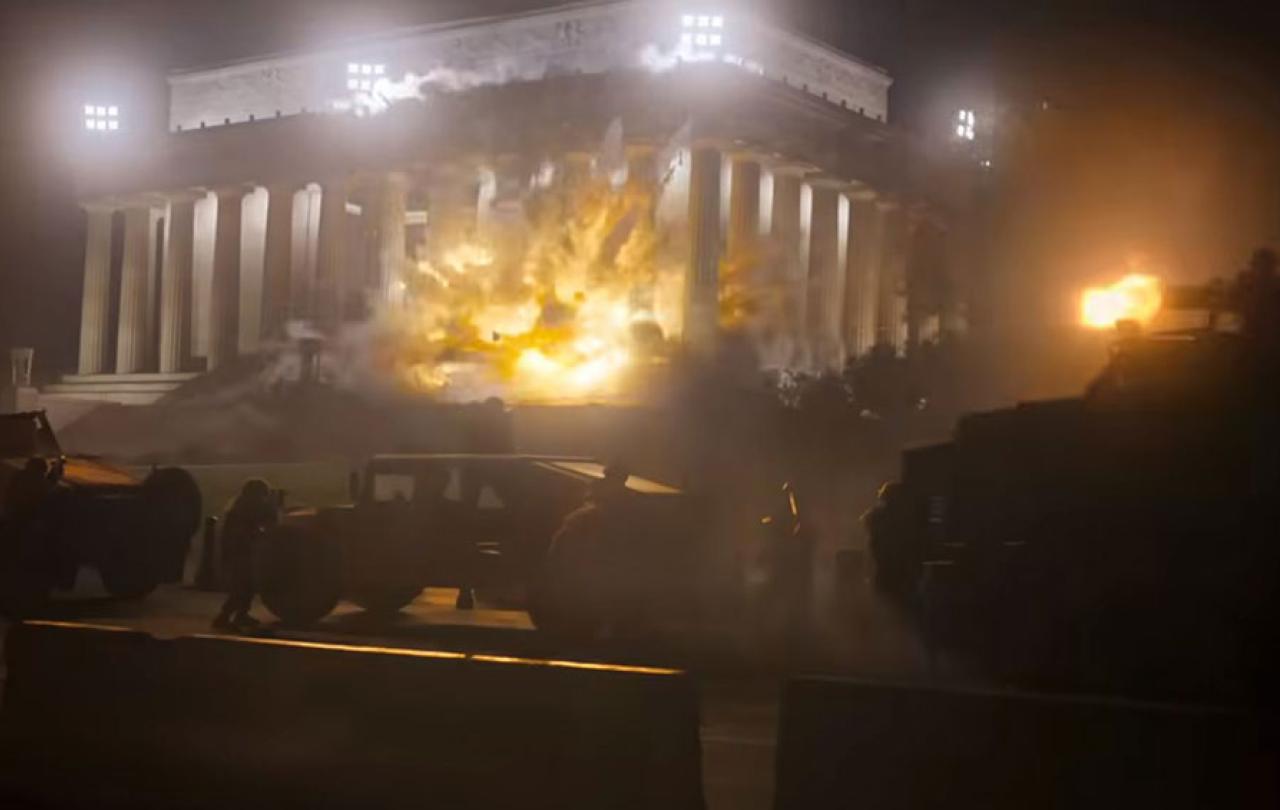
An explosion occurs at the Lincoln Memorail
Civil War's finale in Washington DC.
A24.

The president of the United States is dead. The film Civil War culminates with soldiers of the Western Forces (a fictional secessionist group composed of California and Texas) posing for pictures with a presidential corpse just minutes after executing him. It’s a chilling climax, with optics reminiscent of American soldiers capturing deposed president of Iraq Saddam Hussein in 2003. The film ends with a warning. No democratic country, no matter the perceived strength of its institutions, is immune from tyranny, civil violence, and the bloody process of state failure. Collapse follows when states lose the capacity to provide solutions to the linchpin challenges negatively affecting their citizens. 

A strength of Civil War is the way it articulates a universal political message without defiling itself with the toxic hyper-partisanship asphyxiating real-world American society.  

It features a number of loyalist and secessionist geopolitical groups each motivated by a distinctive combination of social, economic, and political interests and goals. These groups include the Western Forces, Florida Alliance, New People’s Army, and Loyalist States.  

The film’s storyline prioritises a violently unfolding near future civil war in a United States whose president bucked constitutional tradition by remaining in office for a third term. The president, whose character is modelled after Donald Trump, is the villain of the film, despite being supported by over half of the 50 American states. The Western Forces function as the film's hero group. Unlike the mercilessly murderous and viciously xenophobic soldiers affiliated with the Loyalist States, the soldiers of the Western Forces treat an eclectic team of journalists and war photographers (the film’s main protagonists) with kindness and respect, allowing them to accompany them during the final stages of their assault on the White House and entrance into the belly of the beast, the Oval Office. 

The film includes shocking scenes that would make the most patriotic Americans shudder. Shortly after it begins, a suicide bomber associated with the Loyalist States, proudly carrying a large American flag, sprints into the centre of a group of vulnerable people, pleading with agents charged with guarding a water tanker, and detonates a bomb. Dozens of people including children are killed, many of whom were non-White Americans. This scene's power is that it bring home the threats Americans associate with foreign lands. Suddenly the menaces Americans instinctively link with states like Afghanistan, Burkina Faso, and Venezuela exist in cities like Charlottesville, New York, and Washington DC. America is no longer safe, and the threats have come from within instead of from abroad.  

The message of Christ applies to theocracies and secular states alike. Every state, regardless of its attitudes toward religion, has an interest in its people living together peacefully.

As an American watching this film from a cozy cinema in Oxford, I thought about how the violence, polarisation, and civic rage depicted in the film already exists in many forms in the country I love from a distance. Shootings, many of them mass in nature, happen every day in an America whose citizens are comfortable with violence but afraid of each other. The United States suffers from an embarrassingly high association with mass shootings, far more than whichever county manages to claim an ignominious second place. Whilst it is unlikely tanks and attack helicopters will surround the White House anytime soon, the casual spirit of violence that has overtaken American society already fosters a level of violence far above the threshold any twenty first century democratic state should tolerate.  

I watched this film as a proud American and as a committed Christian, a faith I share with many of my fellow American citizens. My Bible, and theirs, does say we are citizens of heaven” destined to enjoy an eternal posterity in a New Creation marked by perfect peace and prosperity. However, until Christ returns, and God remakes the cosmos, Christians do have a vital role to play in their everyday civic communities. Whilst Civil War offers a grim view of America’s immediate political future, that message of Christ contains the content needed to cure the gravest challenges bedevilling the United States. I remain optimistic. 

Not all Americans identify as Christians or even with organised religion; nevertheless, twentieth century history confirms that states that altogether ignore God will soon wither into an ecosystemic abyss of state-sponsored moral relativism that endorses the use of violence for an increasing, arbitrary range of unsuitable, injudicious, and illegitimate purposes. The message of Christ applies to theocracies and secular states alike. Every state, regardless of its attitudes toward religion, has an interest in its people living together peacefully. Humans need a moral system to provide them (as well as their societies at large) with at least a perceived sense of moral structure. Christ’s message articulates a concept of civic love that challenges the existing worship of civic and political violence. Christ argues that violence in moments of disagreement or dismay is never the appropriate option; the mark of genuine Christian devotion is revealed in the avoidance of violent action even when the use of violence would not categorically be condemned by observers. 

Civil War explains how multiple, competing Americas exist. These Americas have different cultures, economic capacities, and sociopolitical ideologies. It teaches that America’s main problem is Americans only love other Americans like them. A number of enclaves exist across American society. Cut off from each other, the development of these enclaves has led to the emergence of micro-Americas so distinctive from each other that some of them no longer view formal geopolitical ties with other micro-Americas as in their best interest.  

The same enclavisation portrayed in Civil War exists in the nonfictional, real-life America. However, unlike in the America depicted in the film, the real-life America still has time to solve its sociopolitical troubles and stop the American state from collapsing. I recommend Civil War to anyone interested in being entertained and warned by what a dystopian, worst-case-scenario of near-future American political activity might actually look like. 

Article
Belief
Culture
Film & TV
Identity
5 min read

Wednesday works wonders bringing the outsiders in

Tim Burton’s echoes of C.S. Lewis

Lauren Westwood works in faith engagement communications for The Salvation Army.

Wednesday Adams scowls while Enid smiles.
Wednesday and Enid.

There’s something delightfully ironic about the mainstream success of Wednesday – Netflix’s Addams Family spin-off directed by Tim Burton. With its whimsy gothic aesthetic, star-studded cast and viral TikTok dance to boot, the first season was a highly bingeable hit in 2022. This summer, the split-release of season two scored over 50 million streams in its first five days. But beyond its cult-like reception lies something deeper: a collective reckoning with identity, acceptance and the desire to belong. 

Jenna Ortega’s Wednesday Addams is an outsider among outsiders. Upon returning to Nevermore Academy – a supernatural boarding school meant to be a haven for ‘freaks, monsters and outcasts’ – she finds herself more alienated than ever. Don’t feel sorry for her: she’s difficult, destructive and I’m not sure I’d want to share a dorm with her (or her pet disembodied hand, Thing.) But that’s why we love her so much. 

Wednesday ‘taps into that sense of not quite fitting in that everyone has,’ praised Marina Hyde on her The Rest is Entertainment podcast. ‘We all feel like we’re the kind of excluded weird mad kid from Burbank, as he [Burton] was growing up.’ 

C.S. Lewis termed the phenomena of not quite fitting in as the ‘Inner Ring’ – the unwritten systems of belonging that permeate all areas of life, from early youth into old age. It can neither be fully defined nor totally avoided. Lewis suggests that all people, at some point or another, experience this ‘desire to be inside the local Ring and the terror of being left outside.’ Ultimately, he warns, this pursuit of surface-level or self-furthering belonging ‘will break your hearts unless you break it.’ 

Lewis, one of Christianity’s most profound cultural influencers, was stirring a deeper call among his fellows Christians: to remember that the gospel is not just good news for those sitting comfortably in the pews – it’s good news for those outside. It’s good news for those searching for belonging in a world that prizes conformity and feasts on exclusivity. 

Tim Burton’s genius lies in his ability to reach out, subverting the mainstream and dismantling the Inner Ring, seemingly with ease. Everyone’s an outsider, so no one is an outsider. As in Edward Scissorhands or Jack Skellington from The Nightmare before Christmas, Burton’s decision to not only tolerate but to celebrate the outcast bridges the gap between the socially excluded and socially accepted. 

The sense of belonging that Burton creates doesn’t feel twee, manufactured or forced. It isn’t the sort of embrace that comes under strait-laced conditions, either. He cultivates spaces where the strange, the sad and the misunderstood become protagonists, empowered to tell their own story. He boldly platforms that which is different, unwilling to conform or compromise. Even the visual language of his work is distinct and unashamed, and his trademark scribbled twists and turns that creep into set designs, costumes and title sequences. 

In Wednesday, this contrast is emphasised by a window that is half-spiderweb, half-kaleidoscope, dividing the room that Wednesday shares with Enid, the optimistic and bubbly roommate. They’re an extreme black-cat, golden-retriever pairing who have little in common, except for feeling that they don’t fit in. 

Their desire for belonging and acceptance looks different. Enid cares very much about how others view her, whereas Wednesday’s cold defiance masks her vulnerability to be seen, known and accepted. This symbolic shared space, and the friendship that is imposed upon Wednesday by Enid, signals a deeper truth: belonging is not found in sameness, but in recognising what connects us and how we can honour one another in spite and because of our differences. 

The subversive nature of Burton’s imagined universe holds a dim mirror to the liberating reality of God’s Kingdom.

While Burton elevates the outsider, his worlds often remain solitary and cut-off. But the Church, at its best, offers not just visibility but the embrace of fellowship. Jesus consistently chose people on the margins – lepers, tax collectors, women – and invite them into relationship. The gospel accounts for him taking less efficient travelling routes seemingly to encounter the lonely, the sick and the despised, to share news of their belonging to God, whose love for them was so strong that he would dwell not only among them, but within them through his Spirit. 

The culture of the early church was informed by Jesus’ example, and their meetings were a mosaic of cultural, ethnic and social diversity, brimming with unlikely partnerships and clashes of custom. Paul reaffirmed the concept that all are ‘one in Jesus Christ’ in his letter to the church in Galatia, declaring that ‘there is neither Jew nor Gentile, neither slave nor free, nor is there male and female.’ This is not a call to erasure, but to radical inclusion. Rather than everyone being an outsider, as in Burton’s world, everyone is an insider in the Kingdom of God. 

Perhaps it isn’t about whether Tim Burton or the Church has done more for outsiders, outliers and outcasts, but to invite personal challenge: Am I willing to get used to different? To disturb my norms, routines and expectations in the name of mutual inconvenience? To embrace a little mess and chaos for the sake of greater unity? 

The subversive nature of Burton’s imagined universe holds a dim mirror to the liberating reality of God’s Kingdom, where the last are first, the poor receive a rich inheritance, and the margins become the centre. Where Burton’s audience may find solace in shared strangeness, the gospel offers something greater: a home not built on similarities and commonalities, but on divine welcome and spacious grace. And an unlimited set of keys to welcome others to their room, too. 

Support Seen & Unseen

Since Spring 2023, our readers have enjoyed over 1,500 articles. All for free. 
This is made possible through the generosity of our amazing community of supporters.

If you enjoy Seen & Unseen, would you consider making a gift towards our work?
 
Do so by joining Behind The Seen. Alongside other benefits, you’ll receive an extra fortnightly email from me sharing my reading and reflections on the ideas that are shaping our times.

Graham Tomlin
Editor-in-Chief