Explainer
Creed
Royalty
4 min read

Consider the crown and who wears it

The Feast of Christ the King prompts Jamie Mulvaney to ask what sort of strong leader we should seek.

Jamie is Vicar of St Michael's Chester Square, London.

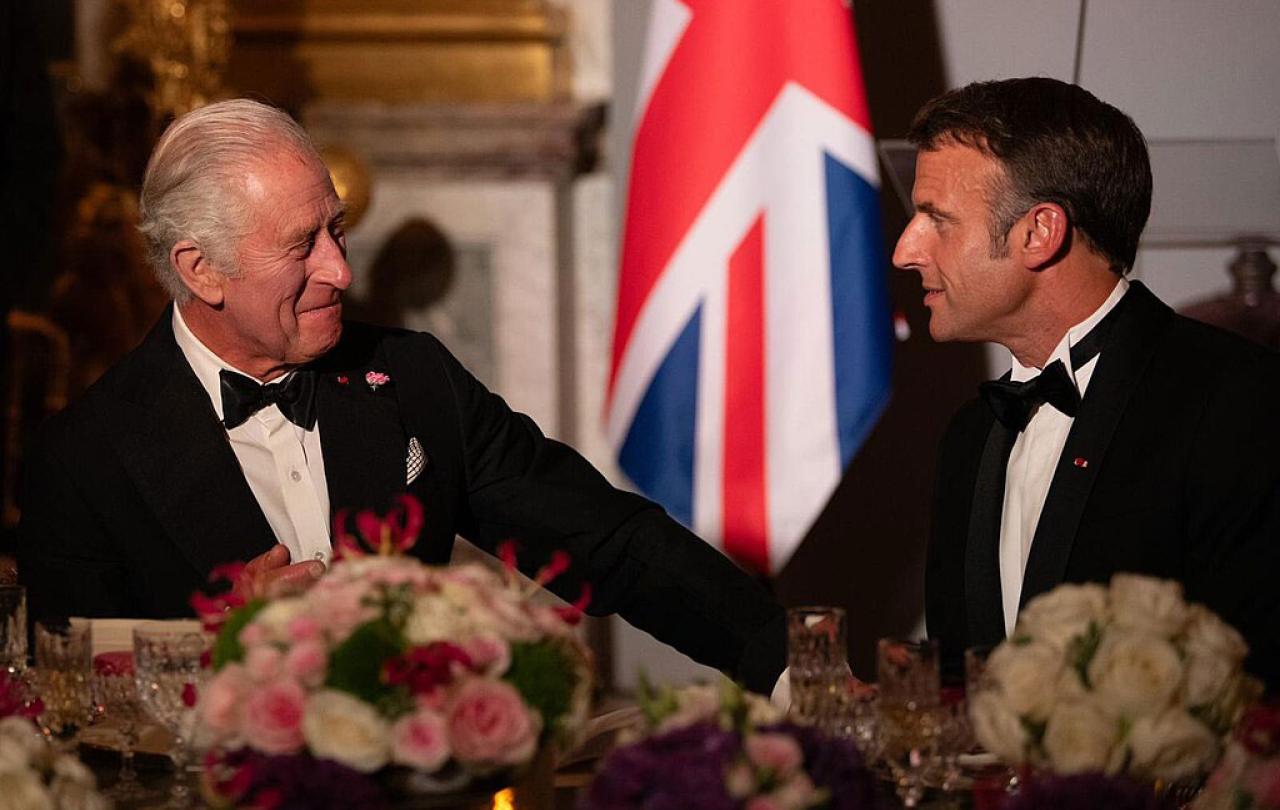
King Charles in a black dinner suit talks and gestures to President Macron who is similarly dressed.
King Charles and President Macron at a September 2023 state visit.

Remember singing 'God Save the King' for the first time and it took a little more effort? Instinctively, we were so used the Queen, and unless you're well into your eighties the concept of a King will still be something a novelty. Slowly the stamps have changed, and new passports are finally being printed. After King Charles' first year on the throne, and having celebrated his 75th birthday this month, we can reflect with a little more perspective about what it means to have a king. 

A new king gives us an opportunity to look forward and back. The crown cradles continuity, bringing the past into the present. And whether you've been indulging in the latest series of Netflix's The Crown or venturing further back into royal history, we can also indulge in a little time travel. Maybe not a regal DeLorean, but if you hop inside the state coach there’s quite the ride to be taken. The historian Dominic Sandbrook recently detailed in The Times how in Britain that 'it is remarkable how often monarchs’ opening 12 months have set the tone for the rest of their reign.'

We find ourselves in a liminal space - not quite an airport terminal - but one where we are on our way although not there yet. We see glimpses of this still-coming kingdom, but not yet fully realised. 

What if we went back to the future even further, considering Jesus Christ as king? We might be unable to argue with the enduring legacy of this historical figure, but most of us are unfamiliar with Jesus as King. We tend to think of baby Jesus, Jesus feeding the five thousand or Jesus on the cross, but what about Jesus as King? Today the church celebrates the Feast of Christ the King, an interestingly fairly recent tradition. A bit like the John Lewis Christmas ad encouraging us to 'let your traditions grow'. But there is nothing new about Jesus' kingship. The church has always thought of Christ as King. According to the accounts of Jesus' life in the Bible, the topic Jesus taught on more than anything else was 'the Kingdom of God'. And King Charles’ coronation was itself a portal to the life of this king. The service began with the Chapel Royal chorister greeting the new monarch, ‘Your Majesty, as children of the Kingdom of God, we welcome you in the name of the King of Kings.’ His reply? ‘In his name, and after his example, I come not to be served, but to serve.’ It was a useful reminder that the form of servant leadership we have assumed and expected from the Queen and now the King is not a modern invention or interpretation of how monarchs should be. 

Much like the arrival of a new king, Christ the King Sunday also enables us to both look back and look forward. We find ourselves in a liminal space - not quite an airport terminal - but one where we are on our way although not there yet. We see glimpses of this still-coming kingdom, but not yet fully realised. The word 'Gospel' was well-known in the ancient world, describing the good news of the rightful king who has returned home to take this throne.  

But this king is quite the contrast to the strong leader we're used to. As we look to world leaders today, we see many elder statesmen (you decide whether 'elder' or 'statesmen' should be emphasised!). There are different understandings and projections of what strong leadership looks like. 

The historical reality of Jesus, his fingerprints on the world today, and the professed experience of millions of people worldwide continue to subvert. 

Jesus is a king who comes in humility. There was speculation of a slimmed-down coronation for King Charles proportionate to the cost-of-living crisis. But in Jesus’ mind must have been more the cost of dying, as he rode on a donkey into Jerusalem, surrounded by a fickle crowd cheering his own coronation before condemnation only a week later. At his execution there was mockery with the sign on his cross ‘King of the Jews’, and of course wearing a crown of thorns. If you travel back to his birth, the magi bring royal gifts, so his life is bookended with rumours of kingship. 

What might this mean for us in the twenty-first century? On the one hand, there’s the personal, individual connection to the king. Pope Francis heralds ‘Christ the King who conquers us’. We’re happy for his rule and reign out there, but what about extending into our own lives? For the past few years on the eve of Christ the King I've been to baptism services at Southwark Cathedral. One of the symbols of the water in baptism is that we overwhelm our lives with Christ's life, and ultimately his reign over who we are, how we are, and what we do. Then there’s the broader reality: a king who does not neatly or easily fit into our political paradigms, whose priorities in one way or another will catch us off guard. 

Jesus is the king who turns things upside-down. His kingdom is not marked by borders but is still whispered of and spoken about two thousand years later. That is what we sing about at Christmas. The king arriving in vulnerability as a baby and one day - who knows when - Christians believe he returns in power as king. On that day, Christians believe justice, goodness and all that we long for will be ushered in. But until then, the historical reality of Jesus, his fingerprints on the world today, and the professed experience of millions of people worldwide continue to subvert. 

As Dietrich Bonhoeffer, the German theologian famous for plotting to kill Hitler said, ‘A king who dies on the cross must be the king of a rather strange kingdom.’ The mystery amidst the majesty. Keep looking back. Keep looking forward. 
Article
AI - Artificial Intelligence
Creed
Morality
Spiritual formation
6 min read

The moral machine: algorithms that give a window into the soul

In TikTok’s algorithm Graham Tomlin saw something that got him thinking. Could it lead to moral health rather than harm?

Graham is the Director of the Centre for Cultural Witness and a former Bishop of Kensington.

A abstract grid of colourful cubes with arrows, crosses and cubes, viewed from above and at an angle
Champ Panupong Techawongthawon's illustration of artificial intelligence.
Google DeepMind on Unsplash.

A few years ago, I was thinking of buying a camera for my wife as a birthday present. I lazily browsed a couple of websites to check out the options. Then something odd started to happen. Somehow, my laptop seemed to think this was a good idea and sprang into action. Whenever I went onto Amazon, Ebay or any other website selling stuff, it kept pushing adverts for cameras at me. Canon or Nikon? Point and Shoot or DSLR? How did it know? Could it read my mind?

It was the first time I noticed the power of the algorithm.

A bit later on, thinking I ought to get up to speed with the regions of social media that I had little clue about, I opened up TikTok and started to swipe upwards (apparently that seemed to be the way to do it). This time I was determined not to like or unlike anything, follow anyone or be followed by anyone. Yet mysteriously, it still worked out what I liked and kept pushing short, addictive videos at me, enticing clips of football, mountains and music along with other random stuff mixed in. How did it know me so well?

It is as old as the hills. The algorithm simply takes the desires of your heart and amplifies them.

Of course, better informed people than me know how all this works. The algorithm figures out which accounts you follow, any comments you’ve posted, clips you’ve liked or shared, and in particular, videos you watched all the way to the end. So, if you linger over a video, it knows you like it. If you rush on quickly to the next one, it makes a mental note that you’re not so keen.

It all feels a little sinister, yet very clever. You often read dark theories of social media, and the way it is re-wiring our brains. Yet when you look a little closer, it is as old as the hills. The algorithm simply takes the desires of your heart and amplifies them. So, if you like or linger over certain videos expressing a particular cultural or political opinion it will send you more of the same. The result is we get confirmed in our own frameworks which never get challenged by others. It's part of why we are so polarised as societies these days. When you ask why ‘the other side’ cannot see the obvious truth that you see, the answer is that they literally don’t see it. They don't see it because the algorithm doesn't feed them the same things as it feeds you.

As a result, TikTok or Facebook is an alarming mirror into the soul – see what it sends you and it just may be that it tells you more about yourself than you would like to know.  

Social media like TikTok, Facebook and Twitter (or X)  learn to recognise what your heart really desires (not just what you say you do). They notice what you linger over, what catches your fancy and sends you more of the same. They are, apparently, studiously neutral on moral questions. They seem to have no moral designs on you to school or form your soul in particular ways, but are simply a reflection of your own longings. What TikTok, Facebook, Instagram and the others all do is to propel you further in the moral direction in which you are already headed. Which for most of us, is not a great idea.

Now of course there would be howls of protest if TikTok announced a moral code – that it was about to encourage virtue and discourage vice by deliberately sending us improving videos, material that the mysterious people who run it think is good for us. And that is not because we think virtue is bad and vice is good, but because we can’t decide on what virtues we want to encourage or what vices to stamp out. We draw a line at cruelty to children and extreme violence, but not much else. It is also because we hold as sacrosanct the freedom of the (adult) individual to choose his or her own way in life, as long as they don’t hurt anyone else.

Such sites are examplars and vehicles of expressive individualism – not just in the myriads of people who show off their dance moves, sing their songs or act out half-funny scenes on a golf course, but in that they confirm me in me my own wishes. They don’t tell me what to want. But they give me more of what I want. As a result, TikTok or Facebook is an alarming mirror into the soul – see what it sends you and it just may be that it tells you more about yourself than you would like to know.

It matters what we feed our souls with. It matters what stories we allow ourselves to be told.  

Such sites appear to be morally neutral. They don’t seem to aim to educate or form you in any particular direction. Or at least they are supposed not to. But of course nothing is entirely neutral.

Funnily enough, it’s not how we bring up children, or educate ourselves. When we bring up a child, most of us have some kind of vague or not so vague moral code in mind. We reward kind and helpful behaviour, and we punish selfish and mean actions. We don’t tend to give more of the same to a child who has eaten the first half of the packet of biscuits, or encourage a brother to hit his sister yet again. We have a goal of some form of moral formation in mind.

Yet, despite our confusion over which virtues to encourage, we need some kind of moral guidance for our wandering and flawed hearts, linked to eyes that are tempted to feast on things that fascinate but are not good for us. Like a glutton who cannot stop eating, even if these sites don’t themselves push extreme violence, pornography, aggression, they offer enough of the soft version of these to draw you in. And it’s not hard to find sites that will take you deeper into the darkness. And those sites will already know the way you are thinking and desiring and are ready to pull you in deeper into the mire.

The problem is not so much with the algorithm. It is with us. Netflix’s documentary, ‘The Social Dilemma’ quotes an alarming statistic - that fake news spreads six times faster than the truth. The reason is not hard to find. We are fascinated by the sensational and alarming rather than something a little more ordinary yet which happens to be true. As one person in the documentary put it: “The internet has a bias towards false information. Because false information makes more money. The truth is boring.”

The moral philosopher Gilbert Meilaender wrote:

“Successful moral education requires a community which does not hesitate to inculcate virtue in the young, which does not settle for the discordant opinions of alternative visions of the good, which worries about what the stories of its poets teach.”

It matters what we feed our souls with. It matters what stories we allow ourselves to be told.

The purveyors of social media are not innocent in this as they do exploit our worst tendencies, but in the end they simply confirm us in our own moral confusion. Yet it does point up the problem in the liberal ideal of leaving ethical decisions entirely up to the individual, to give entirely free choice without any guidance, because with our crooked hearts, it will always end up feeding the darker sides of our characters without a corresponding pull in the other direction, something which Christians called divine Grace.

St Paul wrote to the small group of Christians in Philippi, surrounded by the highly sexualised and violent culture of the Roman empire: “whatever is true, whatever is honourable, whatever is just, whatever is pure, whatever is pleasing, whatever is commendable, if there is any excellence and if there is anything worthy of praise, think about these things.”

I’m not saying don’t watch TikTok. But here’s an idea. Why not try to make it into a morally forming version of what you want to be, not what you are? Exercise a bit of moral direction yourself. If you see a video which you know in your conscience is not good, or is spreading lies, swipe it away quickly. If you see something positive, dwell on it.

If you approach it this way, you might just be able to persuade the algorithm to shape you in good ways and not the bad. It could become a means of growing in goodness, but only if you want it to be.