Article
Church and state
Creed
Politics
6 min read

The Church and the State need to disagree on asylum seekers

Politicians don’t always get how church and state relate, but both have a vital and different role to play when it comes to immigration. Graham Tomlin explores the age-old tensions between clerics and politicians

Graham is the Director of the Centre for Cultural Witness and a former Bishop of Kensington.

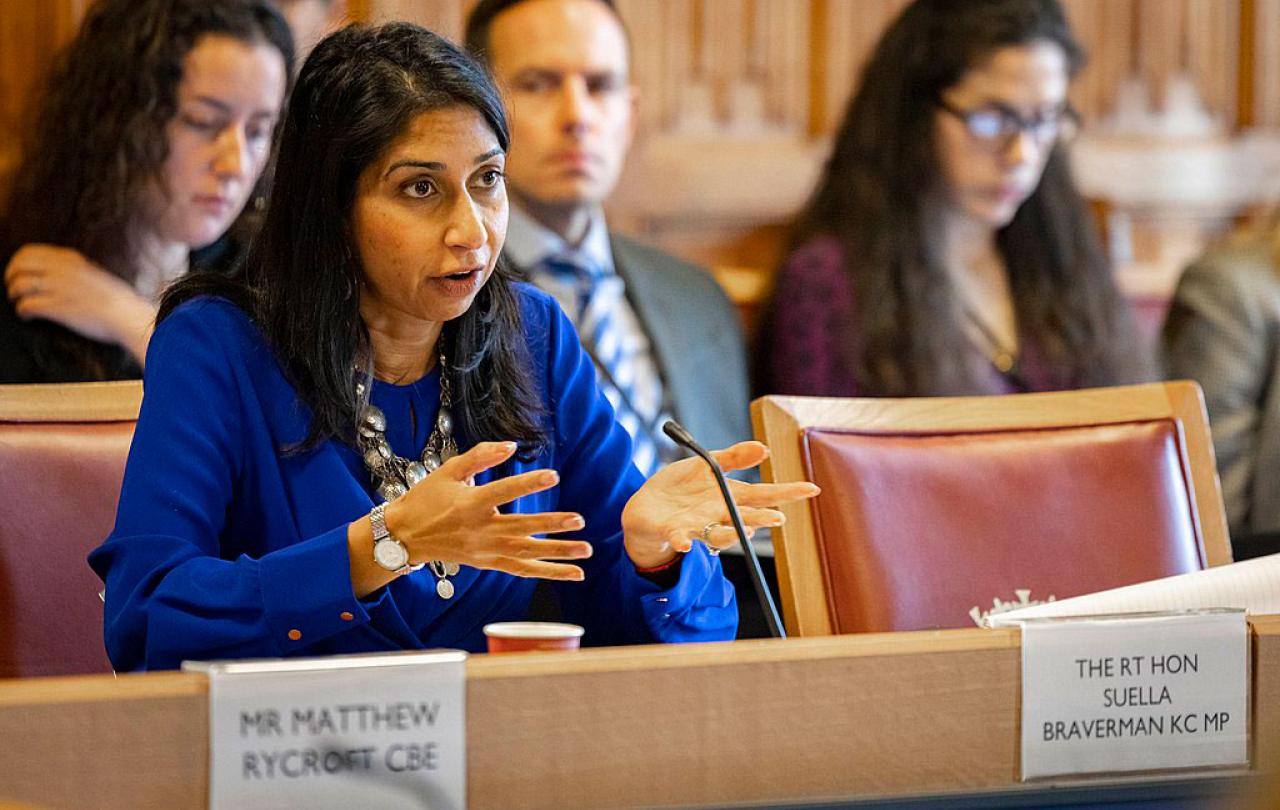
A woman dressed in a blue suit sits at a table talking and gesticulating with her hands.
Then Home Secretary Suella Braverman, answer to a parliamentary committee, December 2022.
House of Lords, CC BY 2.0, via Wikimedia Commons.

As we all know, Suella Braverman thinks the church is aiding and abetting bogus asylum seekers. The case of the Afghan migrant Abdul Ezedi, who carried out an acid attack on a woman and her children and reports that residents of the Bibby Stockholm barge were attending churches nearby has added fuel to the former Home Secretary’s charge that churches are naively supporting the asylum claims of immigrants to the UK. Everyone on the right of British politics seems to have weighed in to the issue, from Nigel Farage to Priti Patel, Robert Jenrick to Melanie Phillips. Now, even the left has joined in. Keir Starmer has indicated he would close loopholes for those who falsely claim conversion if he becomes Prime Minister (quite how he will do that is not explained).  

I feel personally invested in this story. When I take confirmation services as a bishop, quite regularly these days, among the list of candidates, there will be Iranian or Syrian refugees who have apparently become Christians, waiting in line among the 12-year old schoolkids, the new parents who want spiritual help in bringing up their children and the elderly man approaching death who realises he needs do something he’s been putting off for years.  

I have confirmed several Iranian refugees. I can’t look into their heart, or even my own to guarantee all of them were genuine converts. Yet I have seen their desperation to escape an oppressive regime, and although some may have started out coming to church to improve their chances of asylum, in the process some of them at least, have found, to their surprise, real faith. Several that I know have gone on towards ordination in the Anglican Church. If that is a ploy to get past the immigration system, it does seem to be taking things a bit far.  

It’s hard not to think the attack on the church is some kind of retaliation for the bishops’ opposition to the government’s Rwanda scheme. But underneath this argument there are deeper issues at play. 

The wrath of God is more severe than the wrath of Suella. And the generosity of God is wider than the Home Office.

This dispute is in reality another outbreak of the age-old tension between the Church and Caesar. In the early years of the church, Roman emperors never really understood Christianity and thought they could use it for the purposes of the Roman Empire just like they were used to doing with the pagan cults.  

Yet the Christians had other ideas and higher loyalties. As Augustine put it, the loyalty of the church is ultimately to the City of God rather than the earthly city. And in time, they developed a careful understanding of the way the church related to the state.  

So when it comes to immigration, the church will always take a different approach from the state. St Paul, in the very early years of the Christian Church, wrote: “Welcome one another, therefore, just as Christ has welcomed you.” In the very foundations of the Christian faith was this idea that even though we humans were moral and spiritual vagabonds, God has extended us a welcome into his presence. So woe betide any Christian who failed to welcome others into their fellowship if they wanted to join.  

If the Christian life was a matter of imitating and displaying God's ways in the ordinary business of life, then hospitality became one of the core Christian virtues. As one early Christian writer put it: "Do not neglect to show hospitality to strangers, for by doing that some have entertained angels without knowing it." To risk offending an angel - a messenger of God – was a bad idea. The wrath of God is more severe than the wrath of Suella. And the generosity of God is wider than the Home Office.

Now of course such hospitality could be abused. The New Testament also has warnings about naively welcoming scoundrels who speak falsehood and lies: "Do not receive into the house or welcome anyone who comes to you... for to welcome is to participate in the evil deeds of such a person." So, the early Christians were told to be on the lookout for fakes, just like clergy today. Walk down a street with a dog collar and you are a magnet for people telling you that they have lost their wallet and could you give them the train fare to visit their dying mother in Newcastle. With their doctrines of sin and the deceitfulness of the human heart, vicars should know more than most that not every claim to charity is genuine. Yet that dose of realism always took place in the context of a presumption to welcome. To think the best of people not the worst. To give people the benefit of the doubt. 

The state on the other hand has a different role. Later political theology developed more nuanced ways of putting it, but it goes back to St Paul’s claim that civil authorities are “God’s servants, agents of wrath to bring punishment on the wrongdoer.” It is their job to be suspicious, to investigate fully, to winkle out fake claims and to set proper limits, while  tempering justice with mercy and be willing to welcome the genuine person in need. And wisdom is found in the tension between the two. It was always a mistake for the church to act like the state, being overly suspicious and critical. It was equally a mistake for the state to act like the church, being overly optimistic about all claims to asylum or innocence.  

So, when asylum seekers turn up at church asking to be baptised, the local vicar should not act like an agent of the state, assuming they are all bogus, just wanting to fiddle the system. She must act out of loyalty to her faith which tells her to welcome the stranger. The immigration officer on the other hand, whether he happens to be Christian or not, has to play it differently. Of course, there needs to be proper scrutiny of people's application for asylum - that's why we have an immigration system and quite right too. But vicars are not immigration officers. Their job is not start out by doubting motives but to act out the welcome of God, even if it draws the ire of the Daily Telegraph. This is the way that church and state should work together, one reminding the other of the Kingdom of God - a whole different way of life where welcome and grace takes centre stage. The other, conscious of the human tendency to deceive, being rightly cautious.

Suella's problem is, at root, a theological one. She hasn't understood the way Christian faith works. She hasn't understood the relationship between the church and the state. And let's be honest, sometimes in the past, the Church has tried to play the role of the state as well, which is equally a mistake. There is an inevitable tension in this relationship, where sometimes the church will believe the state is being too harsh, or the state will believe the church is being too soft, as we have seen in recent times. But it's one of those creative tensions where each side needs the other.

Perhaps in other, wiser ages, we understood this delicate balance between church and state, and the careful work that went into defining their relationship. Maybe it's time to recognise the role that each plays, not just for the sake of a healthy social life, but for the sake of those people who come to our shores desperately seeking a new life – whether with good motives or bad. 
Article
Comment
Community
Politics
8 min read

Looking upon Labour’s "loveless landslide"

What watching a night that changed the country tells us about its mood.
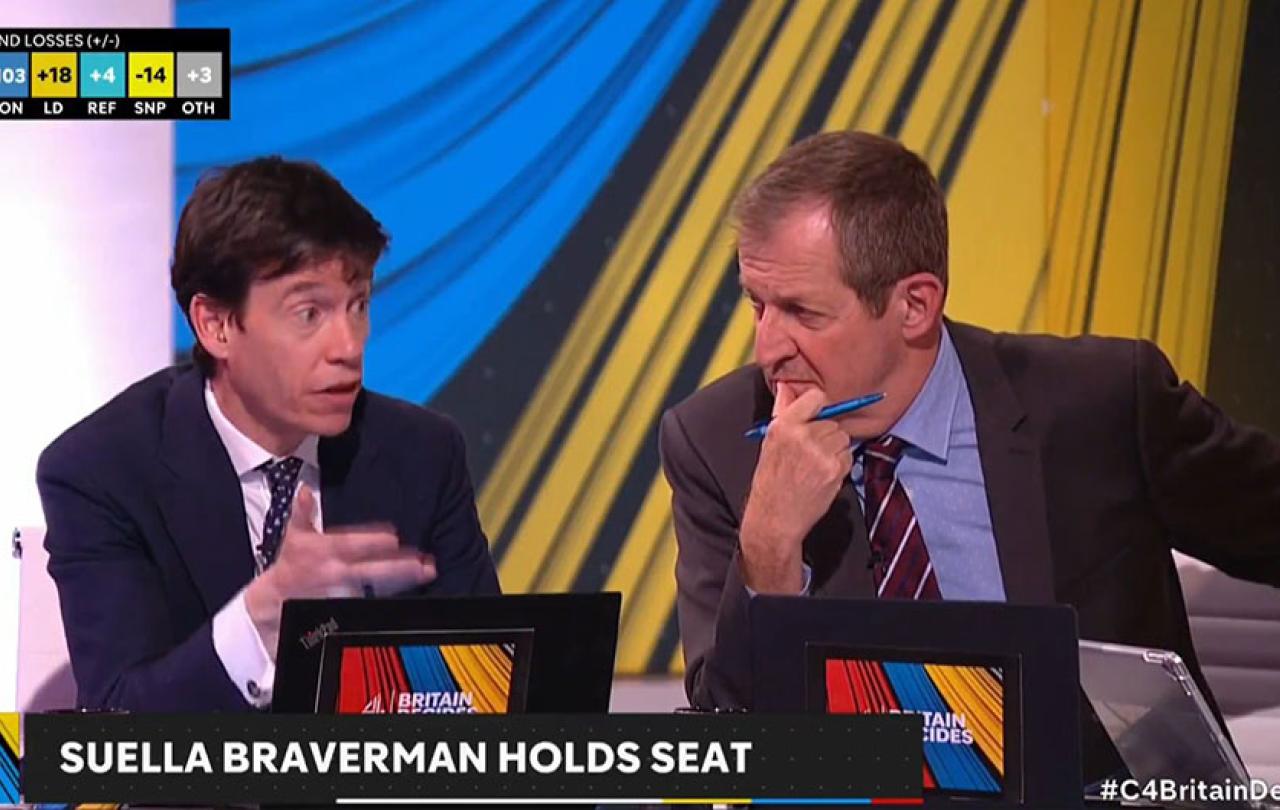
A poltiical pudit opines in a TV studio while his colleague leans in and listens.
The Two Ronnies.

I very much like Mr. Vine, but he is like a Gremlin: you must follow the rules and not give him caffeine or sugar on Election Night. 

What on earth has happened to Aunty!? One of the few things that has united people from the left and right (at least according to my social media) is just how mediocre the election coverage was. The evening started badly for the Beeb when they let Channel 4 distract viewers a full 15mins early. This was to allow Not Going Out to complete its important work of informing and educating the populace. 

As a result, I found myself glued to Channel 4 for most of the night, intermittently flicking back to the National Broadcaster for bouts of genuine bewilderment. In a Channel 4 lull I made the jump only to have every sense immediately assaulted by migraine inducing swingometer graphics (it was synaesthesia inducing…I could practically taste the rapid mix of red, yellow, and blue). This neurological bombardment intensified with the commentary of Jeremy Vine. I very much like Mr. Vine, but he is like a Gremlin: you must follow the rules and not give him caffeine or sugar on Election Night. His high-octane performance drove me to the limit immediately. 

Regular further jumps gave me glimpses into the bizarre: a journalist standing outside of Rishi Sunak’s blacked-out home telling us the lights weren’t on, telling Steve Baker to his face that he was going to lose his seat, having an interview with Jacob Rees-Mogg where he looked like a hostage reading out demands…it really was dreadful! 

Stewart was reinforced by Channel 4 Political Editor Gary Gibbon. With a soft yet authoritative voice, and the appearance of a cheeky Beano character fifty years on. 

I stuck to Channel 4 as my safe space. They very much cornered the market for coverage by bagging both The Rest is Politics and the Gogglebox cast, as well as producing regularly mismatched line-ups of former MPs to pass comment. I must assume this was intentional, but even if not, it meant comedy gold. The scene opened with Emily Maitlis and Krishnan Guru-Murthy talking over each other in a stumbling staccato, while Kwasi Kwartang looked unbelievably uncomfortable sandwiched in between Harriet Harmen and Nadine Dorries (in various shades of pink).  

There were many other talking heads throughout the night, who each brought some magic to the night: Nadim Zahawi (looking like a cross between a wise owl and a Bond villain), Carol Vorderman (who might have started celebrating rather early), Sir Alan Duncan (looking like a wine merchant holidaying on the Amalfi Coast). Mhari Black brought a rather refreshing bluntness to proceedings. 

The standout stars, however, were Mr. Stewart and Mr. Campbell. They brought the Centrist-Dads-disagreeing-agreeably energy that has seen their podcast top the charts. They played off each other with precision and genuine affection, and a fair bit of humour. Campbell would get into a mild row, and then Stewart would jump in with careful analysis that tried to look at the broader political landscape. Dorries proved the perfect foil to Campbell - speaking in accusatory non-sequiturs, rhapsodically musing on the ‘virtues’ of Boris Johnson, weaving nonsense narratives that wouldn’t even make it into one of her novels. Campbell would retort in a tone that was at once bewildered, bored, and bristling. Stewart would valiantly intervene to find the calmer waters of consensus, and the whole cycle would repeat. Kwarteng looked increasingly uncomfortable until he just upped and vanished - perhaps from the embarrassment of being in the same party as Dorries. 

In his attempt to be serious and measured, Stewart was reinforced by Channel 4 Political Editor Gary Gibbon. With a soft yet authoritative voice, and the appearance of a cheeky Beano character fifty years on, he gave the careful analysis of the polls and the turnout, which Stewart would then run with in broader political perorations. The two hosts would often chip-in (quite chippily, actually), rarely able to sublimate their obvious and banterous contempt for some of the more egregious spin. 

Meanwhile, Harriet Harmon looked cross.

A sense of angry Labour malaise was one of the leitmotifs of the night...  there was a noticeable lack of celebration. No smiles. No D:Ream soundtrack. No positivity

This struck me as odd. Just before the show it had been announced that she was to be elevated to the Lords. This honour appeared to give her no joy. Harmen brought every answer back to how dreadful the Tories were, until Kwarteng tried to make a joke out of it to cut the tension: ‘You won, alright!?’ Every successful Labour candidate who was interviewed focused their responses on excoriating the legacy of the Tories, as if they were still in campaign mode. At times it got rather uncomfortable. Every time Rachel Reeves let a grin slip through, she seemed to feel the need to overcorrect by attacking her fallen foes even more harshly. On one of my disastrous forays back to the BBC I was greeted with Wes Streeting being positively thuggish in his language. It wasn’t until Sir Keir gave his victory speech that any Labour figures seemed to feel like they could actually appreciate their victory. 

A sense of angry Labour malaise was one of the leitmotifs of the night. From the moment the Labour Landslide was announced there was a noticeable lack of celebration. No smiles. No D:Ream soundtrack. No positivity. Perhaps it was because they all recognised the truth, succinctly put by Gibbon when giving his immediate reflections on the Exit Poll Result: ‘That looks like love…but that is a loveless landslide.’ Voter turnout was low. The Labour Party went backwards in its vote in many areas - sometimes due to Reform, sometimes due to Gaza protests. This was epitomised by Jess Phillip’s wafer-thin majority. The always pugilistic Phillips had to give both barrels in her speech to those who had campaigned against her, who continued to attempt to drown her out.  

The Labour Party’s massive majority seems to be built on sand, and Zahawi was quick to point out that sand can easily shift. Labour are the beneficiaries of our winner-takes-all electoral system (a system I very much support), and so were continually reminded of the fact that Starmer is no Blair and ’24 is no ’97. The landslide will give some cheer to those who desperately wanted to see the back of the Tories. But it belies the reality that with both the Greens and Reform having four MPs, a number of Labour MPs being defeated by Independents, and decreased majorities in safe-seats up and down the country, we are not a nation united around the charisma of our new Dear Leader. 

Stewart and Campbell continually try to draw the conversation away from the tittle-tattle of what this might mean for Labour infighting and the Farage fulminations we can now expect to see in Parliament, to the broader and deeper questions for the very health of our democracy…but the pull of gossip is sometimes too great for Maitlis and Guru-Murthy. 

None of this is helped by Dorries. 

A big victory, but one which indicates no national unity or confidence. A defeated government that was tearing itself apart long before the loss. Low turnout and lower trust.

From the get-go Maitlis and Guru-Murthy tried to inject intrigue into proceedings; a tough ask when the result was the confirmation of what looked like a foregone conclusion from the moment the election was called. They did their best, and got some sparks from Dorries and Campbell - a Stannis Baratheon-esque grammatical correction (‘fewer’) had me roaring with laughter - but all-in-all I was uneasy. Not quite bored, but not entirely excited and hopeful. Around 3am I fell asleep in my seat. I was awoken at 6am to my children bursting into the living room. I valiantly attempted to continue to watch the coverage while feeding banana-porridge to my son, head tilted in the strain of hearing the telly over the roar of the world’s loudest washing machine. I turned back to my son, admitting auricular defeat. There is no porridge in his belly; plenty all over his face and in his hair.  

At 7am I was banished to the bedroom by my exasperated and long-suffering wife - it has become clear that I am not giving my all to childcare. I saw the gracelessness of Liz Truss arriving late and then refusing to give a concession speech. I saw Stewart play the silent Scottish assassin, gently pressing Stephen Flynn to admit that perhaps the SNP’s losses have something to do with their mismanagement with the Caledonian public realm. Rishi Sunak suggested the election was about tax, and everyone groaned in disbelief - he really doesn’t have any political instincts. 

I never recaptured the magic of the first couple of hours, probably because there wasn’t any. From 10pm onwards there was an underlying sense of disappointment and despair. A big victory, but one which indicates no national unity or confidence. A defeated government that was tearing itself apart long before the loss. Low turnout and lower trust. I am not surprised by this. “O put not your trust in princes, nor in any child of man: for there is no help in them.” This is the warning of the Psalmist. I have already written, a number of times, about my own disgruntlement at the political process, and my doubt that it will be easily remedied.  

But watching the coverage - the baffling BBC, the political Two Ronnies that are Stewart and Campbell, the remarkable hat worn by the returning officer in Blyth - I was fortified by remembering that while the Psalmist is correct, St Paul nevertheless gave us clear advice and instruction: “I exhort therefore, that, first of all, supplications, prayers, intercessions, and giving of thanks, be made for all men; for kings, and for all that are in authority; that we may lead a quiet and peaceable life in all godliness and honesty.” 

I shall pray for Sir Keir, for the new government, for all newly elected MPs.  

They need it. 

More importantly, we need it.