Review
Art
Culture
Ethics
War & peace
5 min read

Can we stop killing each other?

How art, theology, and moral imagination confront our oldest instinct

Jonathan is Team Rector for Wickford and Runwell. He is co-author of The Secret Chord, and writes on the arts.

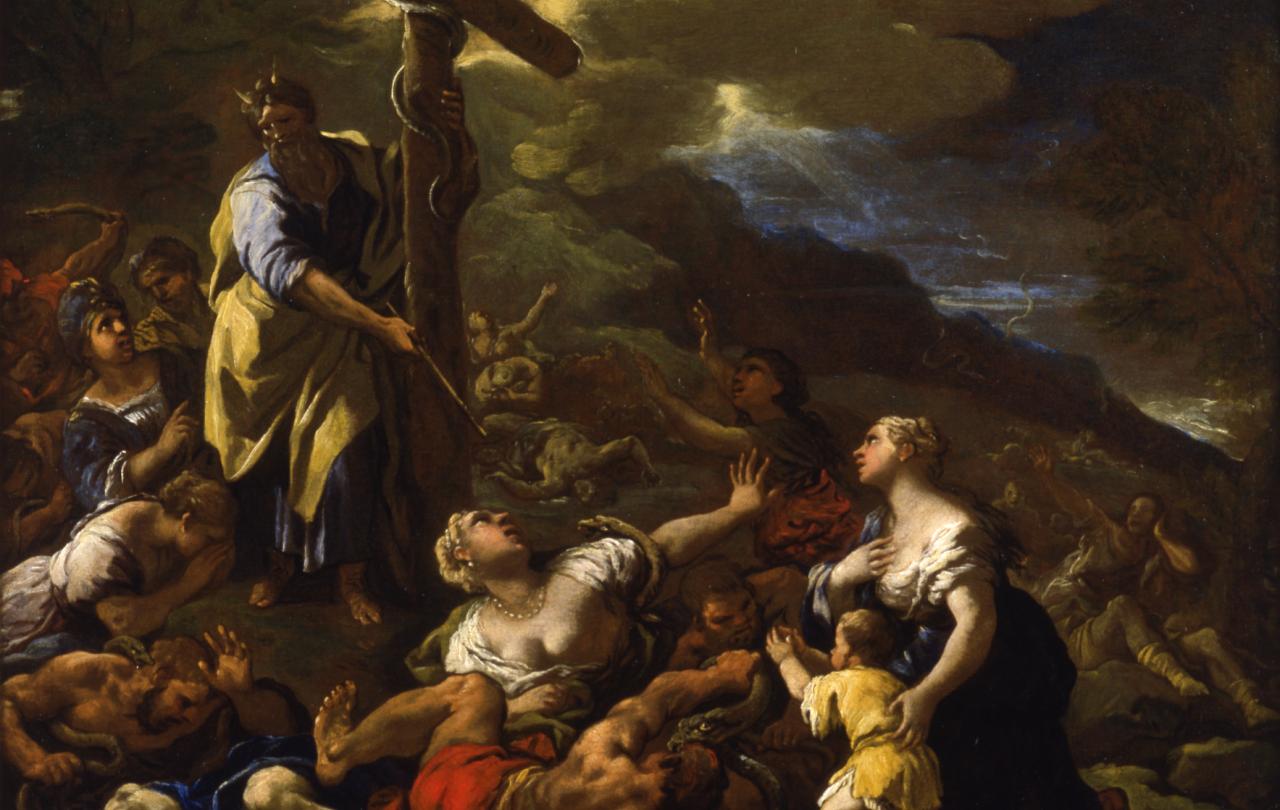
A 17th Century painting of Moses and the brazen cross.
Luca Giordano, The Brazen Serpent, c.1690, oil on canvas.
Compton Verney, photography by Jamie Woodley.

What more important question can there be for humanity, Jago Cooper, Executive Director of the Sainsbury Centre, asks than ‘Can we stop killing each other?’ The Sainsbury Centre’s radical exhibition programme explores the big issues in contemporary society (see my article ‘Life Is more important than art’) so has rapidly arrived at the point where it is exploring what has wrong with the world when killing occurs and how can we put it right. 

Cooper sets out the ground that this series of exhibitions seeks to cover: ‘From interpersonal violence to state level conflict, killing has spread its devastating impact throughout all human cultures across the centuries. Why does this violence occur? And can it be better prevented at a time when increased societal pressures of population growth, resource scarcity, human migration and rapid environmental change make the risk of conflict higher? Every day we read about horrifying acts playing out locally and internationally, but what is the answer to stopping them?’ 

Can we stop killing each other? includes an installation by Aotearoa/New Zealand artist Anton Forde, a series of new paintings reflecting on the refugee crisis by Ethiopian artist Tesfaye Urgessa; presentations of historical artworks such as Claude Monet’s ‘The Petit Bras of the Seine at Argenteuil’, and an exhibition spanning Shakespearean tragedy to Hitchcockian spectacle, which asks questions of violent stage and screen narratives, plus (from November) ‘Seeds of Hate and Hope’ highlighting personal artistic responses to global atrocities, such as genocides, ethnic cleansing, war crimes and crimes against humanity.  

It starts, however, with a room displaying Biblically themed explorations of this question. ‘Denunciation of Cain’ by G.F. Watts depicts the after-effects of the first murder with Watts viewing Cain as a symbol of ‘reckless, selfish humanity’. A pair of paintings by Luca Giordano then take us deeper into the ambiguities of our human responses to anger and violence. ‘The Brazen Serpent’, tells the story of the Israelites’ journey from Mount Sinai in Egypt to the Promised Land of Canaan. On this journey, a plague of poisonous serpents punishes the Israelites for their disobedience and lack of faith. Moses is instructed by God to make a bronze, or ‘brazen’, serpent that will heal those that repent. The curators ask, ‘Does this portrayal of killing as a punishment set a cultural precedent, or establish a moral code for right and wrong?’ Alongside is ‘The Judgement of Solomon’ in which two women both claim to be the mother of a living child and where the true mother is revealed by means of an order that the child to be cut in half with a sword and shared. The true mother reveals herself as the one who will give the baby away to protect the child’s life. Here, the threat of violence is used to bring about justice.  

William Hogarth’s print series The Four Stages of Cruelty, with verses by Reverend James Townley, reveals how violence escalates and shows how a lack of moral supervision can lead to a life of crime. Finally, Matt Collishaw’s series of thirteen photographic works entitled ’Last Meal on Death Row, Texas’ alludes to the number of apostles at the Last Supper while depicting the last meals chosen by condemned prisoners on death row in the state of Texas, United States. 

The curators suggest that: ‘The artworks in this gallery, and beyond, suggest that there is a choice between peace and conflict and that moral stories exist to guide us towards making ethical decisions in real life. Art provides a powerful connection through which to experience life at its most chaotic and incomprehensible, enabling us to pause and reflect on the darkest aspects of human existence. It can also create vital opportunities for society to mourn and remember victims of violence, and to come together in acts of healing and repair.’  

These images and the Bible stories on which they are based give us more than simple moral guidance, however. They also provide an explanation for the existence of conflict between human beings and reveal God’s subversion of that ingrained human tendency. 

In the story of Cain and Abel, Cain is jealous of Abel and kills him as a result. The anthropologist René Girard suggests that this story reveals the way in which we consistently act as human beings. We desire something that is possessed by someone else and become disturbed through our longing for what we don’t have. We resolve our disturbance by creating a scapegoat of the person or people who appear to have or prevent us from having what it is we desire. When the scapegoat is killed, we can gain what we desire and also release the sense of disturbance that we feel.  

This scapegoat mechanism becomes expressed in religions involving human sacrifices as scapegoats to appease their gods. In the story told within the pages of scripture, it is out of such religions that Abraham is called to form a people who do not sacrifice other human beings, but instead use animals as their scapegoats and sacrifices. Jesus is later born into this people who have subverted the existing practice of scapegoating and he further subverts this practice because, as he is crucified, God becomes the scapegoat that is killed. Once God’s Son has become the scapegoat, for those who follow him, the scapegoat mechanism is undermined and the scapegoating of others should no longer be possible. 

In ‘The Judgement of Solomon’, the threat of violence is used to reveal the desire of the woman who had taken the mother’s child and the self-sacrifice of the true mother. On the cross, the violence meted out to Jesus reveals the full horror of the scapegoating mechanism in the torture and violent death of the wholly innocent one.   

Jesus explicitly equated his crucifixion with the raising up of the bronze serpent that brought healing because in that story, when it is raised, as Jesus also was, the image of the source of the poison in the lives of human beings became the source of healing. That is also the promise that Christianity holds out to us in relation to the effect of Jesus’ crucifixion where he becomes sin for us. It heals us of our absolute need to scapegoat and harm others. 


Can We Stop Killing Each Other? Sainsbury Centre: 

  • Tiaki Ora ∞ Protecting Life: Anton Forde, 2 August 2025 – 19 April 2026 

  • Eyewitness, 20 September 2025 – 15 February 2026 

  • Roots of Resilience: Tesfaye Urgessa, 20 September 2025 – 15 February 2026 

  • The National Gallery Masterpiece Tour: Reflections on Peace, 20 September 2025 – 11 January 2026 

  • Seeds of Hate and Hope, 28 November 2025 – 17 May 2026 

Support Seen & Unseen

Since Spring 2023, our readers have enjoyed over 1,500 articles. All for free. 
This is made possible through the generosity of our amazing community of supporters.

If you enjoy Seen & Unseen, would you consider making a gift towards our work?

Do so by joining Behind The Seen. Alongside other benefits, you’ll receive an extra fortnightly email from me sharing my reading and reflections on the ideas that are shaping our times.

Graham Tomlin
Editor-in-Chief
Explainer
Creed
Death & life
Monsters
Paganism
5 min read

Will the owner of ‘Halloween’ please come and collect it?

A mutant festival of saints, spirits, and supermarket costumes resists belonging to anyone
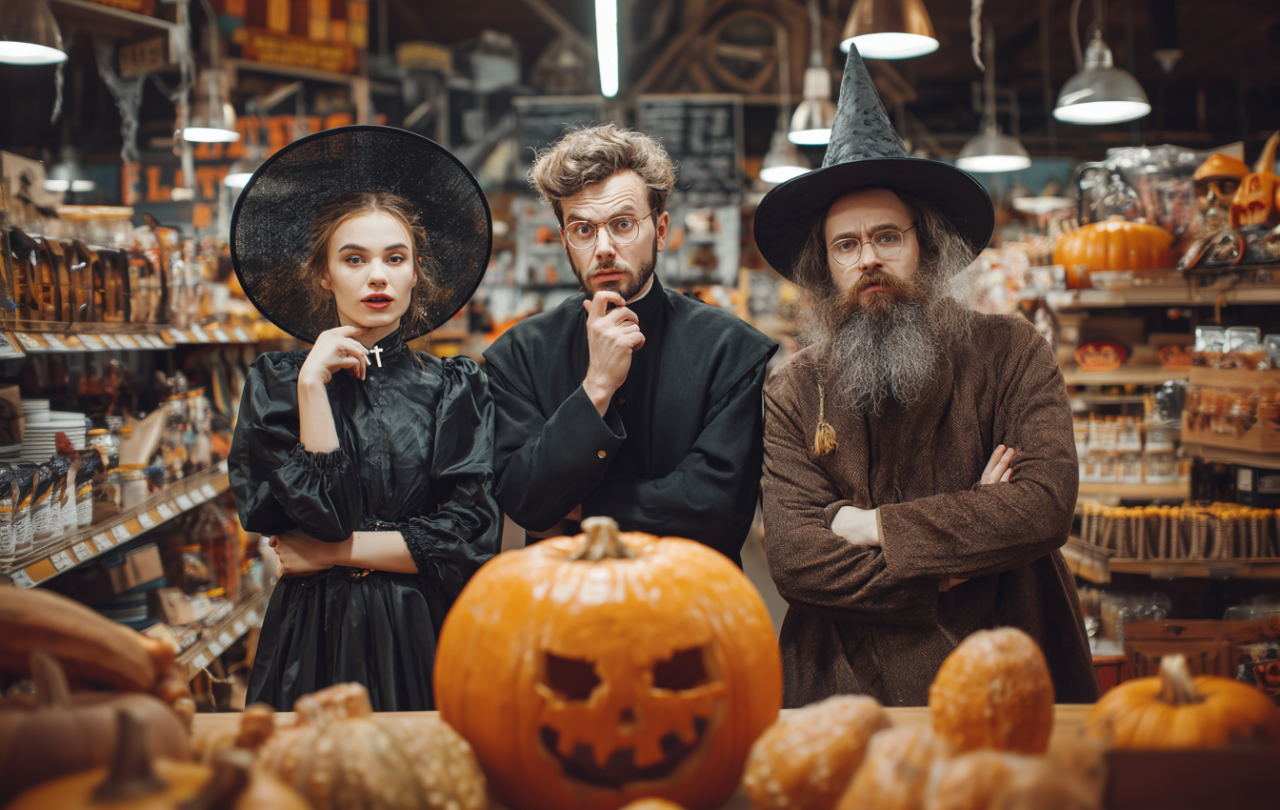
A witch, a priest and a druid stand in a store and look quizzically towards a halloween pumpkin
Nick Jones, Midjourney.ai

The trouble with modern Halloween is that it’s hard to say who it really belongs to. Our contemporary public holiday – 31 October, when people dress up as skeletons, light jack-o-lanterns, and go ‘trick-or-treating’ – has a few prospective owners.  

Perhaps Christians could claim it. The term “Halloween” is a shortening of ‘All Hallow’s Eve’, which is the day before All Saint’s Day (1 November) in the Church calendar.  

But this doesn’t fit with a few things. Don’t Christians dislike all that dressing up as evil spirits, and summoning up misrule and revelry? Instead, the case is made for a pagan ownership of Halloween: it was all due to a Celtic festival called Samhain (pronounced ‘sow-in’). This was a day for appeasing evil spirits, contacting the dead, and acts of mischief – all better fits for modern Halloween, surely? 

Sadly, we just don’t know enough about Samhain to say. We only have evidence about it from centuries after the Christian era, and in limited scraps like: “Samhain, when the summer goes to its rest”. It is unlikely the Christians invented this, to be sure – but none of the data tells us how it was celebrated.  

In fact, there is no evidence at all that All Saints Day was a churchy attempt to ‘take over’ a pre-existing pagan festival. From the get-go, Christians commemorated their dead on the basis that they were still alive in heaven, and able to bring prayers to God. A quick peek at the Book of Revelation (the final book of the Bible) gives a behind-the-curtain look: “and the smoke of the incense, with the prayers of the saints, rose before God from the hand of the angel”.  

Over time, it became more official which ‘holy ones’, or saints, should be honoured at which times. This was not about making dead Christians into gods, though. A famous theologian called St Augustine explains the proper view of the early Christians as they kept hold of bones and clothing from their dead: “We do not build temples, and ordain priests, rites, and sacrifices for these same martyrs; for they are not our gods, but their God is our God”.  

Gradually, a date was set to celebrate all those great men and women in heaven – from this came All Saints, or All Hallows Day. A tradition in northern Europe set this on the 1 November: “As a jewel worn on the brow sparkles time and again, so November at its beginning is resplendent with the praise given to all the saints” reports an English calendar from around 800AD.  

It is all well and good celebrating those who have made it to heaven. But what about the majority of Christians? Those who had died unrepentant and lukewarm – what on earth could be done for them? Here came another separate development: offering prayers and worship on behalf of those who had died as forgiven sinners, but who were still, if you like, serving their time for their bad choices.  

It gradually became the norm to tack that practice onto the pre-existing All Saints Day, so that the souls of regular Joes could have powerful heavenly intercessors close by. And so, All Souls Day became an established part of the Church’s year too, falling on 2 November.  


But here’s the twist. This season of ‘Hallowtide’ (All Saints and All Souls together) carried on for centuries, until England suddenly and violently abandoned it all in the sixteenth century. Seemingly overnight, the Reformations of the Tudor monarchs ended All Souls Day by scrapping all mention of a purgatory for the dead, and attempts to pray for them there. All Saints Day limped on in the new Established Religion as a remembrance of Christian exemplars – but they were not to be thought of as in radio contact from heaven anymore.  

Some people tried to carry on as usual, in illicit gatherings on hilltops, where they would burn straw, and gather to ask for help from great saints and pray for loved ones. But the majority followed the new religious settlement and tried to forge new communal rituals as best they could. The night still had a ‘supernatural’ afterglow thanks to centuries of the now-absent All Saints and All Souls. 

Then, in the nineteenth century, there was a comeback. Irish immigration to the USA and Great Britain plonked a fully formed Hallowtide into English-speaking culture again. It took like a duck to water. Perhaps this was to be expected. Here was a civilisation which had been rapidly deprived of its ordinary way of expressing connection to their deceased loved ones, as well as a sense of protection from heavenly guardians. They were clearly starving for some way to communicate feelings about ‘the beyond’, and to find hope in the darkening, colder days.  

‘Halloween’, really a modern döppleganger of All Hallow’s Eve, quickly became a popular national custom – a world custom, indeed, due to US influence. It took from Christianity that otherwordly atmosphere – but it did not jettison any of the customs that had arisen since the Reformation, and which were themselves continuations of folky responses to the coming of Winter; Samhain is almost certainly a part of that background here, even if it is not a direct connection, as we have seen. 

This Halloween mystery has a twist, then. Here is really a mutant of a festival that belongs to no one in particular - and that is the point. One could really call it one of modern pluralistic society’s great achievements. It has taken over management of this eerie season from the church, and arguably made a successful shared custom out of it. On the other hand, it is arguably consumeristic, tacky and frequently immoral: it was only a few years ago that supermarket costumes allowing people to dress as ‘mentally ill’ showcased this shallowness. 

So, as a Christian, I have some regrets that Christianity does not really ‘own’ modern Halloween, anymore. Because the original All Hallows, as well as All Souls, seem to me to be a historic high point of confidence about our human fate. Here was a whole civilisation that seemed to announce to itself, every November, that death, human wickedness, and the Devil, were not in charge here – those who had died in Christ were now more fully alive; that no one is so beyond hope that they are not worth praying for. The darkening nights and colder air must have seemed less daunting to them.  

Support Seen & Unseen

Since Spring 2023, our readers have enjoyed over 1,500 articles. All for free. 
This is made possible through the generosity of our amazing community of supporters.

If you enjoy Seen & Unseen, would you consider making a gift towards our work?
 
Do so by joining Behind The Seen. Alongside other benefits, you’ll receive an extra fortnightly email from me sharing my reading and reflections on the ideas that are shaping our times.

Graham Tomlin
Editor-in-Chief